When it comes to social butterflies and laid-back icons in the animal kingdom, the capybara is definitely on the list. These gigantic rodents are not only incredibly cute, but their lifestyle is also full of fun and intelligence. This article will explore the capybara from multiple perspectives, taking you on a journey to understand this fascinating creature.
What is a capybara?
Capybaras are the world's largest rodents, with adults weighing up to 70 kilograms and reaching nearly 1.3 meters in length. They look like "enlarged" guinea pigs, but have the gentle temperament of a golden retriever.

Appearance and adaptability
Born for water: The webbed structure between the toes of capybaras makes them natural swimming champions.
High-set eyes and nose: The capybara's eyes and nose are positioned high, which helps them maintain a "peripheral" state underwater.
Constantly growing teeth: Capybaras constantly gnaw on plants to wear down their rapidly growing incisors.
Habitat and Lifestyle
Capybaras primarily inhabit the tropical wetlands, grasslands, and riverbanks of South America. They are fully adapted to an amphibious lifestyle.
Survival skills
Semi-aquatic animals: Capybaras swim like fish in water and can dive for up to five minutes to avoid predators.
Habitat: Capybaras can be found in everything from the savannahs of Venezuela to the Amazon rainforest of Brazil, and even in city parks.
Ecological role
Plant controllers: By consuming excessive aquatic plants, capybaras prevent plant overgrowth in their ecosystems.
Seed disperser: Capybara dung carries a large number of seeds, promoting the growth and distribution of plants in wetlands and forests.
What do capybaras eat?
As vegans, capybaras' menu mainly consists of grasses, aquatic plants, and fruits.
peculiar digestive ability
Coprophagy: Capybaras consume their own feces to maximize nutrient absorption. This helps break down plant cellulose and obtain vitamin B.
Seasonal diet: During the dry season, capybaras will gnaw on tree bark and tougher plants to supplement their nutrition.

The social life of capybaras
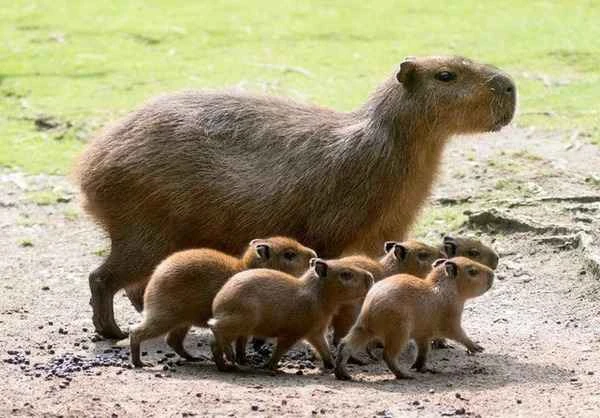
Capybaras are naturally social animals and usually live in small groups of 10 to 20 individuals. During the dry season, they can sometimes form "capybara armies" of more than 100 individuals.
Group structure
Strong social bonds: A group typically consists of a dominant male, several females, and other members.
Capybaras use a variety of communication methods: they use whistles, grunts, and even barks to convey danger signals or express emotions.
Collective defense: Living in groups helps them better defend against predators such as jaguars, pythons, and caimans.
Evolution and Adaptation of Capybaras
Capybaras are perfectly adapted to life near water:
Swimming champions: Their webbed feet allow them to move freely in the water and even "take a nap" on the surface while floating.
Hair function: Although hair is not waterproof, it dries quickly and helps them maintain body temperature.
Evolutionary history: Capybaras evolved from smaller rodents and gradually adapted to a semi-aquatic lifestyle over a long evolutionary process.
The relationship between capybaras and humans
The relationship between capybaras and humans is full of contradictions and interesting aspects:
In the wild: Capybaras are sometimes hunted, their meat is eaten, and their fur is used to make leather.
Pet status: In some countries, capybaras are allowed to be kept as pets, but they need large bodies of water and companions, otherwise they are prone to depression.
Urban "Residents": In some South American cities, they have gradually adapted to coexisting with humans and have even become "mascots" in parks.
Why are capybaras so "laid-back"?
Capybaras are known for their gentle nature and leisurely lifestyle.
The secret to staying calm
The sense of security that comes from living in groups: Living in a group makes them feel safe and secure.
Strong adaptability: Whether in wild wetlands or urban environments, capybaras can find a comfortable way to survive.
Tolerant nature: Capybaras rarely exhibit aggressive behavior and even form mutually beneficial relationships with birds, monkeys, and other animals.
Fun facts about capybaras
Hot spring enthusiasts: In Japan, capybaras soak in hot springs to warm up, making it a popular winter tourist destination.
Social media star: Capybaras have become a global sensation for their "naturally cute" image and amusing interactions with other animals.
Capybara Frequently Asked Questions
Are capybaras suitable as pets?
While it is possible, keeping capybaras requires a great deal of effort and resources, including providing water, a scientific diet, and companionship.
Which animals do capybaras get along with best?
They can live peacefully with birds, monkeys, and even some carnivores.
Are capybaras endangered?
Currently, no. Thanks to its wide distribution and strong adaptability, capybaras are listed as "Least Concern" by the International Union for Conservation of Nature (IUCN), but habitat destruction may pose a threat in the future.
What animals prey on capybaras? Explore predators, habitats, and survival strategies.
Capybaras ( Hydrochoerus hydrochaeris ) are the world's largest rodents, inhabiting wetlands and riparian regions of South America. While these docile herbivores are not aggressive, they play a vital prey role in the ecosystem, attracting the attention of a variety of predators. This article will explore in detail the animals that prey on capybaras, their habitats, survival strategies, and ecological significance.
The main predators of capybaras
Capybaras occupy an important position in the food chain, making them a target for many carnivores.
Jaguar :
The jaguar ( Panthera onca ) is the apex predator in capybara habitat. These large cats rely on cover and a powerful bite to ambush capybaras, typically operating near riverbanks. They are nocturnal hunters, which overlaps with the capybaras' active hours at dusk and dawn.Caiman :
Caimans, especially the black caiman ( Melanosuchus niger ), lurk in the waters where capybaras swim. As semi-aquatic mammals, capybaras frequently enter caiman territory and therefore face significant hunting risks.Green anaconda :
One of the world's largest snakes, the green anaconda ( Eunectes murinus ), is an opportunistic predator. They typically lurk near bodies of water, using their enormous size and constricting abilities to subdue capybaras.Cougars and other felines :
Cougars ( Puma concolor ) and leopard cats ( Leopardus pardalis ) also prey on capybaras. These predators rely on speed and agility to hunt or ambush their prey.Horned eagle :
In some regions, the harpia harpyja may prey on young or smaller capybaras. With their sharp talons and precise hunting skills, these birds of prey are formidable natural enemies.
Capybara Behavior and Survival Strategies
Although capybaras are prey, they are not entirely without defensive capabilities. Here are some of their survival strategies:
Group defense :
Capybaras typically live in groups of 10 to 20 individuals, a group lifestyle that provides numerical protection. Through group alertness, they can detect predator threats earlier, and when danger is encountered, they scatter and flee to confuse the attacker.Semi-aquatic lifestyle :
Water is the best escape route for capybaras. They are excellent swimmers and can dive for up to five minutes, an ability that helps them evade land predators such as jaguars or pumas.Disguise and vigilance :
Capybaras' brownish-red fur blends seamlessly with the surrounding vegetation, providing excellent camouflage. They also possess a keen sense of smell and hearing, enabling them to detect potential threats early.Nighttime and Diurnal Activities :
Capybaras are active at dawn and dusk, thus reducing their chances of encountering predators that are active during the day, such as harpy eagles or humans.
Capybara habitat and ecosystem
Understanding capybaras' habitats helps us explore their relationship with predators and the environment.
Natural habitat :
Capybaras live in the wetlands, savannas, and riparian regions of South America, especially the Amazon rainforest. These areas provide abundant herbaceous plants for them to forage for, as well as bodies of water for cooling and escape.Role in the food chain :
As herbivores, capybaras primarily feed on grasses, plants, and fruits. As prey, they play a crucial role in the food web, providing food sources for high-trophic-level predators such as jaguars and caimans.Biodiversity Hotspots :
Capybaras coexist with crocodiles, birds of prey, and even humans in their habitat. Their presence promotes ecological balance and provides food sources for predators and scavengers.
Predator-prey relationship
The relationship between capybaras and their predators illustrates the complexity of the natural food chain.
Predator hunting strategies :
Jaguar : Uses ambush tactics to precisely strike and capture its prey.
Caiman : Lurks underwater and launches a surprise attack.
Green water anaconda : It subdues its prey by using stealth and entanglement skills.
Ecological significance of capybaras as prey :
Capybaras serve as prey, maintaining the population size of their predators. A decline in capybara numbers could lead to excessive vegetation growth, a decrease in predator numbers, and a disruption of the ecological balance.Threats beyond natural predators :
In some areas, capybaras are hunted by humans for their meat or fur. This has contributed to a decline in capybara populations, which in turn affects the balance of the entire ecosystem.
Capybaras are not only adorable "giant rodents," but also an important part of the ecosystem. As prey, they support the survival of a variety of predators, such as jaguars, caimans, and green anacondas. Their social life, semi-aquatic characteristics, and alertness demonstrate adaptability and resilience.
By understanding capybaras' predators, habitats, and ecological significance, we can gain a deeper understanding of the delicate balance of nature and the importance of protecting these unique ecosystems. In the Amazon rainforest and South American wetlands, capybaras are undoubtedly a vital pillar of biodiversity, demonstrating the close interconnectedness and interdependence of life.
Summary about capybaras
Capybaras are not only the largest rodents on Earth, but they are also an important part of the ecosystem, and their pleasing appearance and leisurely lifestyle have made them one of the most beloved animals by humans. Whether it's their rich social structures, unique aquatic characteristics, or serene attitude, capybaras are truly a marvel of nature.
The next time you see a photo of a capybara lying flat, remember these colorful stories and their contributions to nature!