The Latin phrase “ Homo homini lupus est ” (Man to man is like a wolf), popularized by Hobbes, originally meant to reveal the coldness and cruelty that human nature can exhibit. But human “harm” does not only occur between people, but also profoundly affects other species on Earth.
In recent centuries, hundreds of animals have been driven to the brink of extinction by humans, directly or indirectly. Direct factors are mostly hunting and poaching ; indirect factors include habitat destruction, invasive species, pollution, and climate change . It can be said that human activities are one of the main drivers of modern species extinction.
The main reason why humans cause animal extinction
A common misconception is that "extinction equals poaching." In fact, there is far more than one pathway leading to extinction , and it is often a combination of multiple factors . In summary, there are at least three core mechanisms:
Overhunting and poaching : Systematic killings for meat, fur, feathers, horns, bones, eggs, or under the guise of "pests" have directly destroyed wild populations of many species.
Habitat destruction and fragmentation include large-scale deforestation (such as tropical rainforests), wetland and river alteration, urban and road expansion, mining and energy development, etc., which lead to habitat shrinkage and fragmentation , isolation of populations, and difficulty in maintaining healthy genetic diversity.
Food webs and ecological relationships are disrupted . When a key species is removed, the chain reaction spreads to its predators, competitors and mutualists, further triggering secondary extinctions or regional functional breakdowns (such as reduced pollination and seed dispersal capabilities).
These driving factors are intertwined: for example, habitat destruction forces animals closer to human settlements, increasing the probability of conflict, poisoning, or retaliatory hunting; illegal trade in turn exacerbates hunting pressure, creating a vicious cycle.
Representative animals that went extinct due to human actions (partial list)
The following cases focus on "extinctions caused directly or primarily by human activities" and supplement key identification points and extinction contexts to facilitate quick memorization by readers.
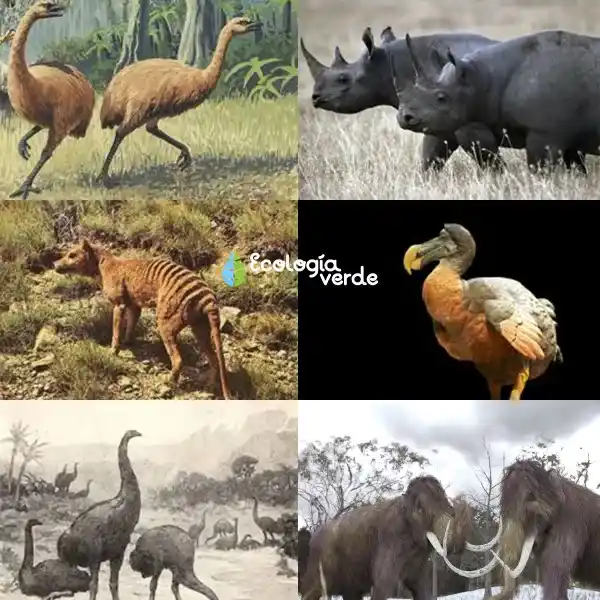
Moas | A large, flightless bird of New Zealand, larger than an ostrich. Intensive hunting by the Maori people and deforestation accelerated its extinction, and it is estimated to have gone extinct around 1500 AD .
West African black rhinoceros (Diceros bicornis longipes) | Due to long-term poaching in West Africa for its horns , coupled with habitat loss, it was finally declared extinct in the early 21st century (regionally extinct in the wild).
Tasmanian tiger/thylacinus cynocephalus | Australia—Tasmania was targeted for culling with bounties due to its status as a "livestock predator," coupled with disease and habitat loss. The last captive individual died in 1936 (the original article states 1982, but the academic consensus is that the individual died at Hobart Zoo in 1936).
The dodo (Raphus cucullatus) was a flightless island bird of Mauritius. It went extinct in the late 17th century due to human predation , the introduction of alien animals (rats, pigs, monkeys, etc.) that preyed on its eggs, and deforestation .
Elephant bird (Aepyornis spp.) | The largest flightless bird in Madagascar (reaching over 3 meters in height). Theft and exploitation of its enormous eggs (of astonishing size) along with habitat destruction led to its extinction within the last thousand years.
Mammoths (Mammuthus primigenius et al.) | The extinction of mammoths in Eurasia and North America was caused by a combination of factors : climate fluctuations led to the shrinkage of grassland-moss habitats, coupled with hunting pressures from prehistoric humans ; the remaining populations on isolated islands also faced genetic problems such as inbreeding depression .
Bali Tiger (Panthera tigris balica) | Indonesia
It disappeared around 1937. An island-type subspecies, its limited habitat was rapidly cleared, and long-term hunting and retaliatory killings made its population unsustainable.The Atitlán Pochard (Podilymbus gigas, Pato Poc) was driven to extinction in the 20th century by shipping disturbances and the introduction of alien fish species to Lake Atitlán in Guatemala, which led to food competition and niche squeeze.
Quagga (Equus quagga quagga) | A subspecies of zebra in southern Africa, it was hunted on a large scale due to demand for meat and leather and competition between humans and wild animals. The last individual died at the end of the 19th century .
Pyrenean ibex (Bucardo, Capra pyrenaica pyrenaica) | Spain-France long- term overhunting combined with habitat pressure, the last wild female died in 2000 (cloning attempts have been made but no stable population has been established).
Western kangaroo/Western possum ("Canguro rabipelado Occidental" should be a mistranslation of possum species) | Australia
Hunting, habitat degradation, and invasive predators (such as foxes and feral cats) are all contributing to functional extinction or regional disappearance in many areas. (The original text referred to "kangaroos," but here we provide a more scientific summary based on common threatened groups of small marsupials in Australia.)Blue Macaw (Glaucous Macaw, Anodorhynchus glaucus) | Northern Argentina – Southern Paraguay – Uruguay – Southern Brazil. A large macaw. Its main food source, the yatay palm forest, was destroyed, coupled with the pressure of the hunting trade, leading to its disappearance between the 19th and 20th centuries (most scholars consider it extinct or possibly extinct).
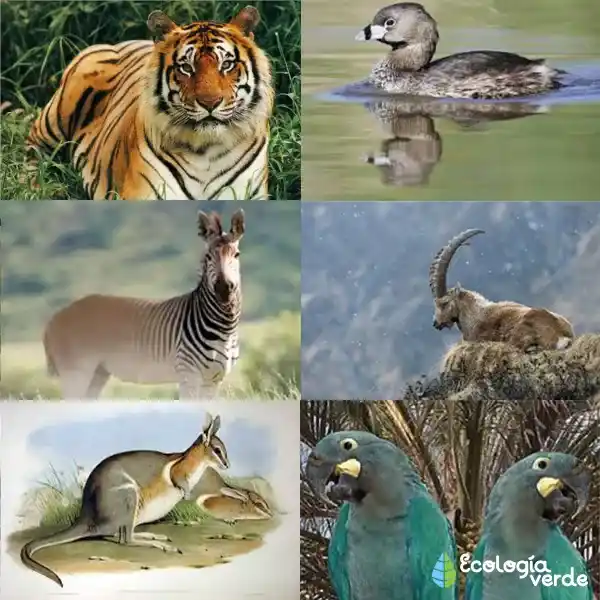
Tip: Many island-lake species lack adaptation to human behavior, invasive species, and natural enemies due to geographical isolation, making them more susceptible to extinction in a short period of time.
Some of the animals still being pushed to the brink of extinction by humans.
These species are not yet extinct , but they are endangered or of high concern due to direct or indirect human pressure. If effective protection measures are not taken in time, they may suffer the same fate as the former.
Lion (Panthera leo)
The wild population in Africa is estimated at around 20,000 , a sharp decline from approximately 500,000 50 years ago. Poaching, prey depletion, habitat fragmentation, and human-wildlife conflict coexist.Leopard (Panthera pardus)
About half a century ago, the population was estimated at 700,000 ; today, it is less than 50,000 . The fur trade and habitat loss are key pressures.Orangutan (Pongo spp.)
The expansion of palm oil plantations has led to the large-scale clearing of tropical rainforests, resulting in a sharp reduction in their habitat and food resources , and all three species of orangutans are now highly endangered.Rhinocerotidae
Horn-driven poaching persists. Regional extinction cases have been reported in several countries (such as Mozambique), and many parts of Africa remain at high risk.Elephant (Elephas maximus / Loxodonta spp.)
There are approximately 30,000 Asian elephants in the wild (the original estimate of "300,000" should be a combined estimate for Africa and Asia; readers should note that the numbers vary greatly across different regions). Every year, a large number of elephants are killed for ivory and in conflict , and African elephants are also under pressure in many countries.Lemurs
Humans have settled in Madagascar for only about two thousand years , and more than 20 species of lemurs have already gone extinct; more than 90% of the existing species are threatened (by deforestation, slash-and-burn agriculture, and illegal hunting).Shark (Selachimorpha)
The shark fin trade, bycatch and incidental fishing, and nearshore habitat degradation have led to sharp declines in many species. Finning is particularly cruel: sharks are cut off their fins and thrown back into the sea, where they drown because they are unable to swim.
Key protection priorities: combating illicit trade, expanding and effectively managing protected areas, ecological compensation and coexistence mechanisms, community alternative livelihoods, traceable and compliant supply chains , and responsible choices for consumers.
Frequently Asked Questions (FAQ)
Q1: Does "prohibiting all use" equal protection?
A: Not necessarily. A comprehensive mechanism combining scientific assessment, community participation, legal and enforcement measures, and compliant trade management is often more sustainable than a blanket ban (avoiding the growth of black markets and community conflict). The key lies in whether baseline monitoring, quota science, habitat management, and livelihood substitution are in place.
Q2: What can an individual do?
Refuse to buy ivory, rhinoceros horn, shark fin, rare furs, and illegal wild game ;
Choose palm oil-free/certified palm oil products (RSPO, etc.) and support sustainable timber (FSC) and seafood certification (MSC/ASC).
Focus on and support local and international conservation organizations ;
When traveling, adhere to the principle of not disturbing wild animals and refuse activities that involve hidden forms of cruelty, such as performances, riding, or handling of young animals .
Disseminate scientific information and participate in citizen science and environmental protection initiatives.
Conclusion
Humans are both part of the problem and key to the solution. History tells us that "man-made extinctions can happen very quickly," while science and action prove that "reversing the trend is not impossible." Looking back at the dodos from today's perspective, the best way to commemorate them is not with regret, but to prevent the next dodo from appearing .