Usain Bolt, a world record holder and sprinter, reached a top speed of 45 km/h . This achievement is considered "supernatural" by humans, but pales in comparison to animals in the wild.
Many animals rely almost entirely on speed for survival: they are either predators, needing to pounce on their prey at lightning speed, or prey, relying on speed to escape predators. Among these animals, some possess unimaginable speeds, even redefining human understanding of "fast." Let's take a look at the world's fastest animals and their astonishing performances.
You might be interested in: [The world's slowest animal]
Types of animal locomotion
Animals' locomotion is directly influenced by their living environment. For example, snakes, pigeons, and dogs have vastly different locomotion methods, which is the result of long-term evolution.
1. Aerial sports
Flying by flapping wings : the most common mode of flight.
Gliding : using air currents or existing propulsion to glide through the air.
Diving : Freefalling from a great height is how many birds achieve extreme speeds.
2. Land sports
Wriggling : like a snake, moving forward by twisting or dragging its body.
Walking/running : the most common mode of locomotion, including humans (bipedal) and most mammals (quadrupedal).
Braquiación : A primate-specific movement that involves swinging one's arms between tree branches to move forward.
Jumping : Kangaroos use jumping as their primary mode of locomotion, and frogs often use jumping to escape.
Contraction and extension : like earthworms, they propel themselves forward by contracting and relaxing the muscles in their body walls.
3. Water sports
There are also various forms of movement in aquatic environments:
Muscular swimming : Propelling forward using muscles and fins is the most common and fastest method.
Flagellar vibration : a mode of movement observed in microorganisms.
Paddle : Some crustaceans use their appendages to paddle in the water.
Jet propulsion : like jellyfish, which propel its body by jetting water.
Crawling : Some crabs can walk on the seabed.
Wave-like movement : like an eel, its body sways from side to side as it moves forward, similar to the movement of a snake on land.
The fastest animal in the world
The following are representatives of the fastest land, air, and some aquatic animals:
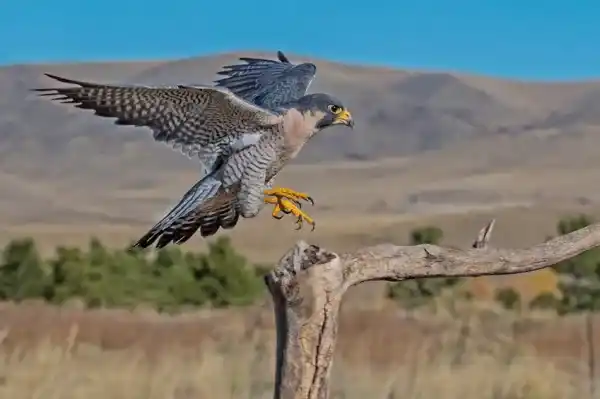
Peregrine Falcon – 360 km/h
The fastest animal in the world. When it swoops down on its prey from high altitude, it can reach speeds exceeding 360 km/h. Its normal flight speed is approximately 100 km/h.Cheetah – 115 km/h
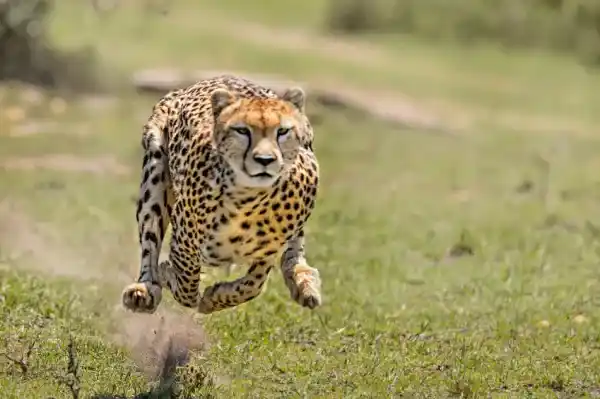
The king of land speed. Found in parts of Africa and the Middle East, it possesses immense explosive power, accelerating from a standstill to 100 km/h in just a few seconds.Mako Shark – 124 km/h
One of the fastest fish in the ocean, it can burst into an astonishing speed of 124 km/h when hunting.Siberian Tiger – 90 km/h
Weighing between 160 and 190 kilograms, they can reach speeds of up to 90 km/h while running, demonstrating the explosive power of large felines.Carolina Squirrel – 90 km/h
Originally from North America, it has now become an invasive species in Europe and is extremely fast.Eastern Grey Kangaroo – 80 km/h
Commonly known as the "giant kangaroo," it can reach speeds of 80 km/h through continuous powerful jumps, and its normal cruising speed is about 50 km/h.Hare – 72 km/h
Its speed is twice that of a human sprint champion, so "as fast as a rabbit" is not an exaggeration.Ostrich – 70 km/h
Although it cannot fly, it is the fastest bipedal animal in the world thanks to its strong legs.Horse – 70 km/h
Horses have long been an important means of transportation for humankind, with top racehorses reaching speeds of up to 70 km/h during sprints.Extreme example: tiny mites (Paratarsotomus macropalpis)
Its body is only the size of a seed, yet it can travel a distance equivalent to 322 times its own length in one second . In comparison, a cheetah can only achieve 16 times that distance. If converted to a human size, this speed is equivalent to 2092 km/h , enough to "exceed the speed of sound." Therefore, it is considered the fastest animal on Earth in terms of relative speed.
The fastest animal in the water
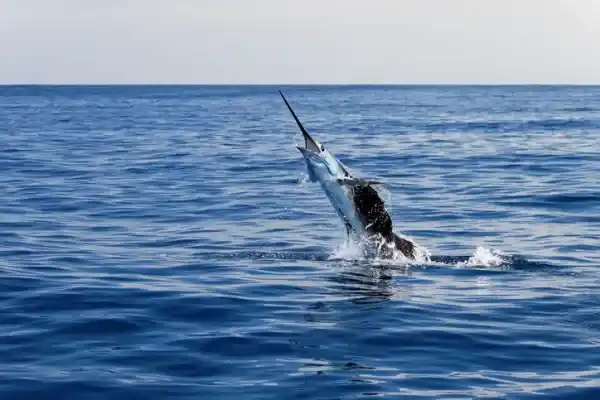
Besides the shortfin mako shark, the following aquatic animals are also known for their astonishing speed:
Pacific Sailfish – 109 km/h
Swordfish – 100 km/h
Blue Marlin – 80 km/h
Bluefin Tuna – 70 km/h
Blue Shark – 70 km/h
These fish are often apex predators, using speed to catch prey or escape predators.
Summarize
Speed is not only a survival advantage for animals, but also an important weapon they have developed in the course of evolution.
Aerial dive : The peregrine falcon reigns supreme.
On land : the cheetah is the undisputed king.
Swimming in the water : Shortfin mako sharks and sailfish demonstrate extreme speed.
Relative speed : Tiny mites have shattered human imagination of "speed".
These examples not only demonstrate the diversity and wonder of nature, but also remind us that protecting these creatures is protecting Earth's most unique natural heritage.