Among the most fascinating and unsettling animals on Earth, chameleons are endowed with so many unique adaptations—independently rotating eyes, a projecting tongue, a graspable tail, and (last but not least) the ability to change color—that they seem to have been relegated to the skies of another planet. Learn 10 basic facts about chameleons, from the origin of their name to their ability to see ultraviolet light.
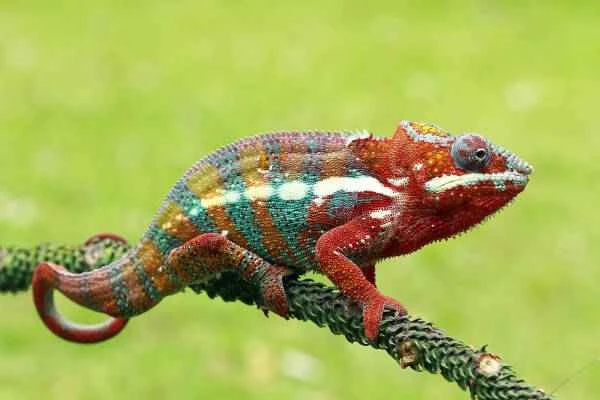
A colorful chameleon in Indonesia
01. The oldest known chameleon lived 60 million years ago.
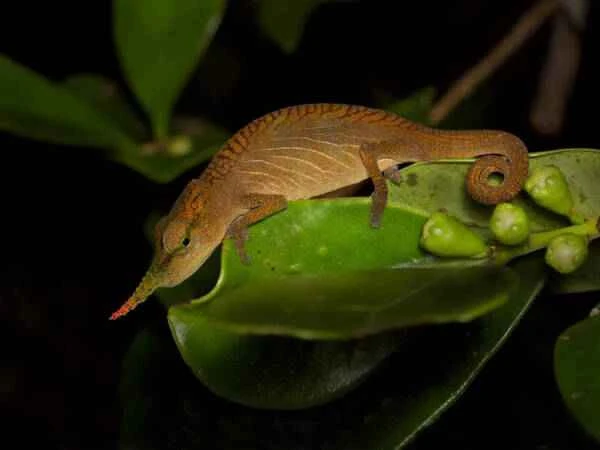
Male long-nosed chameleon in the Wahimana Reserve, Madagascar
As far as paleontologists know, the first chameleons evolved shortly after the extinction of the dinosaurs 65 million years ago. The earliest discovered species is *Anqingosaurus broodysplice*, which lived in Asia during the Middle Paleocene. However, there is some indirect evidence that chameleons existed as early as 100 million years ago, during the Middle Cretaceous, possibly originating in Africa, which could explain their abundance in Madagascar. The most convincing and logical argument is that chameleons must share a final common ancestor with closely related iguanas and "dragon lizards," which may have lived at the end of the Mesozoic era.
02. There are over 200 species of chameleons.
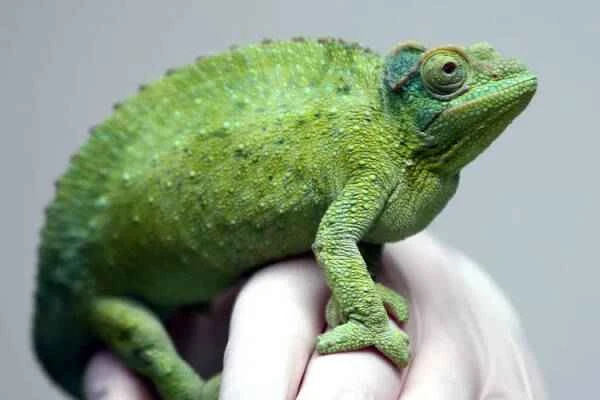
Chameleons are classified as "Old World" lizards because they are native to Africa and Eurasia, comprising a dozen named genera and over 200 species. Broadly speaking, these reptiles are characterized by their small size, quadrupedal posture, protruding tongues, and independently rotating eyes. Most species also possess a foldable tail and the ability to change color, which they use to signal to other chameleons and camouflage them. Most chameleons are insectivorous, but some larger species feed on small lizards and birds.
03. "Chameleon" means "ground lion".
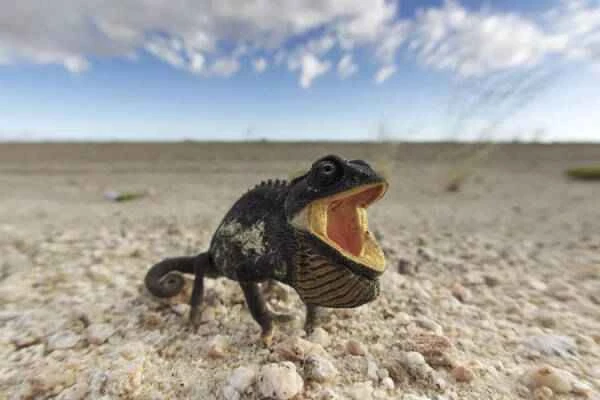
Like most animals, chameleons have existed for far longer than humans, which explains why we find references to this reptile in the oldest written records. The Akkadians—an ancient culture that ruled modern-day Iraq more than 4,000 years ago—called this lizard nes qaqqari, literally meaning "lion of the earth," a usage inherited unchanged by subsequent civilizations over the next few centuries: first the Greek "khamaileon," then the Latin "chamaeleon," and finally the modern English "chameleon," meaning "lion of the ground."
04. Almost half of all chameleons live in Madagascar.
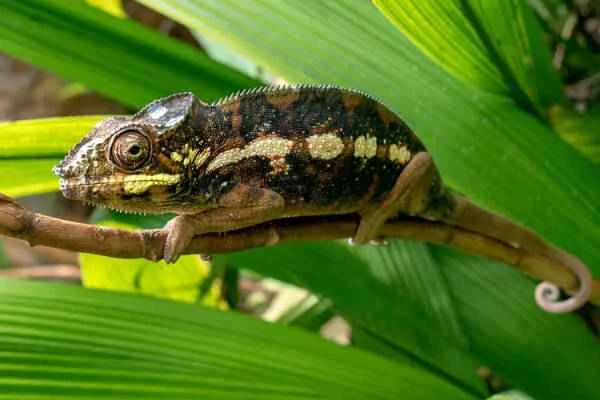
Madagascar, an island off the east coast of Africa, is renowned for its diversity of lemurs (an arboreal primate) and chameleons. Three genera of chameleons—Brønsted's chameleon, Karuma chameleon, and Foussieve chameleon—are endemic to Madagascar, including the dwarf leaf chameleon, the caterpillar-sized pygmy leaf chameleon, the enormous (nearly two pounds) Parsons chameleon, the brightly colored black panther chameleon, and the critically endangered Tarzan chameleon (not named after the Tarzan of the storybooks, but after the nearby village of Tarzanville).
05. Most of them change color
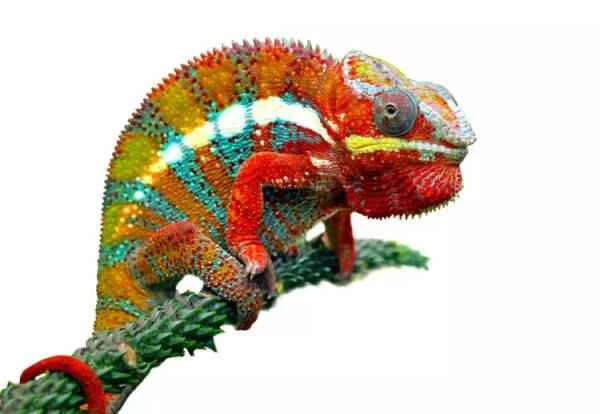
While chameleons aren't quite as adept at blending into their surroundings as depicted in cartoons—they can't become invisible or transparent, nor can they mimic polka dots or checkered patterns—these reptiles are still incredibly clever. Most chameleons can change their color and pattern by manipulating pigments and crystals of guanine (an amino acid) embedded in their skin. This technique is extremely useful for evading predators (or curious humans), but most chameleons also change color to signal to other chameleons. For example, brightly colored chameleons dominate male-on-male competition, while softer colors indicate defeat and submission.
06. Seeing ultraviolet rays
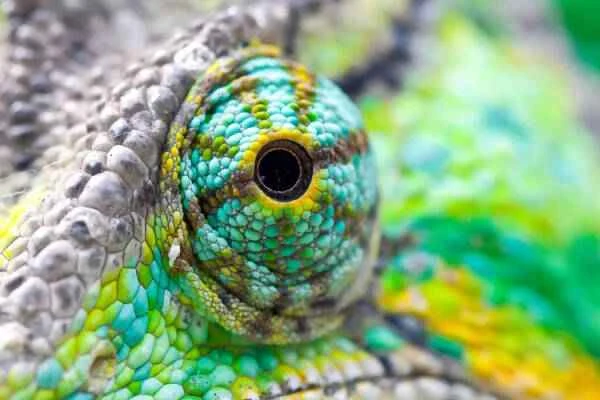
Ultraviolet (UV) radiation has more energy than the "visible" light that humans can detect, and large doses can be dangerous. One of the most mysterious things about chameleons is their ability to see light in the UV spectrum. It is speculated that their UV-sensing ability evolved to allow chameleons to better target their prey. This may also be related to the fact that chameleons become more active, social, and interested in reproduction when exposed to UV radiation, possibly because UV radiation stimulates the pineal gland in their tiny brains.
07. Independently moving eyes
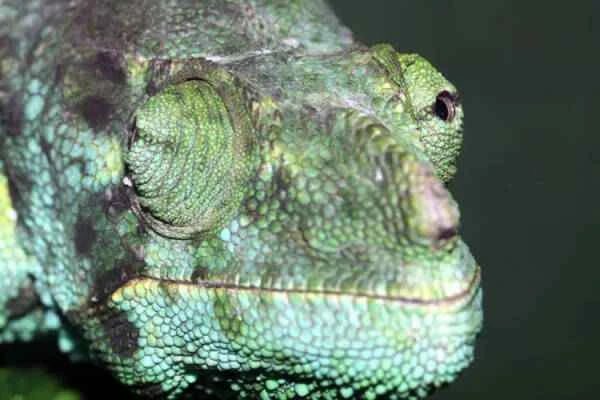
For many, the most unsettling aspect of chameleons is their eyes, which move independently within their sockets, providing near 360-degree vision. In addition to sensing ultraviolet light, they are also adept at judging distances thanks to the exceptional depth perception in each eye. This allows the lizard to target delicious insect prey from 20 feet away without using binocular vision. The chameleon's ears are relatively primitive, hearing only a very limited range of frequencies, which somewhat balances out their remarkable visual acuity.
08. A long, sticky tongue
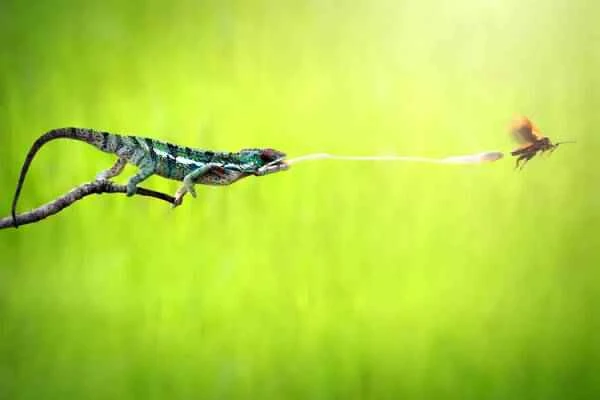
If a chameleon cannot complete the transaction with its prey, its independently rotating eyes are of little use. That's why all chameleons are equipped with long, sticky tongues—typically two to three times the length of their body—which they forcefully eject from their mouths. Chameleons have two unique muscles for this task: an accelerometer muscle that launches the tongue at high speed; and a hypoglossal muscle that pulls the tongue back, with prey attached to the end. Surprisingly, even in temperatures low enough to sluggish other reptiles, chameleons can still fully extend their tongues.
09. Extremely professional feet
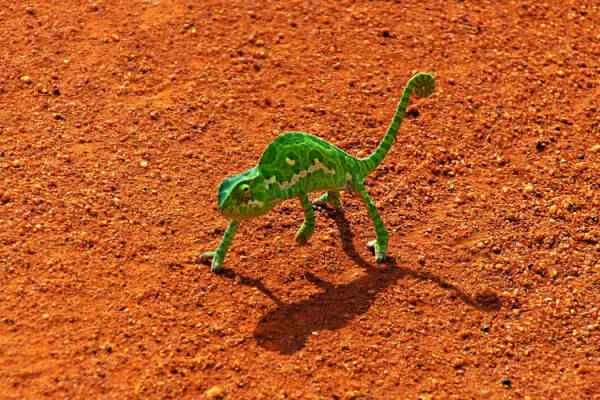
Perhaps due to the immense recoil generated when the tongue flicks out, chameleons needed a way to firmly attach themselves to branches. Nature's solution was "jointed toe" feet. Chameleons have two outer toes and three inner toes on their forefeet, and two inner toes and three outer toes on their hind feet. Each toe has sharp claws that can pierce the bark. Other animals—including birds and sloths—have also evolved similar anchoring strategies, although the chameleon's five-toed anatomy is unique.
10. Most of them have a tail that can be grabbed.
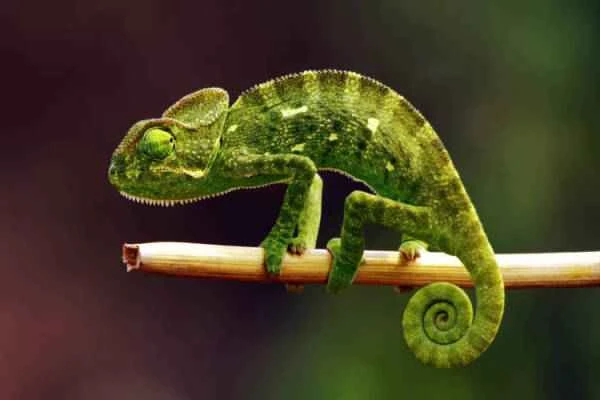
As if their fused toes weren't enough, most chameleons (except the smallest) also possess a grasping tail to entwine themselves around branches. Their tails provide chameleons with greater flexibility and stability when climbing up or down trees, and like their feet, help to counteract the recoil of their explosive tongues. When a chameleon rests, its tail curls into a tight ball. Unlike some other lizards that can shed and regrow their tails multiple times throughout their lives, chameleons cannot regenerate their tails if they are severed.