Crabs belong to the order Decapoda, class of crustaceans, and were also referred to as "蠏" in ancient texts. Since ancient times, crabs have been a delicacy on the Chinese table, especially around the Mid-Autumn Festival, when eating crabs has become a tradition. The *Zhou Li* (Rites of Zhou), in the section on the cook, states: " The delicacies offered are those prepared for the four seasons, such as fish from Jingzhou and crabs from Qingzhou ." The Eastern Han scholar Zheng Xuan, in his commentary on this, highlighted the status of crabs as a culinary delicacy.
Crabs are highly nutritious and beloved by many diners, making them an indispensable part of the seafood category. However, not all crabs are safe to eat; some species are not only inedible but also contain potent toxins, which can have serious consequences if ingested.
As Lu Xun said, " The first person to eat a crab is worthy of respect—if not a brave person, who would dare to take a bite? " Today, we'll take a look at the world's ten most poisonous crabs and remind everyone which crabs should not be touched or eaten to avoid accidental poisoning.
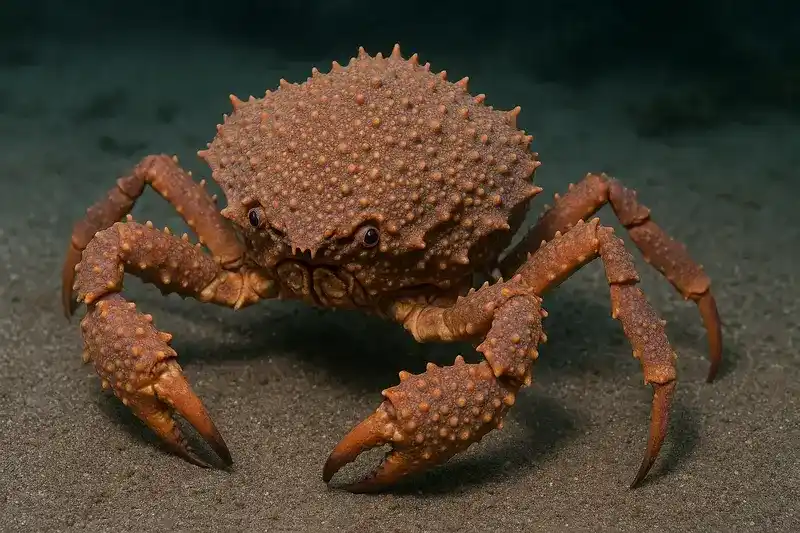
1. Wan's Strange Crab
The Wan's Crab is a large crab with a unique appearance, covered in densely packed small bumps. It is a poisonous crab with a highly potent venom, and is one of the top ten most poisonous crabs in the world. It is mainly distributed in the coastal areas of Southeast Asia and Taiwan. It generally prefers to live in deep waters and feeds mainly on decaying matter. Due to its strong venom, if the venom seeps into the skin, it can have serious consequences if not treated promptly.
2. Fiddler crab
Fiddler crabs, named for their characteristic claw-waving motion, have a wide distribution and diverse populations, mainly found in Hainan and Taiwan. They generally prefer to live in saltwater sandy areas and change their burrows every few days. When they wave their claws, it is usually a warning or courtship gesture. Fiddler crabs often use sight and hearing to communicate and gather together, arranging their rhythm according to the ebb and flow of the tide, exhibiting a highly regular pattern.
3. Lei Jin Ai Jie Crab
The Lamiidae crab, with multiple granular markings on its back, is brightly colored and has an attractive appearance. It is a poisonous crab with extremely high toxicity. It is mainly distributed in Taiwan and other regions of my country. They generally live on coral reefs at depths of 2-30 meters in the ocean. Due to its high toxicity, it has been banned from being eaten and sold. Ingesting this poisonous crab can lead to poisoning and may even cause death.
4. Hairy crab
The blunt-fronted hairy crab is usually covered with seaweed. It is mainly distributed in countries such as Japan and Mauritius abroad, and in Guangdong, my country. The blunt-fronted hairy crab generally prefers to live in seawater at a depth of 10-30 meters and under rocks. It is a poisonous crab with strong venom. It is very good at camouflage and waits for its prey to approach before striking. It uses its venom to penetrate its prey's body to facilitate hunting.
5. The embroidered spine resembles a crab.
The mosaic crab, also known as the embroidered-back crab, is mainly distributed in Australia, Singapore, and the Malay Peninsula. Its body is covered with red and white stripes, making it quite attractive. They often live near coral reefs at depths of up to 30 meters from the low tide line. They contain tetrodotoxin, a potent toxin that can easily kill prey such as rats when hunting. It is best to avoid them to prevent poisoning.
6. Patterned Clean Crab
The patterned cherubic crab is green all over with cloud-like patterns on its back and covered with a smooth, hard exoskeleton, making it very unique in appearance. It is mainly distributed in coral reef areas of the Indian Ocean and the western Pacific Ocean. They often prefer to live in intertidal crevices and inhabit caves. The patterned cherubic crab is a poisonous crab and should not be eaten. The toxicity varies in different regions, but it is quite potent and can even cause instant death in severe cases.
7. The bronze casting resembles a cooked crab.
The bronze-cast, cooked crab, also known as the buried fan crab or the stupid crab, is mainly distributed in Japan and southern Taiwan. They generally live on coral reefs in tropical shallow waters. They are poisonous crabs containing neurotoxins, which are extremely toxic. This crab is not edible. If accidentally ingested, it can cause food poisoning and even death. Currently, there is no antivenom for this poisonous crab, and first aid is ineffective. If you encounter this poisonous crab, immediately throw it back into the sea and stay away from it.
8. Pseudocoral Crab
The pouch-bellied coral crab is mainly distributed in the Philippines, Vietnam, and other regions. It lives in the surrounding waters and has a wide distribution. It usually grows together with corals. It is brightly colored and has a beautiful appearance, which is very eye-catching. However, it is a poisonous crab and has a certain degree of toxicity. It should not be eaten. Eating this poisonous crab may cause poisoning and lead to shock.
9. Reynolds's Crab
The Reynolds crab has a yellowish-brown or light orange base color on its back with irregular patches. It is mainly distributed in Southeast Asian countries and coastal areas of Japan. It is a poisonous crab with strong toxicity and should not be eaten. Eating it may cause food poisoning, and in severe cases, it may even lead to death. It has been reported that there are cases of people dying from accidentally eating this crab in the Philippines every year.
10. The honest and clean crab
The honest and clean crab, which looks similar to the brown crab, is easily mistaken for a poisonous crab. It contains tetrodotoxin and should not be eaten. Ingestion may cause poisoning, and in severe cases, it may even lead to death. It is mainly distributed in Japan, India, Singapore and other regions. It lives on seabed reefs and is generally active in water depths of 10 to 30 meters. It is relatively common.