Orcas (Orcinus orca), also known as killer whales, are among the most intelligent and fascinating marine mammals on Earth. As apex predators in the marine food chain, orcas possess complex social structures, highly developed sensory systems, and astonishing hunting skills. However, many people have misconceptions about a fundamental question concerning the orca's body: Where exactly are the orca's eyes located? Why do their white "eyespots" look like eyes?
This article will take a zoological perspective to comprehensively interpret the true location, function, physiological mechanism, and evolutionary significance of the killer whale's eyes, correcting common misconceptions among the public.
1. Where are the eyes of an orca actually located?
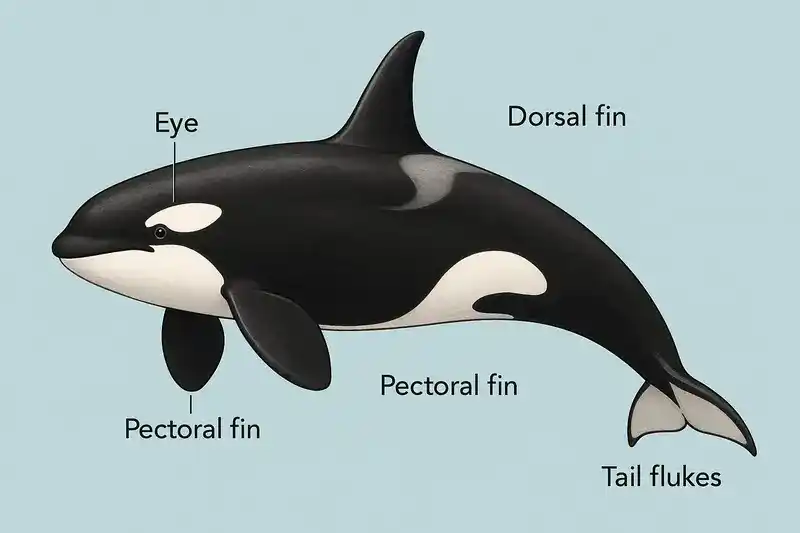
1.1 Actual location: behind the corner of the mouth, not the white eye patch.
The orca's true eyes are located slightly below and behind the corners of its mouth, within a dark skin area, making them relatively hidden.
Their eyes are small, making them difficult to spot from a distance.
This position is further back and lower than the white eye patch.
1.2 Uses of white eye spots
The white eye patches on orcas are not eyes, but rather a form of camouflage or signaling structure, possibly serving the following functions:
Disruptive camouflage helps to conceal the location of the real eyes, preventing prey from attacking vital areas.
Social signals are used for identification or communication between individuals.
Attract the prey and divert attention from the actual target area.
2. Why should the eyes be hidden behind the corners of the mouth?
2.1 Provides protection
A rearward position avoids direct eye injury when attacking prey, and is especially safe when hunting seals, fish, or other large prey.
2.2 Optimize visual range
The eyes are located on both sides, which makes it easier to see the surrounding environment.
Wide field of vision in one eye
By adjusting posture, partial binocular vision can be achieved, enhancing depth perception.
2.3 Facilitates streamlined movement
Embedded eyes reduce water resistance, making orcas more efficient when swimming at high speeds and chasing prey.
III. What are the visual abilities of orcas?
3.1 Underwater and Above-Water Vision
Orcas have excellent vision both underwater and above water.
Specialized corneal structure to adapt to differences in water and air refraction.
It has abundant rod cells, which enhances photosensitivity in low-light conditions.
3.2 Nighttime and Deep-Sea Vision
Orcas possess a highly developed tapetum lucidum, which enhances their vision in dim environments, making them well-suited for Arctic winters or deep-sea diving.
3.3 Monocular and Binocular Vision
Although the eyes are positioned to the side, observation is mainly done with one eye, but by rotating the body, a certain degree of binocular vision can be achieved, improving the ability to judge distance.
IV. Beyond Sight: The Orca's Multisensory System
4.1 Echolocation System
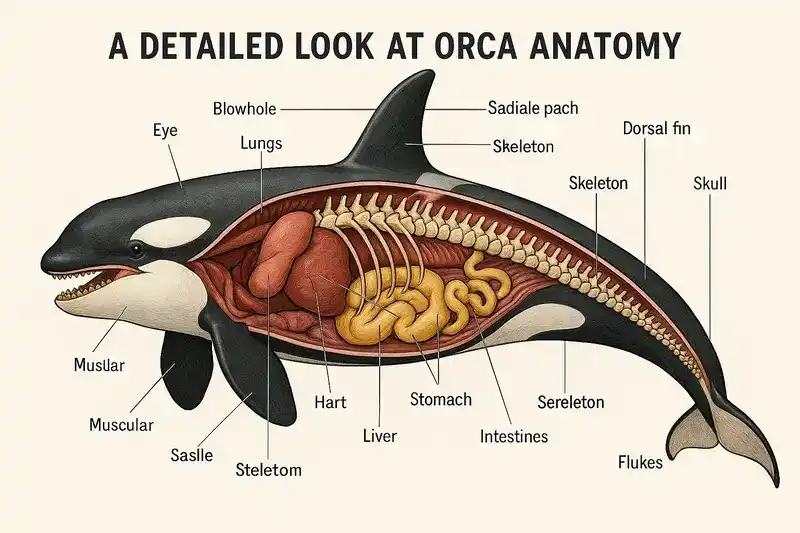
The clicking sound is produced by the melon in the head.
The mandible receives the reflected echoes and transmits them to the middle ear.
Constructing a 3D acoustic map to perceive prey, obstacles, and environmental structure.
4.2 Hearing
Wide receiving frequency range
Used for communication, navigation, and hunting.
4.3 Touch
The skin around the mouth and fins is rich in nerve endings.
Common social friction behaviors may have emotional and physiological significance.
V. An Evolutionary Perspective on the Eye Position of Orcas
5.1 Comparison with other cetaceans
Similar to the eye position of toothed whales such as dolphins
In contrast, baleen whales have eyes that point slightly forward, reflecting a different ecological strategy.
5.2 Evolutionary outcomes of adapting to survival in multiple environments
Placing the eyes behind the corners of the mouth is a compromise that addresses multiple needs, including hunting, defense, social interaction, and mobility.
VI. Public Misunderstandings and Visual Misleading
6.1 Eye spots that are mistaken for "eyes"
Nature documentaries, children's illustrations, and films often depict white spots as eyes, a misconception that may affect people's understanding of orcas' behavior and sensory abilities.
6.2 The Importance of Educational Communication
Zoos, aquariums, and nature educators should disseminate information about the anatomy of orcas in a more scientific and accurate manner to enhance public awareness.
VII. Conclusion: Getting to know the real killer whale and understanding its evolutionary wisdom
The position of an orca's eyes is not merely a matter of "unusual appearance," but rather the result of millions of years of evolutionary selection. Understanding these details can not only correct stereotypes but also help us gain a deeper understanding of the orca's role and wisdom in the marine ecosystem.
The orca's body structure, from its concealed eyes to its sophisticated sonar system, is key to its status as a top predator in the ocean. Every part of its body exemplifies the brilliance of adaptive evolution.
True observation begins with recognizing the eyes of an orca.