Butterflies and moths are two very common and visually distinct insects, both belonging to the order Lepidoptera, but many people often confuse them. Despite some similarities, they have many distinct differences in size, behavior, and habits. In this article, we will detail the differences between butterflies and moths to help you identify these two insects.
Global Lepidoptera Species Statistics
Lepidoptera is the second largest group of insects, after Coleoptera (beetles). More than 160,000 species of Lepidoptera have been recorded worldwide, including:
Moths make up about 90% , or approximately 144,000 species .
Butterflies make up about 10% , or approximately 16,000 species .
Why do moths make up a larger proportion of species?
Wide range of ecological adaptability : Moths inhabit environments ranging from daytime and nighttime, tropical, temperate and even cold regions, and many moth species have shown a high degree of adaptability during evolution.
Diurnal and nocturnal distribution : Most moths are nocturnal insects, using nighttime resources to reproduce and forage, thus occupying a unique ecological niche.
Physical characteristics of butterflies and moths: differences in appearance
The most obvious difference between butterflies and moths is their appearance. Although they both have beautiful wings covered with tiny scales, a closer look reveals many distinct differences.
butterfly wing posture
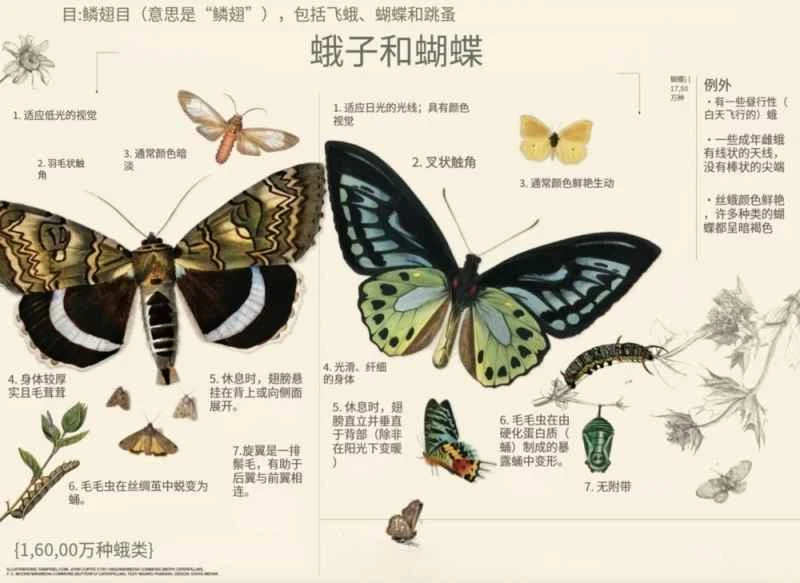
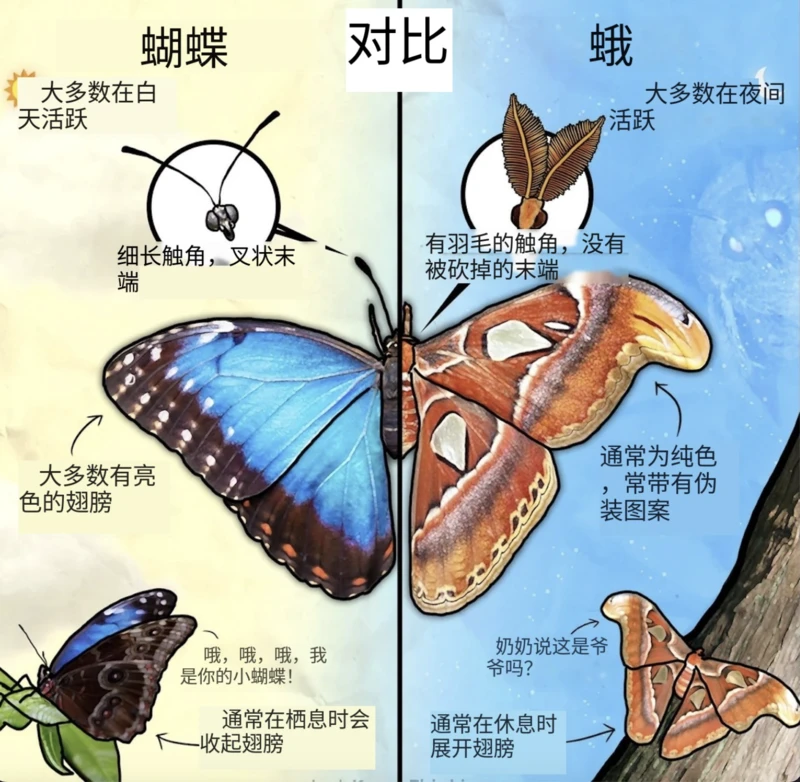
One of the biggest differences between butterflies and moths is the resting posture of their wings. Butterflies usually fold their wings vertically behind their backs when resting, while moths tend to spread their wings flat or slightly tilted. According to Wang Zhiqiang (2020) in Insect Taxonomy, butterflies' wings are usually kept in an upright position, which helps them maintain a relatively light flight posture, while moths tend to lie flat with their wings spread.
Antennae differences: Butterflies and moths
The antennae of butterflies and moths are also an important distinguishing feature. Butterfly antennae are typically thinner and have small, spherical structures at the ends, giving them a distinctive appearance. Moth antennae, on the other hand, are usually more complex. Many moths have feather-like or serrated antennae, a structure that helps them detect chemicals in the air, such as sex pheromones, at night ( Simmons, 2018 ).
Body shape differences: slender vs. stocky
Butterflies typically have slender bodies, while moths are more robust and covered in fine hairs. The slenderness of butterflies helps them fly more nimbly, while the larger size of moths helps them better conserve energy during nighttime flight. Huang Xiaoming (2019) mentions in *Insect Biology* that moths typically require more fat to support long periods of flight, especially at night.
Differences in the living habits of butterflies and moths: diurnal activity
Besides their differences in appearance, butterflies and moths also exhibit significant differences in their activity periods. Understanding their activity patterns helps us better understand these two insect species.
Butterflies: active during the day
Most butterflies are diurnal , preferring to fly and search for nectar during the bright sunshine. Their flight is graceful and elegant, and they typically enjoy the warmth of the daytime sun, which is ideal for foraging and breeding. According to Li Yun (2021), butterflies are generally active during the day, and their visual and behavioral patterns are adapted to life under sunlight.
Moths: Nocturnal
Unlike butterflies, moths are typically nocturnal insects. They prefer to fly at night and are often attracted to streetlights. Moths' nocturnal activity is usually related to their foraging and reproduction. **Shi Wei (2017) points out in his book "Nocturnal Insect Behavior" that moths have evolved special abilities to be active at night, using their complex antennae to sense scents and signals in the night air to help them find food and mates.
Differences in life cycles between butterflies and moths
Although both butterflies and moths undergo complete metamorphosis, their life cycles and reproductive behaviors differ in some ways.
Butterfly pupal stage: pupa
The pupal stage of a butterfly is usually called the pupa . During this stage, the butterfly forms a hard exoskeleton, the pupa shell , and undergoes metamorphosis within it. Butterfly pupae typically have a hard, smooth exterior, often predominantly green, brown, or other natural colors to help them blend into their environment. **Li Tao (2020)** points out that the pupal stage of a butterfly is usually short and requires metamorphosis in an open environment.
The pupal stage of a moth: cocoon
Unlike butterflies, the pupal stage of moths is usually called a cocoon , in which they wrap themselves in silk to form a closed protective structure. This cocoon provides better protection for the moth's metamorphosis, especially in adverse environments. **Zhao Hui (2021)** mentions in "Insect Growth and Development" that the moth's cocoon is relatively soft and can provide good protection, especially for moths that are active at night.
Summary of differences between butterflies and moths: Comparison table
To better understand the differences between butterflies and moths, here is a concise comparison table:
| Features | Butterfly | moth |
|---|---|---|
| Wings pose | When resting, the wings are held upright and folded up. | When resting, wings are spread out or slightly tilted. |
| Antennae | Slender with small spherical structures at the ends | Feather-like or serrated antennae |
| Body shape | Slender body | The body is relatively thick |
| Event Time | Diurnal activity (daytime activity) | Nocturnal activities (night-living) |
| Flight mode | Light and graceful flight | Flight is relatively direct and powerful. |
| Larval habits | Feeding the leaves of specific plants | They feed on a variety of plants and inhabit relatively secluded environments. |
| pupal stage | Forming a hardened pupa | The process of metamorphosis often takes place within the cocoon. |
| Reproduction methods | Seeking a mate during daytime activities | Attracting a spouse with nighttime scents |
Conclusion: The difference between butterflies and moths
In conclusion, although butterflies and moths both belong to the order Lepidoptera, they differ significantly in size, behavior, and habits. Butterflies are typically diurnal insects with slender bodies, while moths tend to be nocturnal and have more robust bodies. Understanding these differences allows us to better identify and appreciate these two beautiful insects.
References :
Wang Zhiqiang (2020). Insect Taxonomy. Entomology Press.
Huang Xiaoming (2019). Insect Biology. Biotechnology Press.
Li Yun (2021). Insect Behaviour. Institute of Entomology.
Shi Wei (2017). Nocturnal Insect Behavior. Entomological Journal.
Li Tao (2020). Insect Growth and Development. Science Press.