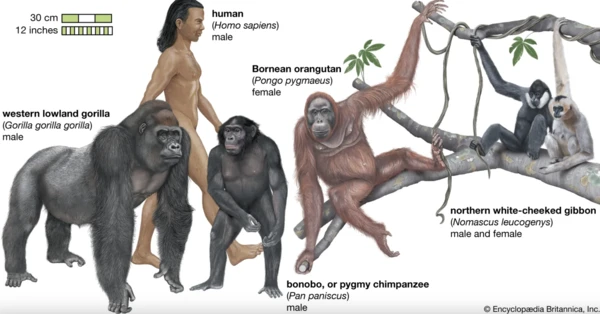
The Hominidae family is a fascinating superfamily of primates, encompassing gorillas, orangutans, gibbons, and ourselves. Their physical structures, behaviors, and ecological significance not only demonstrate the miracle of natural selection but also help us better understand our origins and characteristics. This article will provide a comprehensive overview of the Hominidae family through its classification, evolution, behavior, ecological roles, and conservation status.
What is human science?
The Hominidae family is a group of tailless primates, comprising two main branches: humans, great apes (gorillas, chimpanzees, orangutans, bonobos), and gibbons. They share several common characteristics: highly developed brains, complex social structures, and remarkable adaptability.
Member Classification:
Great apes (Hominidae): include humans, chimpanzees, gorillas, bonobos, and orangutans.
Hylobatidae: including gibbons, known for their agile tree-swinging ability and melodious calls.
Classification and Evolution of Hominidae
Category Overview
Order: Primates
Suborder: Haplorhini
Superfamily: Hominoidea
Hominidae originated approximately 25 to 30 million years ago, diverging from Old World monkeys. Six to eight million years ago, the common ancestor of humans and great apes diverged again, ultimately giving rise to our species—Homo sapiens.
Evolutionary characteristics
Bipedalism: Humans and the earliest Homo erectus began to stand on two feet, which not only freed their hands but also promoted the formation of tools and culture.
A highly developed brain: Complex thinking, social and language abilities are unique advantages of human scientists.
Anatomical and behavioral characteristics
Physical characteristics
Tailless structure: Unlike monkeys, all human species do not have tails.
Flexible shoulders and limbs: gibbons are adapted to swinging between trees, while great apes are adept at climbing.
Strong skull and teeth: adapted to a diverse diet, from fruits to insects and even small animals.
Behavioral diversity
Social structure:
Gorillas are typically led by a silverback male and consist of one male and several females in a family.
Chimpanzees and bonobos practice a more open "split-integration" social system, emphasizing cooperation and communication.
Tool usage and troubleshooting:
Chimpanzees use twigs to catch termites, and they are adept at making simple tools to obtain food.
Communication and Emotion:
Gibbons use songs to declare their territory, while great apes convey information through a variety of facial expressions and body movements.
Humanity's unique position in it
As members of the Hominidae family, humans are a unique group, possessing language, abstract thinking, and the ability to create culture. The fossil record, such as that of *Lucy (Australopithecus afarensis)*, illustrates the transition from arboreal life to bipedalism.
Ecological role of hominids
Forest Guardians
Hominidae primarily inhabit tropical rainforests, and they have a significant impact on the ecosystem:
Seed dispersers: Gorillas and orangutans help plants reproduce by spreading seeds through eating and defecation.
The balance point in a food web: being both a predator and prey for some predators.
The challenges of protection
Many human species face endangerment due to deforestation, illegal hunting, and climate change. International organizations such as the Jane Goodall Institute and the World Wildlife Fund are working to protect them.
Comparison with other primates
Differences from Old World monkeys
Do they have tails? Monkeys have tails, while humans do not.
Locomotion: Monkeys mostly walk on four legs, while hominids are more diverse, such as the "swinging" of gibbons and the bipedal walking of humans.
Differences in brain size: Humans have larger brains and are better at complex behaviors.
The connection between humans and hominids
Humans and chimpanzees share approximately 98-99% of their DNA, demonstrating a close evolutionary link. From emotional expression to cooperative behavior, hominids and humans share striking similarities in many ways.
Hominidae are a marvel of biological evolution; their behavioral intelligence, ecological roles, and conservation value reveal the complexity of life. Through increased conservation efforts and research, humans can help these amazing primates continue to thrive.