Why are pandas called "iron-eating beasts"? This seemingly absurd name actually contains profound cultural origins and scientific basis. As China's national treasure, the giant panda's adorable image is deeply ingrained in people's minds, but what is little known is that in ancient texts, they also had a majestic title—"iron-eating beast." This mysterious name not only carries thousands of years of cultural memory but also hides the scientific secrets of animal behavior. This article will delve into the origin of the name "iron-eating beast," comprehensively analyzing this interesting cultural phenomenon from multiple dimensions, including ancient records, scientific explanations, and cultural inheritance.

I. Records of "eating iron" in ancient books: the source of a thousand-year-old legend
1.1 Records in early literature
The earliest record of pandas "eating iron" dates back to the Eastern Jin Dynasty. The renowned scholar Guo Pu described them in his commentary on the *Erya* as: "Resembling a bear, with a small head, paralyzed legs, and mottled black and white fur; it can lick and eat copper, iron, and bamboo bones." This is the earliest known written record linking pandas to the behavior of "eating iron." Guo Pu's record not only accurately describes the physical characteristics of pandas but also specifically points out their habit of "eating iron."
During the Tang Dynasty, a similar record appeared in the "Newly Revised Materia Medica": "The tapir resembles a bear but is yellowish-black. It comes from Sichuan and eats copper and iron, and is extremely good at dissolving iron." Although these records contain exaggerations, they all point to the same phenomenon: there was indeed a bear-like animal in ancient Sichuan that could lick metal.
1.2 Detailed records from the Ming and Qing Dynasties
During the Ming and Qing dynasties, records about the "iron-eating beast" became richer and more detailed. Li Shizhen, in his *Compendium of Materia Medica*, recorded: "The tapir resembles a bear but has a small head and paralyzed legs, with black and white stripes. It can lick and eat copper, iron, and bamboo bones." Yuan Mei, in his *New Qi Xie*, vividly described a panda entering a villager's home and licking an iron pot: "In Fang County, there is a tapir beast that loves to eat copper and iron without harming people. Whenever it sees plows, hoes, knives, or axes, it drools and licks them, leaving chips and nicks."
While these accounts contain elements of literary exaggeration, they are all based on real observations. Pandas were often seen in the mountainous areas of ancient Sichuan, and they would indeed lick cooking utensils. This behavior was observed and recorded by the ancients, and gradually evolved into the legend of the "iron-eating beast."
1.3 Records in local chronicles
There are also numerous records of the "iron-eating beast" in the local gazetteers of Sichuan, Shaanxi and other places. For example, the "Beichuan County Gazetteer" records: "The tapir is similar to a bear, with black and white markings. It eats copper and iron and is extremely good at dissolving iron." These records in local gazetteers not only confirm the distribution range of the panda in ancient times, but also reflect the widespread circulation of the legend of the "iron-eating beast" among the people.
II. The Truth About "Iron" from a Scientific Perspective
2.1 Research in Modern Zoology
Modern zoological research has unveiled the scientific truth behind the legend of the "iron-eating beast." Studies have shown that the panda's behavior of licking iron objects is actually a common animal behavior known as "pica." In the wild, pandas lick iron-containing rocks or soil to replenish the minerals they lack.
Research from the Institute of Zoology, Chinese Academy of Sciences, shows that pandas have a low efficiency in absorbing iron through their digestive system, and iron is an essential element for hemoglobin synthesis. When food resources are limited in the wild, pandas supplement this essential element by licking iron-containing substances.
2.2 Dental Structure of Pandas
Pandas have a unique tooth structure with well-developed incisors and an astonishing bite force. Studies have shown that the bite force of an adult giant panda can reach 1300N, 1.5 times that of a black bear. Although it cannot actually bite through iron, the powerful bite force is enough to leave tooth marks on the surface of iron, which further reinforces the ancient people's impression of "eating iron".
A research team from Sichuan University discovered through CT scans that pandas have a special enamel structure on the surface of their teeth, making them exceptionally wear-resistant. This adaptive evolution, originally designed for chewing hard bamboo, also allows them to withstand the wear and tear from licking metal.
2.3 Behavioral Ecological Explanation
From a behavioral ecology perspective, the panda's "iron-eating" behavior is an adaptive behavior. In the wild, pandas actively seek out sources of minerals with high iron content. In captivity, this behavior manifests as licking iron fences or feeding utensils.
Observations at the Beijing Zoo show that captive giant pandas have a particular fondness for licking newly installed metal structures. This behavior is especially pronounced in the spring, possibly related to physiological needs during the breeding season.
III. The "Iron-Eating Beast" in Cultural Heritage
3.1 The "Iron-Eating Beast" in Folk Legends
In Sichuan, the legend of the "Iron-Eating Beast" has been passed down through generations. Locals regard pandas as auspicious beasts, believing they possess magical powers. In Ya'an, Wenchuan, and other places, many folk tales about the "Iron-Eating Beast" still circulate today.
For example, a legend circulates in the Wenchuan area: An ancient blacksmith noticed his ironware frequently breaking for no apparent reason. He later discovered a black and white animal licking the ironware at night. Instead of chasing it away, the blacksmith prepared ironware for the animal to lick every day, and as a result, his business flourished. From then on, the locals regarded this animal as an auspicious creature.
3.2 Images in Literature and Art
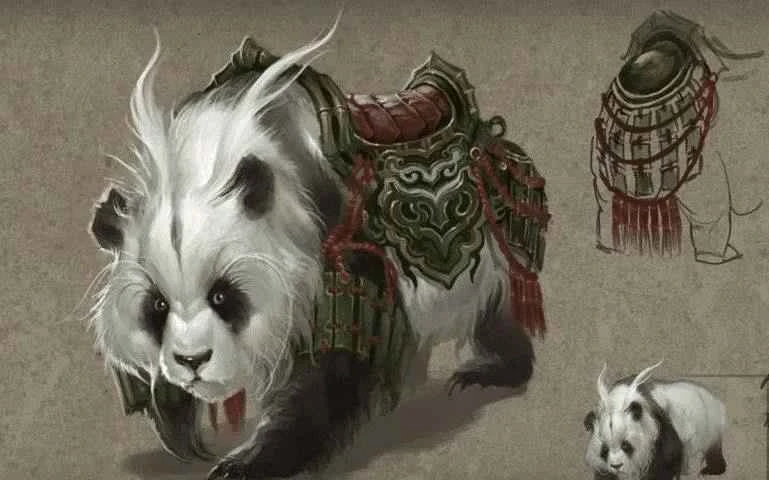
The image of the "iron-eating beast" also frequently appears in ancient literary works. The Tang Dynasty poet Bai Juyi wrote in his "Ode to the Tapir Screen": "The tapir has an elephant's trunk, rhinoceros's eyes, an ox's tail, and tiger's feet; it lives in the valleys of the south. Sleeping on its skin wards off plague, and drawing its image wards off evil." Although this description differs from the real panda, it reflects the ancients' imagination of this mysterious animal.
In the art of painting, the "iron-eating beast" is also an important subject. The Ming Dynasty painting "Auspicious Omens" in the collection of the Palace Museum features an image of the "iron-eating beast." Although the animal in the painting has undergone artistic embellishment, the characteristics of a panda are still discernible.
3.3 Inheritance in Modern Culture
With the development of modern zoology, the truth about the "iron-eating beast" has gradually been revealed. However, this title, shrouded in mystery, is still preserved as a cultural heritage. At the Chengdu Research Base of Giant Panda Breeding, the story of the "iron-eating beast" is used as an important part of popular science education.
In 2018, the Sichuan Museum held a special exhibition entitled "The Iron-Eating Beast: From Legend to Science," which comprehensively showcased the evolution of the legend of the "Iron-Eating Beast" through a combination of cultural relics, documents, and modern scientific research results. This method of cultural inheritance not only preserves the charm of traditional culture but also disseminates scientific knowledge.
IV. Reflections from the Perspective of Ecological Protection
4.1 The Importance of Biodiversity
The evolution of the legend of the "iron-eating beast" reflects the progress of humankind's understanding of nature. From initial fear and worship to current scientific research and protection, this transformation embodies the achievements of ecological civilization construction.
The conservation efforts for giant pandas have provided valuable experience for global biodiversity conservation. Data from the World Wildlife Fund (WWF) shows that, through years of conservation efforts, the wild giant panda population has increased from 1,114 in the 1980s to 1,864 today.
4.2 Integration of Traditional Culture and Modern Science
The modern interpretation of the legend of the "Iron-Eating Beast" demonstrates the possibility of integrating traditional culture with modern science. This integration not only enriches the cultural connotations but also provides new perspectives for scientific research.
For example, research on pandas' "iron-eating" behavior has inspired scientists to gain new insights into animal mineral metabolism. These research findings, in turn, provide a scientific basis for improving the husbandry and management of captive giant pandas.
4.3 Lessons from Ecological Civilization Construction
From "iron-eating beast" to national treasure panda, the evolution of this name bears witness to the wisdom of the Chinese people in living in harmony with nature. It is not only an interesting biological phenomenon, but also a vivid portrayal of the relationship between humans and nature in Chinese culture.
In today's pursuit of ecological civilization, the story of the "iron-eating beast" reminds us that only by respecting nature and understanding life can we achieve true ecological protection. This ecological wisdom from traditional culture has significant implications for contemporary environmental protection.
V. Conclusion
The legend of the "iron-eating beast" is a shining pearl in the treasure trove of Chinese culture. It embodies both the ancients' observations and imaginations of nature and contains the truths of modern science. From legend to science, from fear to protection, the evolution of this name reflects the progress of humankind's understanding of nature.
In protecting giant pandas today, we must not only focus on their survival but also cherish this unique cultural heritage. Letting the story of the "iron-eating beast" continue is not only about remembering the past but also about inspiring the future—both traditional culture and modern science will play vital roles in the path of harmonious coexistence between humanity and nature.
By delving into the cultural connotations and scientific value of the legend of the "iron-eating beast," we can not only better understand this rare species, the giant panda, but also draw wisdom from it to contribute Chinese wisdom to global biodiversity conservation and ecological civilization construction.