The giant panda (Ailuropoda melanoleuca) is one of the world's most iconic endangered species, found only in the mountainous forests of China. While modern giant pandas primarily feed on bamboo and are known for their black and white fur, their evolutionary history dates back millions of years. Fossil evidence and genetic studies have revealed the giant panda's evolutionary journey, from its ancient ancestors in the Late Miocene to its current precarious existence despite conservation efforts.
1. Ancient Origin: Late Miocene (7-8 million years ago)
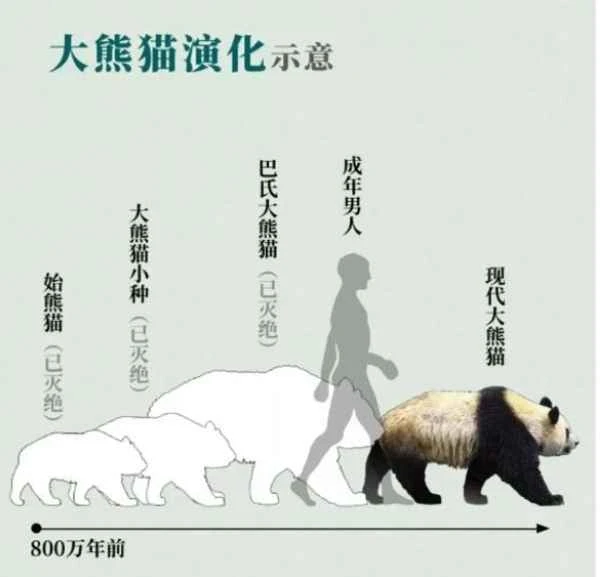
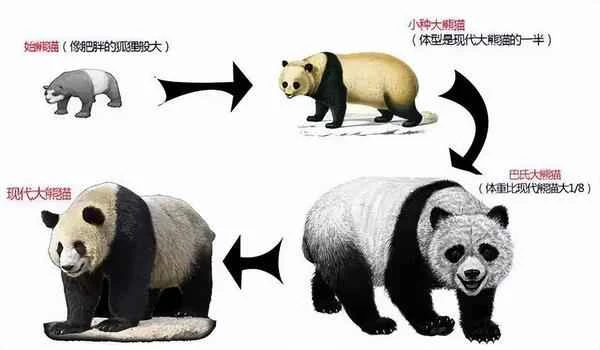
The earliest known ancestor of the giant panda is *Ailurarctos*, which lived in the Late Miocene (7-8 million years ago). Fossils discovered in Lufeng, Yunnan Province, indicate that this panda was much smaller than the modern giant panda, about one-third the size, roughly equivalent to a large dog. It weighed approximately 30-50 kilograms. Their dental structure shows early adaptations to bamboo, with well-developed premolars suitable for chewing bamboo.
1.1 Adaptation to bamboo diet
The dental structure indicates that the early panda had begun to adapt to a diet primarily consisting of bamboo plants.
Well-developed premolars help to chew tough plant fibers.
This characteristic marks the giant panda's transition from an omnivorous to a herbivorous diet, and its gradual differentiation from other bear species.
The early panda lived in subtropical forests, coexisting with various ancient apes and other mammals. They were likely primarily terrestrial, but retained some arboreal abilities, an adaptation that laid the foundation for later evolution.
2. Development stage: Early Pleistocene (2 million years ago)
During the Early Pleistocene (about 2 million years ago), the giant panda further evolved into the smaller species, *Ailuropoda microta*. Its fossils have been discovered in places such as Liucheng in Guangxi and Wushan in Chongqing. In 1984, a complete skull fossil was first unearthed at Longgupo in Wushan.
2.1 Key Evolutionary Changes
The skull is smaller than that of modern giant pandas, indicating that the body size increased during evolution.
The teeth and jaw are more adapted to chewing bamboo, indicating a gradual shift towards a completely herbivorous diet.
They reduced their meat-eating habits; fossil teeth studies show that they almost never consumed meat.
This period marks a significant turning point in the evolution of the giant panda, with its physical characteristics gradually converging with those of the modern panda. The skull of the Lesser Giant Panda was much smaller than that of the modern giant panda, and its body size was about half that of the modern giant panda. Its dental structure showed significant changes compared to earlier pandas. Despite its smaller size, its dental structure already demonstrated greater adaptation to a bamboo-based diet. The Lesser Giant Panda lived in the forest environment of the Early Pleistocene, primarily feeding on bamboo. Its teeth and digestive system gradually specialized, adapting to a bamboo-based lifestyle.
3. Peak Period: The ferocious giant panda of the Middle Pleistocene (1 million years ago), the forest overlord 1 million years ago.
One million years ago, giant panda evolution reached its peak, with the emergence of Ailuropoda baconi. Its fossils have been mainly discovered in Guangxi. It was a large panda, about 2 meters long, and one of the largest pandas in history.
The giant panda of Ba's is the largest recorded ancestor of the panda. Judging from fossil evidence, the giant panda of Ba's subspecies that lived during this period was about 1/9 to 1/8 larger and weighed about 100-150 kg than the modern giant panda, much larger than the modern giant panda (80-125 kg). When standing, they could reach a height of 1.5 meters, comparable in size to modern large bears.
The giant panda (Panda bacai) resembles a super-sized bear, with thick brown or black fur, strong limbs, and sharp claws. Its large head and powerful teeth structure indicate a strong chewing ability, adapted for processing various hard foods.
The giant panda of Ba's was an omnivorous animal adapted to temperate environments, living in the forests of southern China and Southeast Asia about a million years ago. Their diet included plants, insects, birds, and rodents, demonstrating a high degree of dietary adaptability. The giant panda of Ba's had large molars and a strong bite force, enabling them to easily crush hard foods. This powerful chewing ability allowed them to process a variety of high-protein and high-fat foods, such as meat and nuts. Unlike modern giant pandas, the giant panda of Ba's did not rely on bamboo as its primary food source.
The giant panda of Bartholomew was a apex predator in the forests of its time. Their size and strength allowed them to easily take on most animals, even rivaling tigers and lions. They possessed sharp claws and teeth, enabling effective self-defense and attack. Their fur not only provided warmth but also offered some protection in combat. As the apex predator of the forest, the giant panda of Bartholomew occupied a vital position in the ecosystem. Their predatory behavior helped control the populations of other animals, maintaining ecological balance.
The extinction of the giant panda (Panda baconi) is likely related to climate change, dwindling food resources, and competition with other large predators. Unable to adapt to the changing environment, they ultimately faced extinction.
The giant panda of Ba's family spread throughout the monsoon regions of the Pearl River, Yangtze River, and Yellow River basins in my country, and fossils of them have even been found in neighboring countries such as Myanmar, Laos, Thailand, and Vietnam. Archaeologists have discovered panda specimens at many human remains sites, and many of these specimens bear cut marks from human hands. This suggests that the giant panda of Ba's family had already become a delicacy on the tables of prehistoric humans.
3.1 Early Human Relationship with Pandas
Archaeologists have discovered panda fossils at prehistoric human sites, indicating that humans once coexisted with giant pandas.
Some panda skeletons bear cut marks, suggesting they may have been food for prehistoric humans.
During this period, the giant panda population was widespread, forming multiple regional subspecies and demonstrating a high degree of biodiversity.
4. Decline and the survival of modern giant pandas (over the past 20,000 years)
Over the past 20,000 years, giant pandas have faced survival pressures from climate change, habitat loss, and human activities. The modern giant panda (Ailuropoda melanoleuca) is the only surviving species.
4.1 Climate Change and Habitat Loss
During the last glacial period (around 20,000 years ago), temperatures dropped, causing mammals from North China to migrate south, which intensified the competition for survival.
The shrinking bamboo forest ecosystem has forced giant pandas to retreat to the mountainous forests of Sichuan, Shaanxi, and Gansu.
Human activities (such as deforestation) have further reduced the panda's living space.
4.2 Current Status of Gene Isolation and Conservation
Modern wild giant panda populations are scattered, leading to a decrease in genetic diversity.
Artificial breeding and habitat restoration have become key conservation measures.
Institutions such as the China Conservation and Research Center for the Giant Panda (CCRCGP) and Wolong National Nature Reserve are working to save the giant panda population.
5. Conclusion: The Future of Giant Pandas
The evolutionary history of the giant panda demonstrates its remarkable ability to adapt and survive, having evolved over millions of years from the ancient Ailuropoda to the modern giant panda. However, current issues such as habitat destruction, climate change, and genetic isolation mean that the future of the giant panda depends on conservation efforts.
Key takeaways:
✅ The giant panda's evolution originated from the Ailurarctos, which lived 7-8 million years ago.
✅ Two million years ago, the small giant panda (Ailuropoda microta) marked an important stage in the evolution to the modern panda.
✅ One million years ago, the giant panda baconi (Ailuropoda baconi) reached its peak in size and distribution.
✅ Over the past 20,000 years, climate change and human activities have led to the decline of the panda population.
✅ The survival of modern giant pandas mainly depends on China's conservation projects, such as artificial breeding, ecological restoration, and genetic research.
Thanks to global conservation efforts, giant pandas still have a chance to escape endangerment and continue to thrive on Earth as a symbol of biodiversity and ecological conservation.