Squid belong to the class Cephalopoda, a group of mollusks , similar to octopuses and cuttlefish. Their bodies are typically streamlined, covered by a pouch-like mantle , and they have well-developed heads and large eyes. Their primary mode of locomotion is jet propulsion . Most squid have eight arms and two longer tentacles (a total of ten appendages), primarily used for quickly grasping prey. Many species also possess the ability to change color , which can be used for camouflage, communication, or stress response.
Below is a list of 10 representative squid species , including their size, distinguishing features, habitats, and typical habits.

What are the typical characteristics of squid?
Mantle: A muscular structure that encloses internal organs and is also the power source for jet propulsion.
Ten appendages: usually eight short arms + two long tentacles, with suckers at the ends of the tentacles for hunting.
Jet swimming: Achieving rapid backward movement or acceleration by ejecting water through a funnel.
Skin discoloration: relies on pigment cells (pigment sacs) to rapidly change color and pattern.
1) Patagonian squid ( Doryteuthis gahi )
Appearance and body shape
Body length: up to 23 cm, belonging to the relatively small squid category.
Body color: A shade between white and blue, with a red stripe running through the body.
Appearance: Protruding eyes, short and broad head, and long and thin mantle.
Appendages and reproductive characteristics
It has 10 appendages: 8 shorter arms and 2 longer tentacles. One of the key differences between males and females is that males possess a hectocotylus , used to transfer sperm to females. The text describes how males "renew" this special arm in different seasons.
Distribution range
The article mentions that it lives along the Pacific coast from Peru to Cape Horn in Chile ; on the Atlantic side, it can be seen from the Gulf of San Matthias to the waters near the Falkland Islands (Malvinas Islands) .
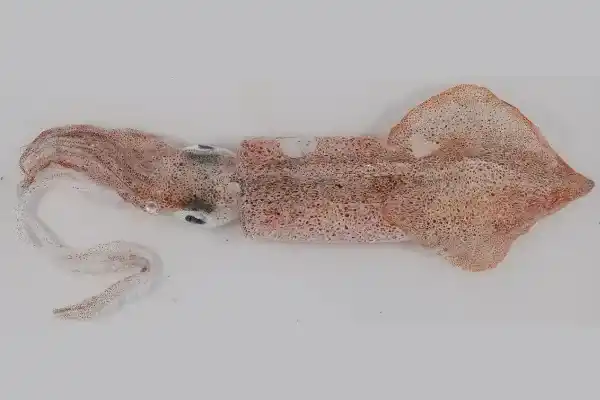
2) Sword squid/Sword-tailed squid ( Loligo edulis )
External features
Body type: Slender
Markings: The entire body is covered with reddish-brown and brown spots.
Fins: Rhomboid in shape; in adults, the fin area can cover approximately 70% of the length of the mantle.
Body length and distribution
It typically measures 15–25 cm in length, with a few individuals reaching up to 40 cm . The text indicates that it is mainly distributed in the waters of Southeast Asia .
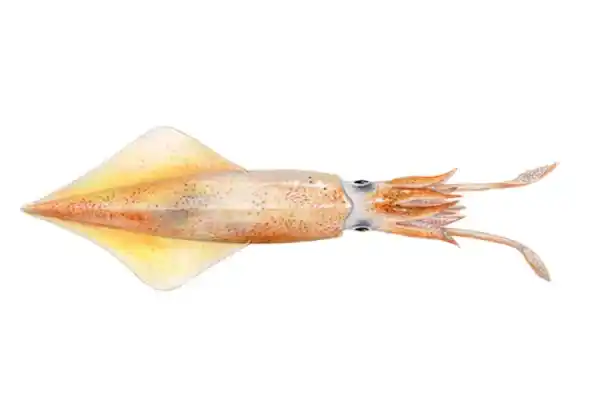
3) Common squid/European squid ( Loligo vulgaris )
Appearance and Habitat
Common squid have slender, cylindrical bodies that can be gray, reddish, or translucent. They are semi-benthic , mostly inhabiting sandy or muddy seabeds, but are not a deep-sea species.
Distribution range
The article mentions that it is widely distributed, including the Mediterranean Sea, the Adriatic Sea and parts of the Atlantic Ocean, and can also be found in the Irish Sea , the coast of England and Scotland, and extends to the Gulf of Guinea .
Relationship with humans
This is one of the squid species with a very high catch and trade volume. Its flesh is often considered a good source of protein, but it is also subject to pressure from recreational fishing.
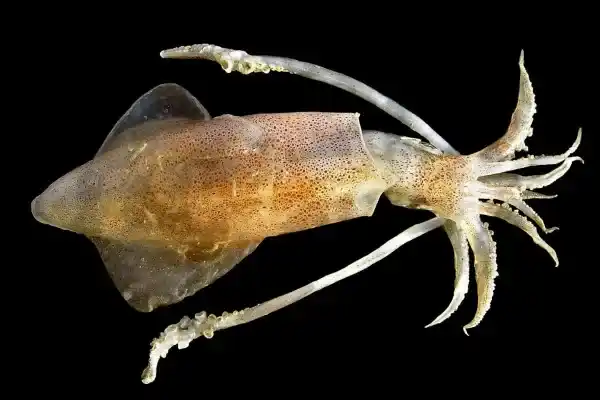
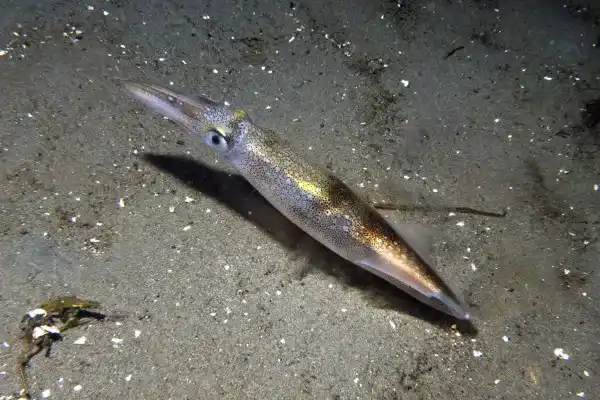
4) Monterey squid/California market squid ( Loligo opalescens )
Body shape and structure
Coat length: Approximately 19 cm
Fin shape: Two triangular fins extend from the end of the mantle to about the middle section.
Color change and "protein sheen"
Under normal conditions, it may appear golden, red, blue, or translucent. Because its skin contains pigment cells , its color can quickly change to a deeper red or dark brown when it eats, gets excited, or is startled. It also often exhibits a slightly milky, shimmering "opalescent" sheen, hence its English name "opalescens."
5) Giant squid ( Archiiteuthis dux )
Why did you become famous?
Giant squid are known for their enormous size and elusive nature. The text mentions that they are also called "Atlantic giant squid," primarily associated with the Atlantic Ocean, though there are occasional records of sightings in the Pacific .
Research difficulties
Giant squid mostly live in the deep sea and rarely approach the coast, so many behavioral details are difficult to observe and study systematically over a long period of time, which is one of the reasons why they are so "mysterious".

6) Indian squid ( Loligo duvauceli )
External features
The text describes the Indian squid as small in size but thick in body, with rhomboid fins that are longer and narrower in width, tapering to a point at the end of the body.
Distribution and Economic Value
The article states that its distribution is very "wide," citing examples such as India, California, Scotland, Morocco, and South Africa . Due to its whitish flesh, it is often considered a high-value catch by fishermen and enters the large-scale food industry supply chain. Fishing methods include hook and line fishing, longline fishing, and trawling.

7) Giant Squid ( Mesonychoteuthis hamiltoni )
Body size and weight
It is often considered one of the largest living squids . The article mentions that immature individuals studied can reach 12–15 meters in length (including tentacles), and speculates that adults may be even larger. Its body is thick and very robust.
Unique "suction cup + hook" structure
Unlike many squid, the text describes its tentacles as having not only suckers at the ends but also possibly hook-like structures for a more secure grip on prey.
Deep-sea adaptation
The text mentions that it may be a deep-sea predator, hunting smaller squid and other creatures. It is also often thought to have extremely large eyes, capable of detecting faint light and movement cues in dimly lit waters; furthermore, the text suggests that its eyes may possess bioluminescent structures, using bioluminescence to aid in locating prey.

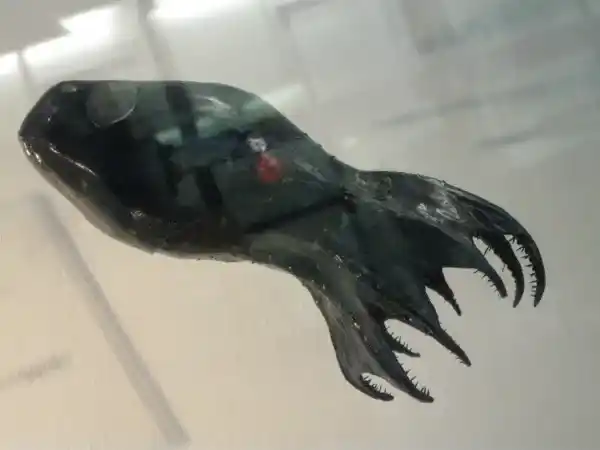
8) Vampyroteuthis infernalis
Why is it called a "fake squid"?
Although the vampire squid has "squid" in its name, the article emphasizes that it is not a squid in the typical sense, but rather belongs to a separate category , distinct from common squid and octopus. It is often included in "squid science popularization" mainly because popular searches and physical impressions easily categorize it as such.
feeding method
It is more inclined to scavenging/detritus : it collects organic debris floating in the seawater (similar to "ocean snow") and uses its very long appendages to capture these "floating foods," which is a very energy-efficient survival strategy in the deep sea environment.
9) Boston squid/Longfin nearshore squid ( Doryteuthis pealeii )
Shape identification points
Snout: Appears as a more elongated, "duckbill"-like protrusion.
Body color: Golden beige with light-colored spots and darker horizontal stripes.
Body length: The text describes it as reaching approximately 50 centimeters.
Distribution and Migration
The text mentions that it is distributed from Venezuela to Newfoundland and is migratory, moving to different sea areas to spawn. During the spawning season, it tends to move to deeper waters.

10) Japanese squid ( Loligo japonica )
Distribution and habitat depth
The text states that it is distributed in parts of the Northwest and Central Pacific Oceans , and can be found in the waters near Japan, Vietnam, and China . It is a pelagic species , typically active in shallow waters, with a maximum depth of about 30 meters .
body shape
It is a small squid, described in the text as being about 12 centimeters in length.
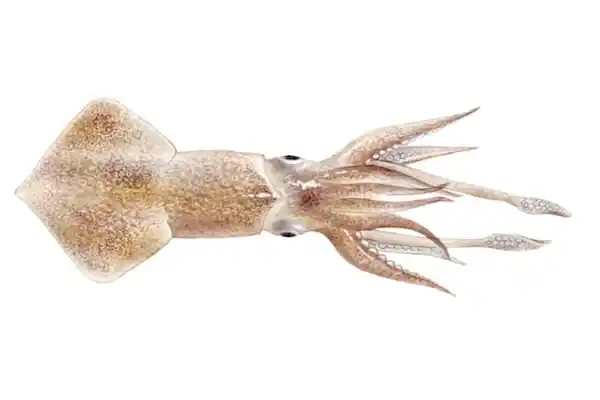
Quick Comparison: Small Nearshore Squid vs. Giant Deep-Sea Squid
Nearshore and commercial squid : They are smaller in size, more numerous, and renew quickly, often becoming the mainstay of the fishery and market (such as common squid and California market squid).
Giant deep-sea squid : extremely difficult to observe and with few research samples, but possessing extreme structures adapted to the deep sea (such as giant squid and giant cuttlefish).
Easily confused by names : Vampire squid is often mistaken for a real squid, but it has a more special classification and its feeding method is significantly different from that of common squid.