Rays (also commonly referred to as "rays," "stingrays," "devil ray," "manta rays," etc.) are a fascinating group of cartilaginous fish. Their bodies are flattened , often appearing triangular, rhomboid, or nearly circular when viewed from above, resembling a "flying" underwater blanket; their skeletons are primarily cartilaginous , rather than distinctly ossified like those of bony fish. Many rays are adept at gliding close to the seabed, burying themselves in the sand to ambush prey; others (such as manta rays and manta ray-like devil ray) prefer to cruise in open waters and even live in groups.
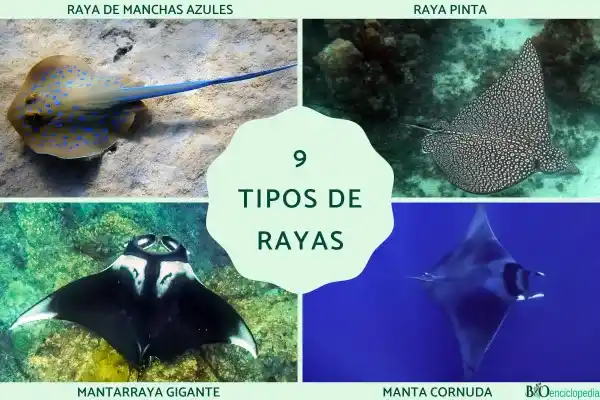
Below is a summary of nine common or representative types of rays , including their distinguishing features, size, distribution area, and living habits.
What is a ray? Why does it look like an "underwater flying carpet"?
Rays belong to the same group of cartilaginous fish as sharks. Their most distinctive features are their large pectoral fins that extend into "wings," their flattened bodies, and their eyes typically located on the top of their heads. Rays have their mouths and gill slits mostly on their ventral side, allowing them to feed close to the seabed. Many species possess venomous stingers in their tails (for defense), but not all rays use these stingers as primary weapons; some rays even have their stingers covered by skin, while others simply retain them as vestigial structures.
1) Cow Ray ( Pteromylaeus bovinus )
Appearance and body shape
Size: Up to 2.5 meters tall and weighing up to 100 kilograms
Dental row: There are multiple rows of teeth on each side of the upper and lower jaws (described in the text as 7 rows per jaw).
Body color: Beige to gray, with horizontal stripes visible on the upper surface.
Habitat and Distribution
Bull rays are commonly found on muddy seabeds at depths of approximately 10–150 meters . The text describes their distribution as including the Atlantic coast, waters near the Iberian Peninsula , and the coast of South Africa . They are named "bull rays" because of their large, thick heads; their snouts are long and slender, somewhat resembling a duck's bill.

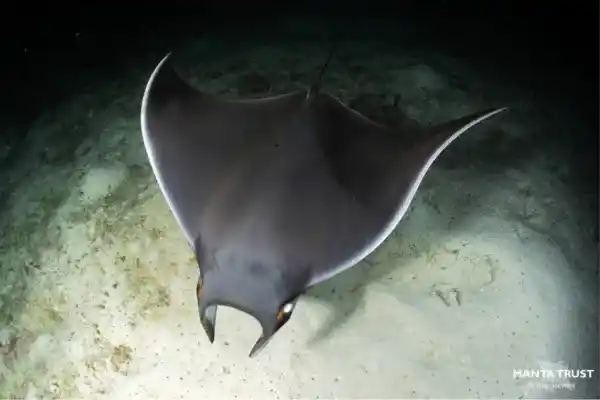
2) Mobula munkiana (Dwarf Manta Ray)
Common alternative names
It is also known as the "pygmy manta ray" or "Munk manta ray".
Appearance and body shape
Size: Body diameter slightly larger than 1 meter, weight up to approximately 25 kilograms
Body color: grayish-purple or grayish-brown on the back, with a darker "collar" band often present on the neck area.
Distribution and well-known behaviors
Most commonly found in tropical waters , including the Gulf of California , Baja California Southern California , Peru , and the Galapagos Islands and Malpero Island , as mentioned in the text. One of its most amazing features is its collective "dance" during the breeding season: large numbers of individuals form a vortex-like formation, creating a spectacular "underwater vortex show" that lasts for hours.
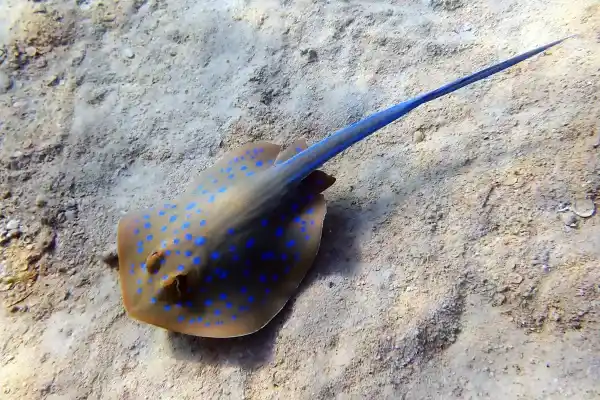
3) Blue Spotted Ray/Blue Striped Ray ( Taeniura lymma )
Key points for identification
Back markings: The back is covered with striking round blue spots in shades of gray, greenish-gray, or yellowish.
Body shape: more rounded than a sharp triangle
Tail: Long and slender, with venomous barbs that can be used to strike threats for defense.
Habitat
It is also often called a " reef ray " because it frequently inhabits coral reefs and their surrounding areas. Compared to many rays with relatively uniform colors, the blue-spotted ray's spotted pattern is very easy to identify.
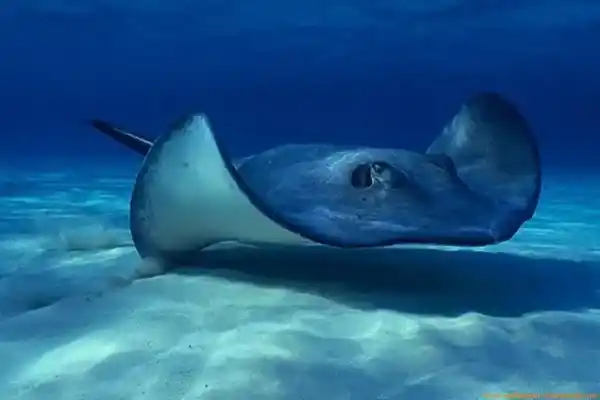
4) American whiptail ray/Southern stingray ( Hypanus americanus )
Distribution range
They are mainly distributed in the Gulf of Mexico , the Caribbean Sea , and parts of the South Atlantic Ocean.
Appearance and Lifestyle
Body disc: Rhomboid
Body color: Light brown on the back, whitish on the belly
Behavior: During the day, it often buries itself in the sand and goes out to forage at night.
Diet and Reproduction
It preys on larger marine invertebrates and also eats some bottom-dwelling fish (which often burrow into the sand to hide). The text mentions that it can produce 3–5 juveniles per litter, with a gestation period of about 6–9 months .
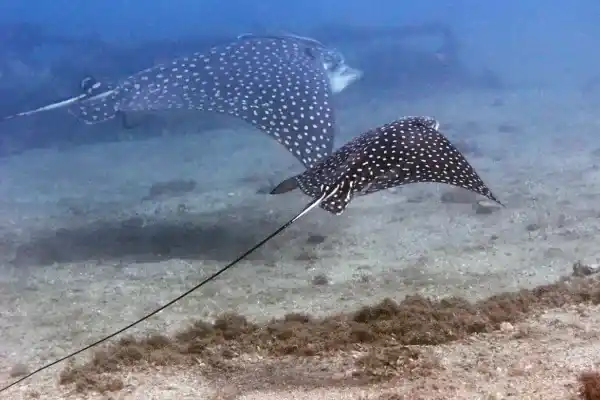
5) Spotted Eagle Ray / Spotted Ray ( Aetobatus narinari )
Key points for identification
Back: A deep blue to almost black "cloak"-like back with light-colored dots.
Tail: Extremely long, often 2–3 times the body length, with venomous barbs for defense.
Size: Can reach approximately 3 meters in height and weigh approximately 230 kilograms.
Distribution and lifespan
It is commonly found in shallow coastal waters, and the text describes its distribution as quite wide: including the vicinity of Venezuela and Ecuador , the Gulf of Mexico , and parts of the Indian Ocean , Oceania , and Southeast Asia . Its lifespan is often described as about 15 years in the wild and up to 20 years in captivity. Its whip-like tail is one of its most distinctive identifying features.
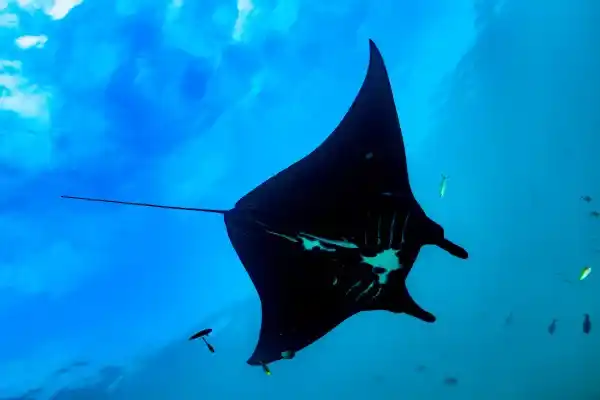
6) Giant manta ray/Pelagic manta ray ( Mobula birostris )
Body size and lifespan
Body disc width: On average, it can reach approximately 5.5 meters.
Weight: up to approximately 1.5–2 tons
Lifespan: Up to approximately 50 years (common description)
Behavioral Highlights
Giant manta rays are known for their " leaping out of the water " behavior: they burst out of the water and slap the surface, producing a very loud sound. Some believe this loud noise may be related to communication among themselves, as the sound of water slapping can travel long distances in open ocean.
Tail spine description
The article mentions that it has a thorn at the end of its tail, but it is usually covered by skin and is not used as an active defense mechanism, which is different from many stingrays with venomous thorns.
7) Common Eagle Ray ( Myliobatis aquila )
Appearance and body shape
Size: Body length nearly 2 meters, weight approximately 15 kilograms (common description)
Body color: Brown or dark gray on the back, whitish on the belly
Tail: Long and thin like a rat's tail, hence the common name "rat ray".
Distribution and characteristics
The text describes its habitat as parts of the Atlantic Ocean (including the area around Ireland and the British Isles ) and the Mediterranean Sea . In some regions, its flesh is also consumed as food. Its distinctive swimming motion, characterized by the flapping of its pectoral fins, is very similar to "birds flying underwater."

8) Butterfly Ray ( Gymnura altavela )
Why is it called "butterfly ray"?
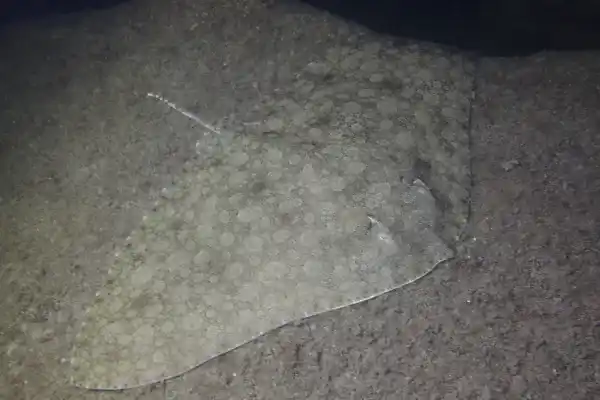
The butterfly ray has a broad disc, and its pectoral fins spread out like butterfly wings, giving it an elegant appearance. The text also mentions that it is also called the "paper ray" because when it lies flat on the sand, it resembles a patterned sheet of paper, providing excellent camouflage.
Diet and Threats
It feeds on plankton, fish, mollusks, and crustaceans. Because it often stays close to the seabed, it is easily caught as a bycatch in bottom trawls , and is therefore considered to face high survival pressure in some areas.
9) Horned Manta Ray ( Mobula tarapacana )
Key points for identification
The "horned" appearance: The two cephalic fins at the front of the head look like two horns.
Size: Approximately 2–2.5 meters tall, weighing up to approximately 400 kilograms.
Tail: Very short, almost appearing as if it has "no tail at all".
Lifespan: Approximately 15 years (described in the text)
Behavioral characteristics
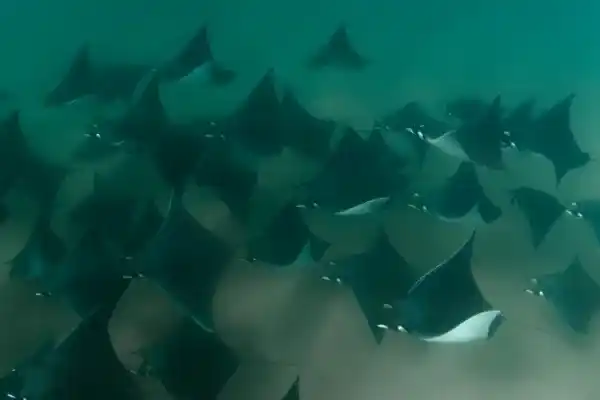
It belongs to one of the types of rays that can gather in large numbers under certain conditions, and may form obvious groups during periods of foraging, migration or reproduction.
Quickly distinguish between benthic stingrays and manta rays/devil ray
Skeletons that live close to the bottom : Their bodies are often rhomboid or nearly circular, and they like to bury themselves in the sand for camouflage, and prey on bottom-dwelling prey (such as American whiptail rays, butterfly rays, and some "stingrays").
Manta rays and devil rays (Mobula species) : They are better at swimming in open water, flapping their pectoral fins like they are flying, and often leap out of the water or exhibit group behavior (such as giant manta rays, manta rays, and horned manta rays).
Not all rays have tail stingers : many rays and eagle rays have venomous stingers, but some manta rays do not often use their tail stingers for defense.