Many people search for "jellyfish that don't sting," but from a biological perspective, this isn't entirely accurate. Almost all jellyfish possess special cells called cnidocytes , which contain nematocysts that release venomous substances for predation and defense. Therefore, strictly speaking, all jellyfish are capable of stinging .
However, in everyday language, "jellyfish that don't sting" usually refers to two situations:
They only sting when strongly stimulated or threatened ; they are unlikely to produce a noticeable reaction when exposed to other things.
It can indeed sting, but its toxicity to humans is very weak . Most people experience almost no sensation or only slight itching after contact, posing no danger.
Below are some types of jellyfish that are often considered "relatively harmless". They are not "without stinging cells", but are classified as "low-risk jellyfish" because their impact on humans is usually very minor.

Why do some jellyfish appear to "not sting"?
Low toxicity: The toxins are mainly targeted at small zooplankton or juvenile fish, and have little effect on humans.
The penetrating power of nematocysts is limited: some species of nematocysts are better suited for penetrating soft-bodied prey and have a weak triggering effect on human skin.
The defense trigger conditions are more stringent: the sting is only noticeable when the victim is squeezed, gripped, stepped on, or subjected to strong interference.
Brief contact: A short, light touch is often not enough to cause noticeable stinging.
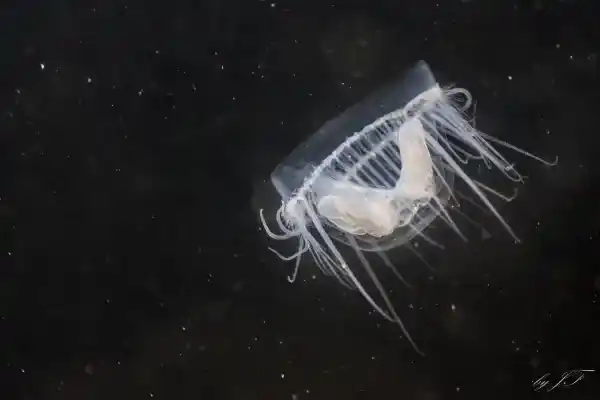
1) Aequorea forskalea (a multi-ribbed jellyfish)
Appearance and Highlights
The multiribbed jellyfish belongs to the hydromedusa group , and its most distinctive feature is its bioluminescence . When it glows, longitudinal lines appear on its bell-shaped body, resembling "ribs," hence its name. It is relatively flat overall, with its oral arms clearly visible.
Structural features
Number of tentacles: Commonly described as approximately 60–70 slender tentacles with radial channels.
Visible structures: Gonads are visible along the duct.
Body color: Primarily transparent with whitish edges; may also have a slight brownish tint, but is more commonly a deep blue tone.
Mouth location: Located in the triangular area below the umbrella body, its appearance is quite distinctive.
Habitat and Distribution
They mostly operate in the open sea, and the text mentions that they can be seen in the North Atlantic , the eastern and western Mediterranean , and parts of Central America .
Is it dangerous to people?
Its toxicity to humans is usually very low, so it is often considered to be basically harmless to humans .
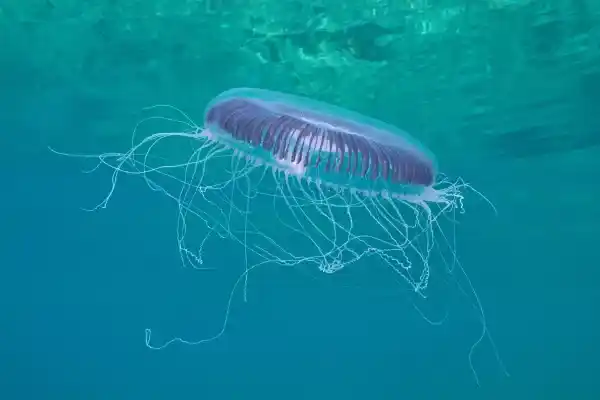
2) Freshwater jellyfish/peach blossom jellyfish ( Craspedacusta sowerbyi )
Why is it special?
Unlike most jellyfish that live in seawater, freshwater jellyfish live in freshwater environments . They are very small, with a bell diameter of only about 2.5 centimeters and tentacles so thin that they are almost invisible.
Main features
Number of tentacles: The text describes it as approximately 400–600.
Umbrella shape: Slightly flattened bell shape, transparent, with a hint of blue-green.
Two types of tentacles: long tentacles help with stable and graceful swimming; short tentacles are used to capture food (such as zooplankton).
Special structure: It has a "veil" (referred to as a "veil" in the text) and an opening that allows the mouthpiece to extend to the mouth.
Function of the mouth stalk: Connects the stomach under the umbrella to the mouth, and is responsible for transporting food into the digestive system.
distributed
The article mentions that it was originally endemic to East Asia , but now it is distributed worldwide and can be found in many freshwater bodies such as lakes and reservoirs.
Is it dangerous to people?
It does have stinging cells for predation, but they are usually not obviously harmful to humans, so it is often classified as a "non-toxic or low-toxicity jellyfish".
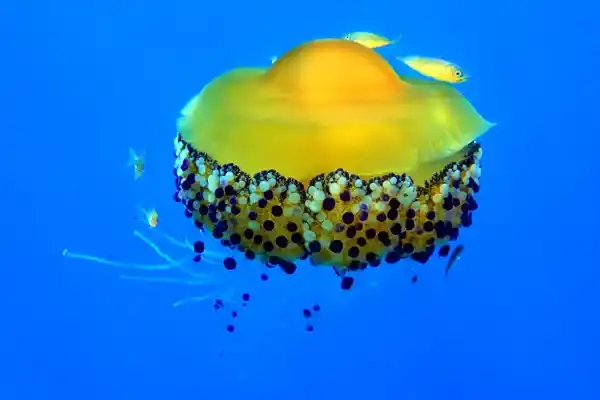
3) Fried Egg Jellyfish ( Cotylorhiza tuberculata )
origin of name
Viewed from above, its umbrella-like shape resembles a fried egg: the center is raised like the "yolk," and the outer edge resembles the "white." It mainly lives in the Mediterranean Sea.
Body size and clustering
Size: Medium-sized, approximately 15–30 cm
gregariousness: They like to appear in groups and can form large jellyfish swarms, moving in the sea like "the same clump".
Oral arms: The oral arms are relatively short, with visible purple, flat, disc-shaped structures at the ends (described in the text as "disc-shaped tentacles").
Symbiosis and the phenomenon of "sunbathing"
Its tissues contain a symbiotic algae called zooxanthellae . Therefore, in a typical symbiotic relationship, the jellyfish may rise to a place closer to the sea surface, allowing the symbiotic algae to obtain more sunlight, just like "replenishing its light energy through algae".
Is it dangerous to people?
During the peak summer tourist season, its abundance in certain sea areas can be "annoying" to tourists, but its toxicity is usually very low . It is mainly used to paralyze prey such as small fish and generally does not pose a threat to humans.
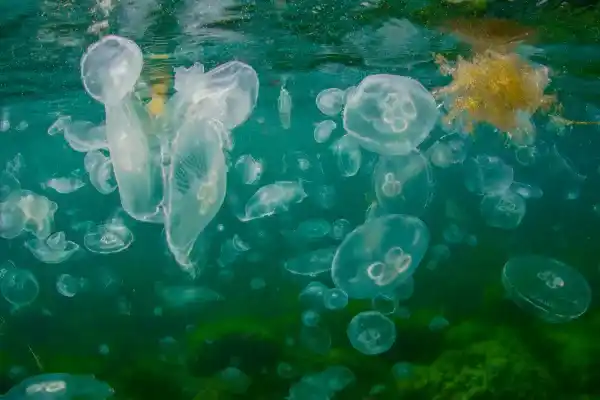
4) Moon jellyfish ( Aurelia aurita )
Jellyfish often considered the "most gentle"
If you're wondering "which is the most harmless jellyfish," the moon jellyfish is often one of the most frequently mentioned answers. It is generally non-toxic or has almost no effect on humans, and some people even keep it as an ornamental jellyfish in aquariums because it is relatively easy to care for (although the article also mentions that its lifespan may only be about 12 months).
Appearance and body shape
Shape: Flat, round, with an overall understated design.
Body color: Transparent with a faint blue tint
Size: Approximately 20–40 cm
distributed
The moon jellyfish is widely distributed, described in the article as one of the most "global" jellyfish, found in almost every sea area around the world, and often active in the near-surface layer.
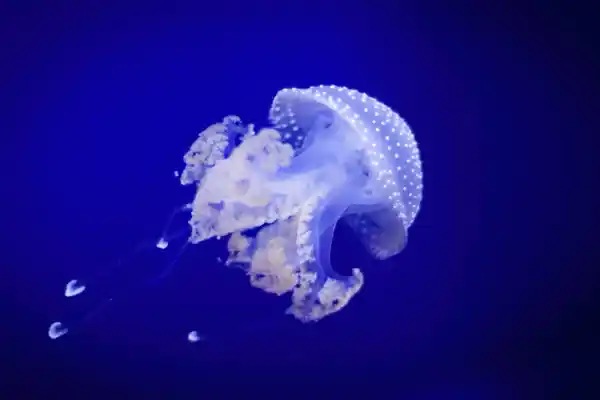
5) Australian spotted jellyfish ( Phyllorhiza punctata )
Distribution and Invasivity
The article mentions that it can be found from Australia to Japan and is often considered invasive : in warm, suitable waters, it reproduces quickly and its numbers increase significantly.
Shape recognition
Size: Approximately 40–50 cm
Body color: Semi-transparent with a whitish tint
Pattern: The umbrella body has regularly distributed dotted spots.
Salinity tolerance and symbiotic effects
It belongs to the euryhaline jellyfish family, meaning it can adapt to seawater environments with varying salinity without experiencing metabolic breakdown. However, the article also mentions that when rainfall causes a significant drop in salinity, it may be affected by the loss of zooxanthellae within its body, as these symbiotic organisms also help with its balance and energy.
Is it dangerous to people?
Its toxicity is usually described as very low and is generally not considered a threat to humans. Even contact may not always cause noticeable pain. The text mentions that if mild discomfort occurs, it can be treated with vinegar or saline solution (as an emergency measure when resources are limited).
The correct understanding of "jellyfish that don't sting".
Almost all jellyfish can sting , the difference lies in the strength of the sting and the extent of its impact on humans.
"Won't sting" is closer to "low risk" : most people experience no noticeable pain or only slight itching after contact.
People with sensitive constitutions should still be careful : those with sensitive skin or allergies may experience more pronounced reactions.
Do not touch them unintentionally : even low-toxicity jellyfish, tentacle fragments can cause irritation.