The Chinese serow (Capricornis milneedwardsii), also known as the mountain donkey, celestial horse, serow, or four-unlikes, is a beautiful wild mammal with a unique ecological position. They are distributed in the mountains of China and surrounding regions, attracting the attention of many ecologists and animal lovers with their striking appearance and agile movements. This article will explore this species in detail from multiple perspectives, helping readers gain a comprehensive understanding of the Chinese serow's biological characteristics, habitat, behavioral habits, and conservation status.
Scientific taxonomy of species
The Chinese serow (Capricornis milneedwardsii) belongs to the order Artiodactyla, family Bovidae, and subfamily Caprinae. It is related to species such as goats, antelopes, and snow leopards, and is a typical mountain-dwelling animal.
Scientific name and other names
Scientific name: Capricornis milneedwardsii
Common aliases: mountain donkey, pegasus, serow, four unlikes
History of Zoology
The evolutionary history of the Chinese serow can be traced back millions of years. They originated in the high mountain regions of Asia and adapted to a complex and ever-changing environment. Through generations of evolution, they gradually developed characteristics adapted to mountain life, such as agility and tenacious survival skills.
Species classification
Kingdom: Animalia
Phylum: Chordata
Class: Mammalia
Order: Artiodactyla
Family: Bovidae
Genus: Capricornis
Morphological characteristics and physical properties
physical characteristics
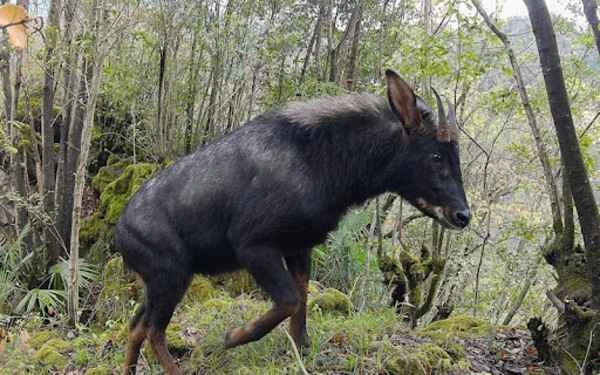
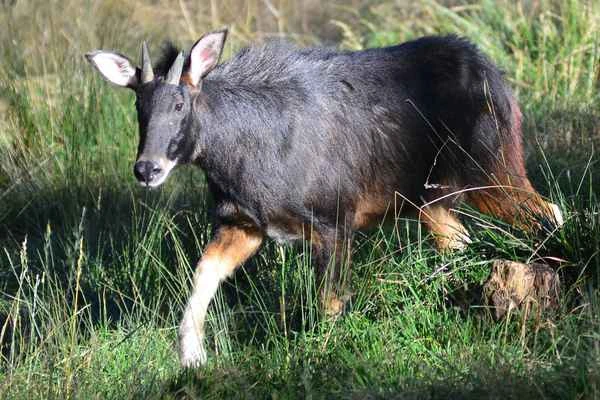
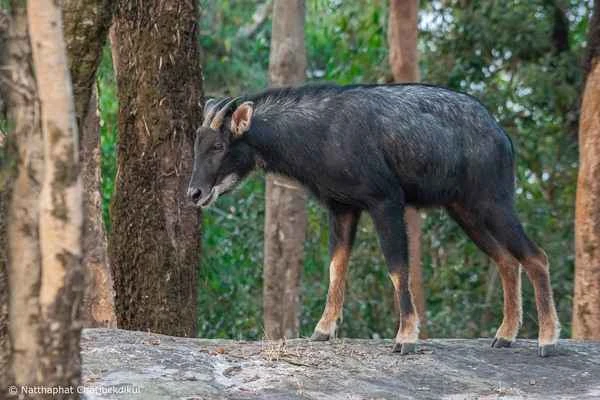
It has a tall stature, long legs, dark fur, and short, backward-curving horns. Long, bushy manes form a thick ridge extending down its back. It possesses prominent preorbital glands, a short, hairy tail, and a blackish-grey or reddish-grey body coat, particularly on the long mane and legs, with coarse, thin hair. Compared to the serow genus, its horns are longer and thicker, and its transverse ridges are larger. The Chinese serow is much larger than the serow but much smaller than the takin. The Sichuan subspecies has a black mane, while the South China subspecies has a grayish-white mane.
The Chinese serow is medium to large in size, with males typically being larger than females. They have large heads with prominent curved horns; the males' horns are thicker, reaching up to 50 centimeters in length. Their fur is generally gray to light brown, and the longer hair on their limbs helps them stay warm in the cold mountain environment.
Body length and weight
Body length: usually 120 to 150 centimeters
Shoulder height: Males are about 100 cm tall, females are slightly shorter.
Weight: Males weigh approximately 60 to 90 kilograms, while females weigh slightly less.
life
In the wild, the lifespan of the Chinese serow is generally 15 to 20 years, but when domesticated, their lifespan may be even longer.
Global distribution and habitat
Global distribution
The Chinese serow is mainly distributed in Assam, Myanmar, Thailand, Indonesia, the Malay Peninsula, and Sumatra. It is also found in Shaanxi, Gansu, Sichuan, Yunnan, Hubei, Hunan, Zhejiang, Fujian, Guangdong, and Guangxi provinces of China. It inhabits enclosed habitats such as rocky forests and thickets, and in the wild, it lives in dense subtropical forests and rocky areas. It is active at dawn and dusk, and mostly solitary. It is solitary and does not socialize, but is adept at leaping among treacherous rocks. Their habitat is typically located in high-altitude forests or rocky mountains at elevations of 1500 to 3500 meters.
Habitat
They prefer to inhabit cliffs or dense forests, and like to hide in areas with lush vegetation, using these natural barriers to avoid attacks from predators or hunters.
Ecology and Behavior
Daily activities and social behavior
The Chinese serow is a diurnal animal, typically foraging at dawn and dusk. It feeds on the tender leaves and branches of various shrubs and weeds . They are social animals, usually forming small family groups with a clear social structure, where males often assume a leadership role.
Foraging strategies
They feed on grasses, shrub leaves, and moss from high mountains, adapting to the barren food conditions of the highlands. In winter, they also eat the tender shoots of some evergreen plants to maintain their strength.
Migration patterns
The Chinese serow does not undertake large-scale migrations, but it adjusts the altitude of its habitat according to seasonal changes. Especially in winter, it may choose lower valleys to escape the cold.
Reproduction and raising young
The breeding season for the Chinese serow typically occurs in the autumn, with multiple seasonal mating periods. Males and females engage in fierce struggles for mating rights. The gestation period for females is approximately 7 to 8 months, lasting 220–226 days. They usually give birth to one calf per litter. The calf remains attached to its mother after birth until it is about 6 months old and can then become independent.
Current status and protection level
Preserve the status quo
The Chinese serow is classified as a vulnerable species (VU), with its main threats stemming from habitat loss, illegal hunting, and conflict with human activities. Because its habitat is largely located in remote mountainous areas, conservation efforts are currently relatively challenging.
The Chinese serow is gradually becoming endangered due to habitat destruction and frequent overhunting. It is listed as a Class II protected wild animal in China's National Key Protected Wild Animals List. It is also listed as Vulnerable (VU) on the IUCN Red List of Threatened Species and in Appendix III of the Convention on International Trade in Endangered Species of Wild Fauna and Flora (CITES).
Protective measures
The Chinese government and several conservation organizations are taking measures to protect the Chinese serow, including strengthening habitat protection, combating poaching, and conducting public education campaigns. Meanwhile, nature reserves have been established in some habitats to safeguard the species' survival.
Population status and major threats
Population status
According to the latest field survey data, the population of the Chinese serow has declined, and the existing populations are mostly scattered and isolated groups. Nevertheless, the population recovery is relatively good in some areas, especially in some well-protected nature reserves.
Main threats
Habitat destruction: With the expansion of human activities, mountain development, agricultural expansion and deforestation have continuously encroached on the habitat of the Chinese serow.
Illegal hunting: Although the Chinese serow is not directly considered commercial prey, it remains a target for local residents and illegal hunters.
Climate change: Environmental changes caused by climate change may affect their food resources and habitats.
Ecological value
The Chinese serow is an important component of alpine ecosystems, playing an indispensable role in maintaining plant diversity, regulating vegetation structure, and providing food chains for predators. As herbivores, they maintain a natural balance among different plant populations.
Related cultural and economic value
In some regions of China, the Chinese serow is regarded as a symbol of the mountains, representing nature and power. They hold a certain sacredness and symbolic significance in local cultures. In addition, the Chinese serow attracts a large number of ecotourists, becoming one of the highlights of ecotourism.
Economic value
Although the Chinese serow does not have direct economic value, its potential in ecotourism and wildlife conservation should not be underestimated. With increasing awareness of ecological protection, they are gradually becoming an important natural resource.
Close relatives
| Species name | scientific name | Main distribution area | Features |
|---|---|---|---|
| Himalayan serow | Capricornis sumatraensis | Himalayan region | Living at high altitudes and adapted to cold climates |
| Alpine serow | Capricornis ibex | Alps | They inhabit high-altitude rocks and have long, hard horns. |
| Black serow | Capricornis blacki | Southeast Asia | They are small in size and inhabit tropical forest environments. |
Conclusion
The Chinese serow, a high-altitude species with a long evolutionary history, carries rich natural heritage and ecological value. Through effective conservation measures and the support of scientific research, we hope to further protect this precious species in the future, ensuring their continued survival and prosperity on Earth. We hope more people will pay attention to and participate in this conservation effort, working together to protect this natural wonder of the mountains.