Crickets are common insects belonging to the class Insecta, order Orthoptera, and family Gryllidae, known for their melodious chirping at night. They are widely distributed globally, adapted to diverse environments, and play an important role in ecosystems. This article will provide a detailed introduction to the morphological characteristics, physiological features, habits, and ecological environment of crickets, helping you to gain a deeper understanding of this fascinating insect.
1. Main characteristics of crickets
(1) Body structure
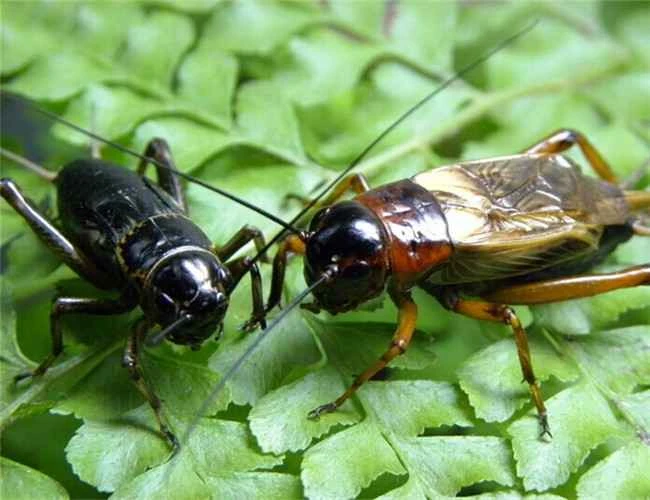
A cricket's body consists of three parts: head, thorax, and abdomen. It is elongated and generally ranges in length from 1 to 5 centimeters . Different species of crickets vary in color and size, but generally share the following characteristics:
Head : Large, with a pair of compound eyes (to help perceive light) and long, flexible antennae (for detecting the environment).
Mouthparts : It belongs to the chewing mouthparts and is able to chew plants, insects and organic debris.
Forewings : Some species of male crickets have hard forewings (wings with friction organs) used to produce chirping sounds.
Hindwings : The hindwings are relatively thin, and some crickets can fly short distances , but they usually rely more on jumping to move.
Hind legs : The hind legs are muscular and adept at jumping , capable of leaping several times their own length in a single bound.
Abdomen : At the end of the female cricket's abdomen is an ovipositor used to lay eggs in the soil.
(2) Singing and hearing
Stridulation : The chirping of crickets is mainly produced by male individuals and is an important behavior for attracting females, driving away competitors, and asserting territory .
They produce a chirping sound by rubbing their special friction structures (serrated wing veins) together on their forewings.
Different species of crickets have different chirping frequencies, and some studies have shown that the chirping frequency of crickets is related to the temperature.
Hearing (Tympanal organ) : The cricket's auditory organ is located on the tibia of its forelegs , and it can perceive the chirping of other crickets.
2. The living environment of crickets
Crickets are highly adaptable and can survive in a variety of ecological environments , including grasslands, farmlands, forests, deserts, humid areas, and indoor environments . The following are the main habitats of crickets:
(1) Grasslands and farmland
Suitable environments : grasslands, fields, and farmland edges.
Food sources : crops, weed leaves, insect remains, organic debris.
Ecological role :
Some species (such as the Chinese cricket ) are considered pests by farmers because they eat the leaves and roots of crops.
However, they are also an important part of the food chain, providing food for birds, amphibians, and reptiles.
(2) Forests and shrublands
Habitat : Forest ground layer, leaf litter, under decaying wood.
Food : Dead leaves, fungi, small insects.
Adaptive characteristics :
Some crickets prefer damp environments and hide in shady tree roots and rock crevices.
They use burrows in the soil and crevices in tree bark as hiding places to avoid being preyed upon.
(3) Desert and arid regions
Survival challenges : scarce water resources and large temperature differences between day and night.
Adaptation strategies :
Some crickets can survive in extremely dry environments, such as the desert cricket (Schistocerca gregaria).
Reduce water loss through nighttime activities and absorb moisture through tiny pores on the skin's surface.
(4) Caves and underground environments
Representative species : Cave Crickets .
feature :
These crickets are adapted to dark environments, typically having small or degenerate eyes, and longer antennae and legs to sense their surroundings.
They mainly feed on fallen leaves, fungi, or small insects.
(5) Urban and Indoor Environment
Why do crickets enter indoor spaces?
Foraging: Indoor food scraps, breadcrumbs, and mold in damp corners may attract crickets.
Overwintering: Some crickets (such as the house cricket (Acheta domesticus) ) will enter warm buildings to avoid the cold during the winter.
Common cricket species
House crickets : Widely distributed worldwide, they are often found in corners of houses, kitchens, warehouses, and other similar locations.
Field crickets typically inhabit gardens, under eaves, or in underground burrows.
3. The diet of crickets
Crickets are omnivorous insects with a wide variety of food sources:
Plant-based foods : leaves, flowers, seeds, buds, fruits, etc.
Animal food : insect carcasses, small invertebrates (such as aphids and ants).
Saprophytic food : decaying plants and animals, fungi.
Human food scraps : Crickets living in cities sometimes eat bread crumbs, vegetable scraps, etc.
4. Ecological Roles of Crickets
(1) Key role in the food chain
Predators : Crickets are an important food source for birds, frogs, spiders, mantises, lizards, and some mammals such as hedgehogs.
Decomposers : Crickets eat decaying plants and animal carcasses, playing a role in decomposing organic matter in the ecosystem.
(2) Agricultural impact
Positive impact :
As part of the food chain, crickets help control the populations of other pests.
Negative impact :
Some crickets feed on crops, which may damage agricultural production.
5. The relationship between crickets and humans
(1) Cultural symbol
In Chinese culture , crickets are often regarded as a symbol of good fortune and luck because of their melodious chirping.
Cricket fighting : In ancient China, cricket fighting was a popular form of entertainment, especially during the Ming and Qing dynasties.
(2) Scientific research
Cricket chirping is closely related to temperature changes , so scientists use the frequency of cricket chirping to estimate ambient temperature (Dolbear's Law).
Crickets are used in research on insect biomechanics, nervous systems, and other fields.
(3) Pets and food
Some crickets are kept as pets or as feed for birds and reptiles , such as the domestic cricket (Acheta domesticus).
in conclusion
Crickets are highly adaptable insects, found in a wide variety of environments worldwide. They not only play an important role in ecosystems but also hold special significance in human culture and scientific research. Their distinctive chirping can be heard in farmlands, forests, and even at home.