Grasshoppers, scientifically known as *Acrididae* , are common insects widely distributed throughout the world. They are renowned for their powerful jumping ability, herbivorous diet, and adaptability . Grasshoppers are not only an important component of ecosystems but also a significant subject of human culture, agriculture, and scientific research. This article will detail the morphological characteristics, habits, habitats, and roles of grasshoppers in ecosystems .
1. Main characteristics of grasshoppers
(1) Body structure
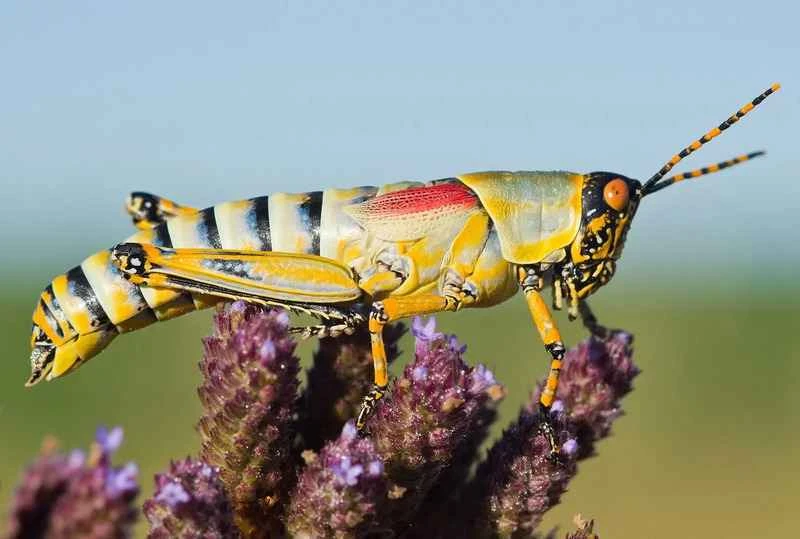
The grasshopper's body is divided into three parts: head, thorax, and abdomen , exhibiting typical characteristics of Orthoptera insects.
head
They have large, protruding compound eyes , which provide a wide field of vision, helping grasshoppers spot predators and find food.
Short, hard antennae are used to sense the environment.
Chewing mouthparts , suitable for crushing plant-based foods such as leaves and grass stems.
Chest
Its hind legs are particularly well-developed, making them suitable for efficient jumping , sometimes allowing it to jump dozens of times its own length .
The muscles in the hind legs are elastic, allowing them to store energy before jumping in order to quickly escape predators.
Forewings (leathery wings) : Hard protective wings that normally cover the hindwings.
Hindwings (membranous wings) : unfolded during flight for short-distance gliding.
Strong hind legs :
abdomen
The abdomen is relatively long and contains the digestive and reproductive systems.
Female grasshoppers have an ovipositor at the end of their abdomen , which they use to dig in the soil and lay their eggs.
(2) Color and camouflage
Grasshoppers' body color varies depending on the species, with common colors including green, brown, yellow, or mottled patterns , which help them camouflage themselves in grass and avoid being spotted by predators.
Some grasshoppers, such as the African desert locust , change color in different environments, from green to yellowish-brown or red.
(3) Wings and flight ability
Most grasshoppers can fly , but their flying ability is weak; they usually glide a short distance after jumping.
Some species (such as locusts) have a strong migratory ability and can migrate on a large scale when food is scarce, causing locust plagues.
(4) Perception ability
The auditory organ (tympanic membrane organ) is located in the first abdominal segment and can perceive the calls of its own kind or the sounds of enemies.
With keen eyesight , their compound eyes can quickly detect moving objects, preventing them from being preyed upon by predators.
2. The living habits of grasshoppers
(1) Diet
Grasshoppers are typical herbivorous insects , mainly feeding on herbs, grains, and leaves , and especially fond of:
Grasses (such as wheat, rice, corn, and sorghum).
Wild grasses (such as foxtail grass, reeds, and dandelions).
Some vegetables (such as cabbage and lettuce).
They sometimes consume flowers or fruits , but do not eat rotten organic matter.
(2) Reproduction
Oviparous insects , female grasshoppers bury their eggs in the soil or humus using their ovipositors, laying dozens to hundreds of eggs at a time.
Eggs hatch into nymphs at suitable temperatures , and the nymphs develop into adults after 3-5 molts .
The peak breeding season is usually in summer and autumn , when their numbers increase rapidly in warm and humid environments.
(3) Activity Mode
Diurnal insects , which mainly forage, jump, and fly during the day .
Temperature affects activities :
They are most active when it is warm, and their activity decreases when the temperature is low.
They usually rest on plant stems and leaves at night.
(4) Chirping behavior
Some male grasshoppers can chirp , making sounds by rubbing their wings together with their hind legs or by rubbing their wings together, mainly to attract females or drive away competitors .
3. The living environment of grasshoppers
Grasshoppers are highly adaptable and can survive in different ecological environments , mainly distributed in the following types of environments:
(1) Grasslands and farmland (most common)
Typical examples : Chinese grasshopper (Acrida cinerea) and East Asian migratory locust (Locusta migratoria manilensis).
Adaptive characteristics :
They rely on tall grass to conceal themselves and reduce the risk of being preyed upon.
They can reproduce rapidly, and their numbers explode in an environment with abundant food.
It is an agricultural pest that often causes damage to crops.
(2) Forest edges and shrublands
Some species live in the bushes and low grasses at the edge of the forest , such as the spotted grasshopper (Oedaleus decorus).
These environments provide grasshoppers with ample food and shelter.
(3) Wetlands and marshes
Grasshoppers in grassy areas near water are well adapted to moist environments, such as the aquatic grasshopper (Stethophyma grossum).
They rely on aquatic plants and moist soil as their habitat.
(4) Desert and arid regions
Representative species : Desert locust (Schistocerca gregaria), a major insect causing locust plagues.
These grasshoppers have strong heat and drought resistance and can fly long distances in search of food.
(5) Cities and suburbs
Grasshoppers can also be found in urban green belts, parks, flower beds, and other places.
In this environment, grasshoppers mainly rely on lawn plants and wild grasses to survive.
4. The ecological role of grasshoppers
(1) Role in the ecosystem
As herbivores , grasshoppers control plant growth and influence vegetation structure.
It is an important food source for predators such as birds, frogs, lizards, and spiders.
Laying eggs in the soil helps with the soil's ecological cycle.
(2) Agricultural pests
Under certain conditions, some grasshopper populations can multiply rapidly, causing locust plagues and severely damaging crops.
For example, desert locust plagues in Africa can destroy large areas of farmland, leading to food shortages.
(3) Cultural and economic value
In ancient China, grasshoppers were used in insect fighting , similar to cricket fighting.
In some areas, grasshoppers are eaten (such as fried grasshoppers), as they are rich in protein.
In scientific research, grasshoppers are used to study insect biomechanics, jumping movements, and group behavior .
5. Conclusion
Grasshoppers are highly adaptable herbivorous insects , widely distributed in various ecological environments. Their jumping ability, flight ability, reproductive capacity, and herbivorous behavior make them an important part of the ecosystem. Although grasshoppers pose a threat to agriculture in some cases, they also play an important role in maintaining ecological balance and in scientific research.