From ordinary seashells washed ashore to some of the world's rarest shells, these wonders of nature are captivating with their intricate designs, diverse beauty, and the stories they tell from the depths of the ocean.
Bone snail shell
The Venus pecten has excellent spines.
The bony snail (Muricidae) is a large carnivorous sea snail, often called a bony snail or rock snail. They are known for their various wonderful decorations and carvings.
Many species of bony snails are brightly colored, but most are soft pastel colors, and their beauty is renowned for their intricate shapes and magnificent spines.
The outstanding species is the comb-shaped snail (Murex pecten).
This absolutely stunning shell is named after the Greek goddess Venus, who is said to have used this bony snail shell to comb her hair.
They typically inhabit tropical waters of the Indo-Pacific region. While not one of the rarest shells in the world, perfect specimens of the Venus vallis are extremely difficult to find due to their incredibly fragile structure.
Their long, complex external siphons are covered with hundreds of tiny spines. These spines help the snails protect themselves from predators and prevent them from sinking into sand and mud.
scientific name | Muricidae |
category | Gastropods |
Types of skeletal snail shells | Venus comb snail, Miyoko snail, pink-throated snail, branch snail, chicory snail |
Conch shell
The giant whelk, *Strombus gigas*, grows in the tropical waters of the West Indies, the Caribbean Sea, Florida, and the Bahamas.
It is estimated that there are only 50,000 snails left in the world.
Most conch shells typically have a high, curled tip, which is the point of twist at the end of the shell. They also have a very prominent siphon.
Sea snails lay hundreds of thousands of eggs when they reproduce, but unfortunately, only a small fraction of them actually develop into adult snails.
Representative species
Giant conch (Strombus gigas)
The giant whelk has long been considered one of the most beautiful seashells. Reaching up to 10 inches (25 cm) in length, it is one of the largest living seashell species.
Due to their large size and beautiful appearance, this particular species of shellfish is now threatened because their meat is overfished and they are popular among shell collectors.
Early civilizations discovered interesting uses for the conch shell, such as using it as a horn in religious ceremonies and as an ornament. Over the centuries, its glossy pink shell has also been crafted into jewelry, such as shell bracelets, shell earrings, and hair clips.
scientific name | Cypraeidae |
category | Gastropods |
Types of conch shells | More than 60 varieties, including: true conch, eagle wing conch, strawberry conch, Lister conch. |
Baby Shell
The rare " Cypraea argus " shell is a favorite among shell collectors.
For centuries, baby shells have been used as jewelry and currency. In many African cultures, you will find women wearing jewelry made from various types of baby shells, which are seen as symbols of femininity, fertility, birth, and wealth.
The shells themselves are almost always very smooth and shiny, oval in shape, and open like slits. All varieties have a porcelain-like luster, and many have colorful patterns.
The outstanding species, Cypraea argus.
The Hundred-Eyed Baby Shell is one of the rarest seashells in the world.
If you are lucky enough to witness this unusual marine treasure feeding while diving or snorkeling in shallow coral reefs, you will be extremely fortunate. They often hide under loose rocks along the coasts of remote tropical islands such as Chagos, Madagascar, Reunion Island, and the Seychelles.
The shells of the Hundred-Eyed Baby Shell are quite easy to identify. These beautiful shells are cream-colored with tiny brown circles on the surface that resemble eyes—hence their name. Their unique dotted pattern and perfect porcelain-like finish make these rare baby shells very easy to spot.
scientific name | Architectonicidae |
class | Gastropods |
Types of baby shells | More than 270 varieties, including: Hundred-Eyed Baby, Golden Baby, Isabel Baby, Maroon Baby, Dirty Baby, Tiger Stripe Baby |
sundial shell
The Architectonica perspectiva , a sundial shell, is now an endangered species.
The Architectonicidae, also known as the stilt house shell or sundial shell , is widely distributed in temperate to tropical waters worldwide. They inhabit shallow sandy areas, are usually nocturnal, and are rarely seen on land.
They are a gorgeous and colorful species, and quite unique, with distinctly flat, disc-shaped or conical shells.
Architectonica perspectiva: A remarkable species that allows for the observation of a sundial shell.
Architectonica perspectiva , commonly known as a transparent or see-through sundial shell. Its name comes from a sundial, an instrument that measures time by detecting the position of the sun.
The conical shells spiral upwards from their flat base. Their spirals are composed of vibrant black, white, and brown.
They were once common in most of their distribution areas, but are now less common due to uncontrolled shell collecting and habitat destruction by development and other activities such as explosive fishing and dredging. The see-through sundial shell is now listed as an “endangered” species.
scientific name | Volutidae |
class | Gastropods |
Types of sundial shells | More than 140 species, including: Architectonica karsteni, variegated sundial snail, and partridge sundial snail. |
Snail shell
The "Aulica imperialis" scroll is sought after by collectors for its impressive appearance.
Most snail species have thick shells, but they vary greatly in size and appearance. Their shells are usually brightly colored, with a narrow opening on the first whorl, and all species have deep folds on the inner lip.
Snails typically live in warm, shallow waters, but they can also be found in temperate waters, and they are most common in Australian waters. Most snails burrow in the sand and are carnivorous.
The outstanding species, the imperial vortex (Aulica imperialis)
The Imperial Whirl Shell is typically milky white with brown cave paintings on its surface, but more notably, its majestic appearance comes from its crown-like spikes.
Distributed in the southern Philippines, they typically inhabit shallow, sandy waters. King snails can grow up to 10 inches (25 cm) long.
scientific name | Pan Ke |
class | Gastropods |
volute type | More than 200 varieties include: Emperor melon, noble rot melon, Philippine melon, and Indian melon. |
abalone shell
The abalone shell “ Haliotis iris ” is known for its bright turquoise color.
Most abalone live in cold water and are known for their beautiful rainbow-colored shells.
Although it may not look particularly special, the innermost layer of abalone is made of a special type of calcium carbonate called nacre or mother-of-pearl, which has been widely used in jewelry and other decorative arts in the past.
Different types of abalone have different colors, but their interiors are often shiny, ranging in color from silvery-white to turquoise, green, blue, and red mother-of-pearl.
Abalone shells are also known for their exceptional sturdiness. They are composed of very small calcium carbonate blocks stacked together like bricks. They vary in size, ranging from one inch to one foot, are round, and have two to three spirals. The inner spiral grows into a large "ear" shape, which explains their other common name, "ear shell."
In the early 20th century, abalone were abundant and once supported a huge commercial and recreational fishing industry. Due to overfishing and disease, abalone are now endangered – both white and black abalone are listed as endangered species under the Endangered Species Act.
Outstanding species: Pāua abalone shell (Haliotis iris)
The rainbow abalone (Haliotis iris) , also known as pāua, black-footed pāua, or rainbow abalone, is a species found almost exclusively in New Zealand, but it has also been found as far north as the Philippines.
Bawa abalone shells are prized for their inner surface, which is a vibrant metallic blue and green with a yellow sheen. This is the most common abalone variety in New Zealand, reaching lengths of up to 7 inches (18 cm).
scientific name | Haliotis |
class | Gastropods |
Types of abalone shells | More than 50 varieties, including: Pāua abalone, sheep's ear abalone, mule's ear abalone, green abalone, and pink abalone. |
Miter joint shell
The papal tiara “ Mitra stictica ” can be up to 3 inches (8 cm) long.
The crown oyster is most common in the tropical Indo-Pacific region. It is named for its resemblance to a bishop's tiara (bishop's crown). Its thick shell is usually bullet-shaped, with five to eight whorls and a high, pointed apex.
The crowns of the Indo-Pacific are typically brightly colored, while those of the Eastern Pacific are lighter in color. Many crowns are smooth, while others are decorated with spiral ribs. All crowns have narrow apertures, short siphons, and the outer lip of the crown may be serrated, smooth, or wavy.
The Species of the Pope (Mitra stictica)
Mitra stictica , commonly known as Pope Mitra or sungkod-sungkod, is a species found in the tropical Indian Ocean near Aldabra, Chagos, Mascarene Basin, Mauritius, and Tanzania, as well as in the Pacific Ocean near Fiji, New Zealand, and the Solomon Islands.
This species is quite similar to mitra papalis , but it is shorter, has more distant sutures, and narrower nodules.
scientific name | Mitridae |
class | Gastropods |
Types of miter shells | 500 types, including: papal and bishop's crowns, bishop's crowns, and queen's crowns. |
cone snail shell
The taro snail " Conus gloriamaris " is the only known species of molluskaloid to have been stolen from a museum.
Cone snails are a large, highly venomous carnivorous sea snail species, ranging in size from small to large. Their venom is a mixture of hundreds of different toxins, released through their retractable snouts and forked teeth. This species can be fatal; never touch them.
The geographical cone snail, * Conus geographus*, is the most venomous of the more than 600 known cone snail species, and has caused numerous human deaths.
Conical shells are named for their conical or cylindrical outer shell. They come in a wide variety of colors and patterns. All conical shells have a pointed apex, and their colors range from dull to very glossy, from smooth to striped and bumpy.
Outstanding species: Alocasia (Conus gloriamaris)
Conus gloriamaris , also known as the "cone of the sea," is one of the most expensive and rarest seashells in the world.
The splendor of the sea cone was once considered one of the rarest seashells in the world. For much of the 19th and 20th centuries, fewer than one hundred sea cone specimens were known, making it one of the most valuable seashells in the world. Since then, hundreds more specimens have been collected, and the value of the sea cone has significantly decreased.
This exquisite shell, native to the Indo-Pacific region, can reach lengths of up to 6.3 inches (16 cm). It is characterized by its incredibly conical shape and intricate cross-patterned markings (creamy brown in color). Its elegant qualities make this beautiful shell highly sought after by collectors.
scientific name | Conidae |
class | Gastropods |
Types of cone snail shells | More than 600 species, including: striped cone shell, common cone shell, letter cone shell, marble cone shell. |
worm and snail shell
The fargo worm snail "Vermicularia fargoi olsson" has three spiral ribs on each shell whorl.
The shells of earthworms, commonly known as "insect snails" or "insect shells," are extremely irregular and differ from those of ordinary snails.
These shells differ from the typical coiled shells common in gastropods. They have slender, tubular shells that can attach to hard substrates such as rocks, sponges, or other shells.
The outstanding species, the fargo snail (Vermicularia fargoi olsson).
The Fargo worm snail's shell is regularly curled up at the beginning of its life, until it is about an inch long. From then on, the shell begins to unfold, forming its typical irregular shape. The shell "tube" is about 3/8 inch (1 cm) in diameter.
These shells can reach a maximum length of 3 inches (8 cm). The first six whorls of the shell are usually coiled regularly, while the subsequent whorls gradually detach from the shell.
scientific name | Vermetidae |
class | Gastropods |
Types of snail shells | 135 species, including: fargo worm snail, scaly worm snail, jellyfish worm. |
olive shell
The olive with the letter "Oliva sayana" engraved on it is the largest olive shell.
Olive shells ( Olividae) are easy to identify. Their shells are smooth, shiny, and slender oval in shape, just like olives, hence the name.
They range in length from very small to 3 inches (7.5 cm). Many types of olive shells typically come in a variety of soft but charming colors and may also have patterns. They usually have a short pointed top, a narrow opening with a groove at the front, a large foot, and a mantle that covers the shell.
This species sometimes resembles the highly venomous cone snail in shape and appearance, but is harmless to fish or humans.
The orange-billed olive parrot, “Oliva miniacea”, is listed as “vulnerable” on Singapore’s Red List of Threatened Species.
The prominent species is the olive tree (Oliva sayana).
Inscribed olive shells are the largest of the olives, reaching up to 3.5 inches (9 cm) in length. Their common name comes from the intricate hieroglyphic markings on their shells.
Their colors range from light grayish-brown to dark chocolate brown, with marbled patterns of deep purple, yellow, dark blue, and pale purple. Empty shells are usually washed ashore.
scientific name | Olividae |
class | Gastropods |
Types of olive shells | More than 350 varieties, including: Alphabet olive, Purple olive, Raised leaf olive, and Netted olive. |
Scallop shell
The giant scallop , *Pecten maximus* , is a robust species found in the Northeast Atlantic.
Scallop shells ( Pseudococcus ) are perhaps the most representative of all shells. Many species of scallops are highly regarded food sources, and the pearls they produce can be used to make jewelry.
Scallop shells are similar to those of oysters and clams. The main difference between scallops and other common bivalves is that they can swim. Scallop pearls also differ from oyster pearls because they lack the typical iridescent luster.
Scallop pearls are extremely rare and are a byproduct of wild scallops found in seafood markets. It is estimated that only one in ten thousand scallops produces pearls.
The outstanding species, the emperor scallop (Pecten maximus).
You may not know its name, but you'll recognize it instantly as the giant scallop, also known as the Atlantic giant scallop or "common scallop." It's the logo of one of the world's largest companies and a central element of the famous artwork "The Birth of Venus." It's also one of the most environmentally friendly seafoods.
The giant scallop differs from other scallops in its larger size and symmetrical "wings." Its "ears" are prominent, at least half the width of the shell. The giant scallop's shell is pink or red, and its mantle has brown and white marbled patterns.
scientific name | Pectinidae |
class | Bivalve |
Types of scallop shells | The 350 varieties include: Gulf scallops, giant scallops, spotted leaf scallops, noble scallops, and Mediterranean scallops. |
clam shell
The clam "Donax variabilis" is common in coastal areas around the world.
Clam shells consist of two (usually equal) lobes connected by a hinge joint and ligaments, which can be internal or external. The outline of a clam shell is more oval or round than that of a mussel.
Clams are a valuable food commodity, also known for their ability to produce pearls by compressing sand over a long period. However, pearl production by clams is not as common as that of oysters. Only about 1 in 5,000 clams can produce pearls of any size.
The outstanding species is the grey clam (Donax variabilis).
Clams (Donax variabilis) are known for their highly varied color patterns, typically including pink, yellow, blue, white, or lilac.
Shell limestone shells are buried beneath the surface of the sand in areas of the beach that are washed by waves (known as swell zones). Typical shell limestone shells are only 0.4–1 inch (1–2.5 cm) long and are very active; they migrate back and forth on the wave-washed beaches.
scientific name | Veneridae |
class | Bivalve |
Types of clam shells | More than 400 species, including: clams, mussels, Manila clams, Atlantic razor clams, cockles, Pacific razor clams, geoduck clams. |
mussels
The Mediterranean mussel "Mytilus galloprovincialis" has a blackish-purple exterior.
Mussels are the common name for edible bivalve mollusks belonging to the family Mytilidae.
These shells share the common feature of being long and asymmetrical in shape, and their outlines are usually more or less round or oval compared to other edible bivalve animals (mussels, scallops, and clams).
Most marine mussels have shells that are longer than wide, and are wedge-shaped or asymmetrical. The outer shell is usually dark blue, black, or brown, while the inside is silver and pearly.
The Mediterranean mussel (Mytilus galloprovincialis) is an outstanding species.
The Mediterranean mussel (Mytilus galloprovincialis) is native to the Mediterranean coast, but due to unintentional transportation, it has become an invasive species in many parts of the world.
They are also known as black mussels because their shells can be dark blue, brown, or even black.
Mediterranean mussels are relatively large with smooth shells, and can grow up to 6 inches (15 cm) long, but are usually between 2 and 3 inches (5 and 8 cm) in length. The two shells are equal in size, each with rounded and slightly curved edges, and are almost quadrilateral in shape.
scientific name | Mytilidae |
class | Bivalve |
Types of mussels | The 412 species include: blue mussels, Asian green mussels, Mediterranean mussels, and ribbed mussels. |
Nautilus shell
An internal view of the nautilus shell cavity, showing that the cavity is arranged in a logarithmic spiral.
The common name for nautiloids comes from the Latin word for " sailor," and they are the only cephalopods (squid, octopus, and close relatives) with a shell. They are known for their beautiful, curled shells, which come in a variety of colors, from white to orange and even purple, with unique color patterns.
These rare and ancient shells appeared more than 500 million years ago, serving as a link to ancient history. This species has existed for over 480 million years, even before the age of dinosaurs, swimming in deep-sea coral reefs.
If you look at a nautilus shell in cross-section, you'll see it consists of many coiled chambers. Their beautiful shell armor, composed of nacre, allows them to camouflage themselves in the sea. Their striking iridescent shells are highly sought after by shell collectors and can be crafted into exquisite jewelry.
The outstanding species is the nautilus (Nautilus pompilius).
The coelomic nautilus (Nautilus pompilius) , also known as the pearl nautilus, is the largest and most well-known species of nautilus. It is famous for its unique spiral-shaped shell, which may exhibit the most popular logarithmic spiral shape inside.
Due to its low reproductive rate, slow growth, and late maturity, the nautilus is a highly vulnerable species. Under the Endangered Species Act, the nautilus is now listed as a threatened species.
scientific name | Nautilidae |
class | Cephalopods |
Types of nautilus shells | The six species include: Cochlear nautilus, Bali nautilus, Palau nautilus, White-spotted nautilus, Nautilus navel, and Hard-shelled nautilus. |
Fang shell
The common ivory shell “Antalis vulgaris” ranges in length from 1.2 to 2.4 inches (3 to 6 centimeters).
Scaphopoda gets its name from its conical and slightly curved shell , which makes it look like a small elephant tusk. Another notable feature of this species is that its tubular shell is open at both ends, rather than at only one end like most mollusks.
Their habitat ranges from shallow coastal waters to depths of 15,000 feet (4,572 meters). As adults, they bury themselves in sand or mud, head down. For this reason, and because most species are relatively small, many beachgoers are unfamiliar with them; their shells are not as common or easily seen on beaches as those of snails and clams.
The prominent species is the common ivory shell (Antalis vulgaris).
Antalis vulgaris, commonly known as the common tusk shell, is a species found from southwest England to the western Mediterranean. They mainly inhabit sandy seabeds at depths of 16-3280 feet (5-1000 meters).
Most individual shells are typically white with a pink tip, or yellow with a black tip.
scientific name | Scaphopoda |
class | boat-footed animals |
Types of Tash shells | More than 350 types, including: ordinary ivory shells, reticulated ivory shells, ivory shells, and hexagonal ivory shells. |
How to identify seashells
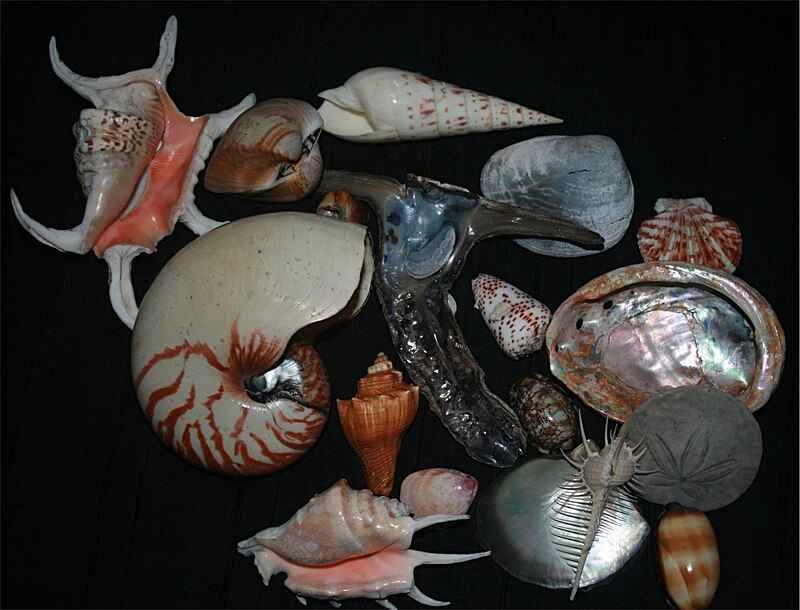
Shells are not grouped or classified according to the shells themselves. Instead, scientists have developed a system to classify the animals (molluscs) that commonly live in shells. There are seven main types of mollusks that live in shells, including:
Gastropods : They have shells, which can be either flat or conical spiral shells.
Bivalves : Two shells are connected together by muscles.
Nautiloids : They have a conical shell from which the head protrudes.
Aplacophora : No shell: Only some extinct primitive forms have a shell.
Monoplacophora : has a shell that encloses its body.
Cephalopods : have only a thin internal shell or a tightly curled outer shell (nautilus).
Polyplacophora : The back of the shell consists of eight hard plates.