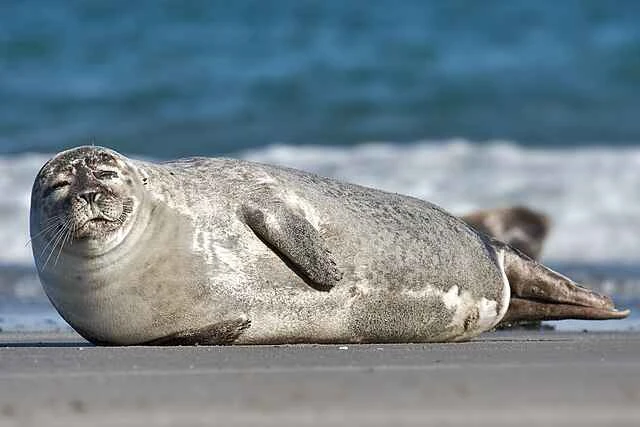
Seals are marine animals widely distributed along the coasts of the world's oceans, renowned for their agile swimming abilities and thick layers of subcutaneous fat. Many people question the biological classification of seals: are they mammals? In fact, seals are mammals , belonging to the order Carnivora, suborder Pinnipedia, family Phoccidae . This article will analyze the mammalian characteristics of seals from multiple perspectives, including biological classification, body structure, physiological features, and reproductive methods, and explore their important role in the ecosystem.
1. Biological classification of seals
1.1 The taxonomic status of seals
According to modern biological classification, seals belong to:
Kingdom : Animalia
Phylum : Chordata
Class : Mammalia ✅
Order : Carnivora
Suborder : Pinnipedia
Family : Phocidae
1.2 Why are seals classified as mammals?
Seals reproduce viviparously , with females nursing their young , which is one of the core characteristics of mammals.
They possess warm-blooded characteristics (homeothermic) , enabling them to maintain a stable body temperature.
Seals have a thick layer of subcutaneous fat under their skin, which serves to keep them warm and store energy.
Their lung structure and respiratory system are similar to those of other mammals, requiring them to surface periodically to breathe .
2. Physical characteristics and mammalian traits of seals
2.1 Body Temperature Regulation and Subcutaneous Fat
Seals are warm-blooded animals , meaning they can maintain a body temperature of around 37°C even in cold marine environments. This depends on:
A thick layer of subcutaneous fat : effectively insulates against heat and reduces heat loss from the body.
Dense fur : Although not as long as that of land mammals, it helps maintain body temperature.
High metabolic rate : able to maintain energy supply in extremely cold environments.
2.2 Pulmonary Respiratory System
Unlike fish that breathe through gills, seals breathe oxygen through their lungs , a key characteristic of mammals. They can:
Holding your breath for an extended period (usually up to 20-30 minutes) allows you to enter "diving mode" by reducing your heart rate and blood circulation.
They surface to breathe , similar to marine mammals such as whales and dolphins.
2.3 Tooth structure and carnivorousness
As part of the order Carnivora, seals have teeth similar to those of felines and canines , possessing:
Sharp canine teeth , used to capture prey.
The serrated back teeth help to tear food.
They mainly prey on fish, squid, and crustaceans ; some seals even hunt penguins.
3. Seal Reproduction – A hallmark of mammals
3.1 Viviparous reproduction
Unlike fish or amphibians, seals do not lay eggs; instead, they give birth to pups directly , which is one of the fundamental characteristics of mammals.
The gestation period is usually 9-11 months , but it varies slightly depending on the species of seal.
Female seals typically give birth on ice floes or beaches to ensure the safety of their pups.
3.2 Breastfeeding of cubs
After the pups are born, the female seal secretes high-fat milk ( up to 50% fat content) to help the pups grow quickly in the cold environment.
The cubs are usually weaned within 4-6 weeks and then begin to forage for food independently.
Some species of seals (such as elephant seals) can double their weight in just one month.
3.3 Parent-child relationship and cub survival
Compared to many mammals, seals have shorter parent-child relationships ; the mother seal usually leaves after the pups are weaned.
The young need to learn to swim and hunt quickly, otherwise their survival rate is low.
Due to threats from predators (such as killer whales and sharks), many calves do not survive their first year.
4. Comparison of seals with other mammals
| feature | seal | Typical land mammals (such as lions) |
|---|---|---|
| Body temperature regulation | Constant temperature (warm blood) | Constant temperature (warm blood) |
| Reproduction methods | viviparous | viviparous |
| Breastfeeding methods | Breastfed babies | Breastfed babies |
| Breathing methods | To breathe with lungs, one needs to surface for air. | Lung breathing |
| Limb structure | flippers, suitable for swimming | Limbs are adapted for running |
| Population relations | Some live in groups, some live independently. | Generally gregarious |