From delicate soft corals to hard corals that form coral reefs, there are 17 different types of coral species here, which is truly breathtaking.
1. Staghorn Coral
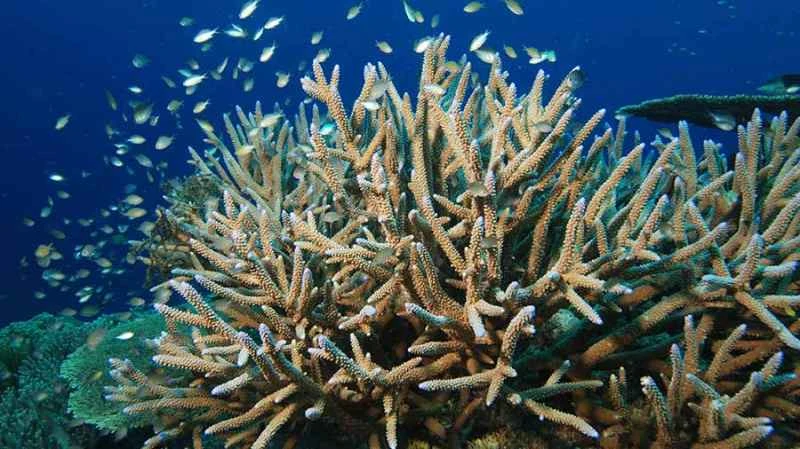 Staghorn corals provide sanctuary for numerous marine animals | Image: Albert Kok
Staghorn corals are among the fastest-growing and most important coral species in coral reef ecosystems. These reef-building hard corals have made a significant contribution to the formation of coral reefs worldwide today.
Because its shape closely resembles the antlers of a stag, it is commonly known as "staghorn coral." Its sharp points and forked textures form a dense coral garden, making it easy to identify.
This fish is typically found in shallow water, but unfortunately, this poses a significant threat to the species as it is severely affected by coral bleaching caused by global warming.
| scientific name | Staghorn Coral |
| Common name | Staghorn coral, staghorn coral, table coral, staghorn coral |
| type | Hard coral, branching |
| Size (maximum) | Height: 4 feet (1.2 meters), Diameter: 8 feet (2.4 meters) |
| Habitat (depth range) | 15-60 feet (4.6-18 meters) |
| Preserve the status quo | Critically Endangered |
2. Lettuce leaf coral
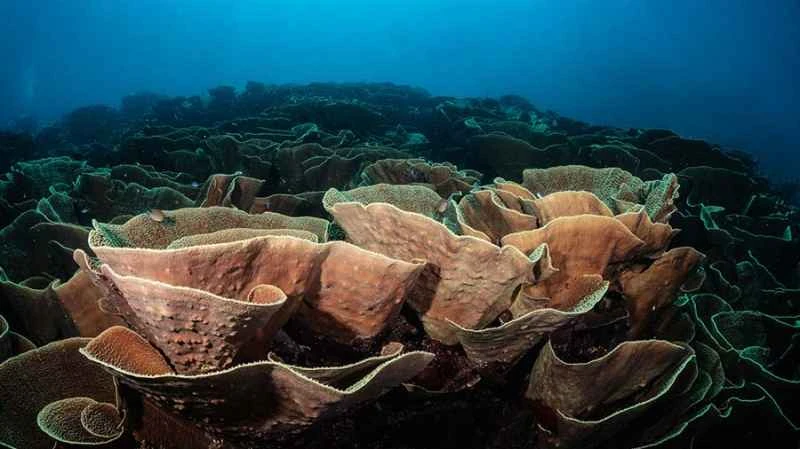 Lettuce leaf coral is also known as cabbage coral, plate coral, or vase coral | Image: Carra Oneal
Lettuce leaf corals grow upwards in a distinctive conical shape, with large folds that make them resemble large cabbages. They feed on plankton and are most commonly found in soft yellow, green, and brown hues.
Their enormous disc-shaped structures provide a sheltered habitat for a variety of marine life, allowing them to escape predators.
These rocky reef-building corals are found throughout the Indian and Pacific Oceans, thriving in shallow coral reefs at depths of up to 20 meters.
| scientific name | Agaricales |
| Common name | Lettuce leaf coral, leaf coral, cabbage coral, vase coral |
| type | Hard coral, branching |
| Size (maximum) | Diameter: 3 feet (0.9 meters) |
| Habitat (depth range) | 15-245 feet (5-75 meters) |
| Preserve the status quo | Least concerned |
3. Staghorn Coral
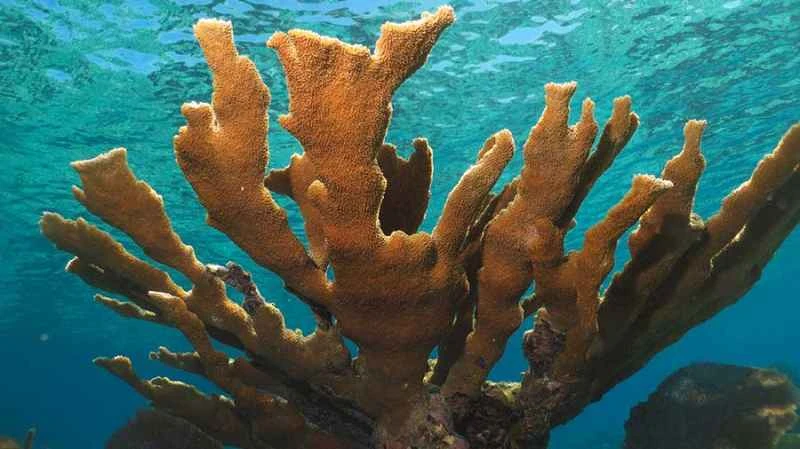 The shape of elk antler coral is reminiscent of deer antlers | Image: David E Guggenheim
Staghorn coral is undoubtedly one of the most striking coral reef species. Its unique antler-like features set it apart from other coral reef species, making it an impressive sight for any snorkeler or diver.
This rocky reef-building coral was once considered one of the most abundant corals in the Caribbean reef ecosystem. However, due to global warming and coral bleaching, staghorn coral is now a critically endangered species.
| scientific name | Palmate Staghorn Coral |
| Common name | Staghorn coral, staghorn coral, table coral |
| type | Hard coral, branching |
| Size (maximum) | Height: 6 feet (1.8 meters), Diameter: 12 feet (3.7 meters) |
| Habitat (depth range) | 3-65 feet (1-20 meters) |
| Preserve the status quo | Critically Endangered |
4. Carnation Coral
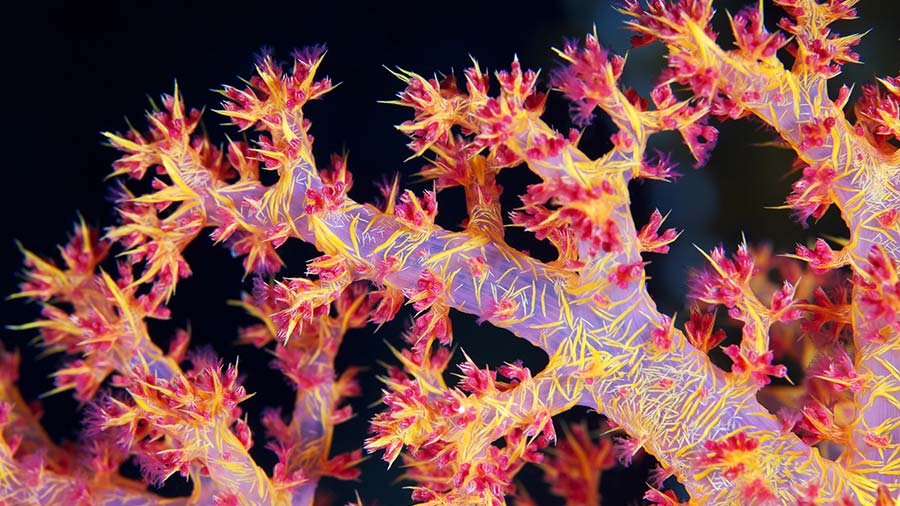 Carnation corals are a favorite among underwater photographers!
The stunning carnation coral species, or "Dendronephthya," can be found in coral reefs around the Red Sea, the Indian Ocean, and the western Pacific Ocean.
Carnation corals thrive in fast-flowing waters, typically growing on walls or hanging from rocks. When the current is strong, these corals spread out, blooming flowers to feed; when the current is calm, they wither.
Their branching stems are pearly white, while their flower heads come in pink, red, orange, and yellow. These vibrant colors make carnations one of the most eye-catching and photogenic coral reef species.
| scientific name | Tree kidney algae |
| Common name | Carnation coral, tree coral, cauliflower coral |
| type | Soft coral, branching |
| Size (maximum) | Diameter: 2.5 feet (0.8 meters) |
| Habitat (depth range) | 33-165 feet (10-50 meters) |
| Preserve the status quo | unknown |
5. Bubble Coral
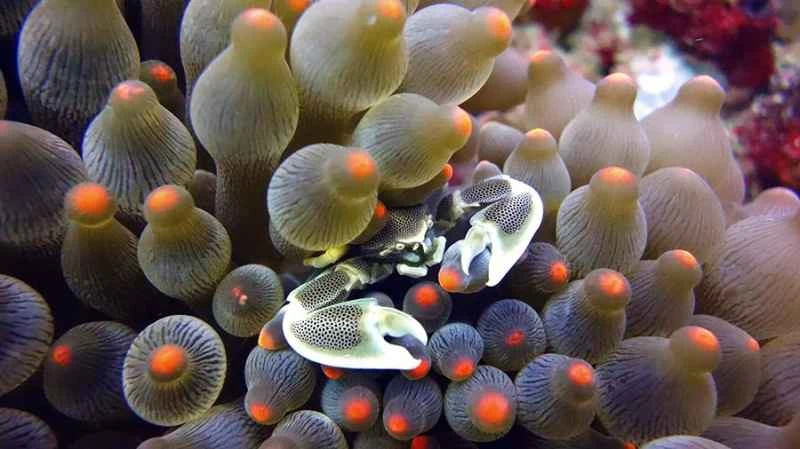 Bubble corals are often mistaken for fish eggs | Image: Simon Ilett
Bubble coral (scientific name: Plerogyra sinuosa) is one of the most fascinating coral reef species. Bubble corals typically live in sheltered waters at depths of 3 to 35 meters and are often mistaken for fish eggs.
During the day, these white/skin-colored polyps look like bubbles, or even a bunch of grapes, but at night, these little balloons deflate, allowing their tentacles to extend out in search of food.
Bubble corals can be found in coral reef areas from the Red Sea and the Indian Ocean to the Central Pacific Ocean.
| scientific name | Toothed gooseberry |
| Common name | Bubble coral, bladder coral, pearl coral, grape coral |
| type | Hard coral |
| Size (maximum) | Diameter: 3.3 feet (1 meter) |
| Habitat (depth range) | 10-115 feet (3-35 meters) |
| Preserve the status quo | Near Danger |
6. Gorgonium
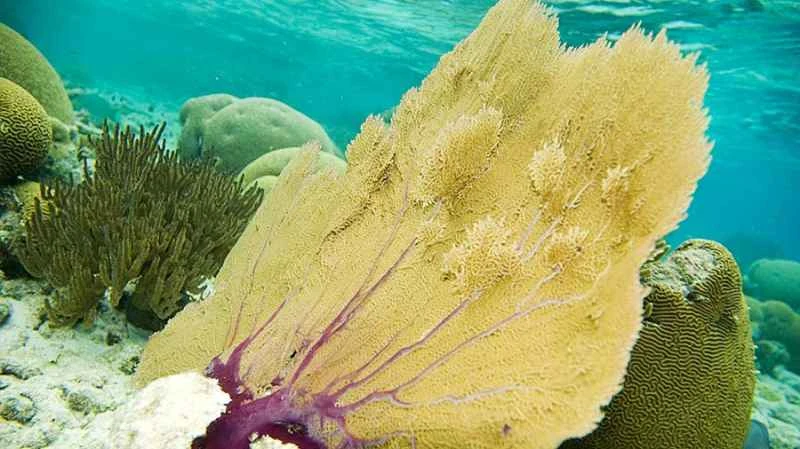 Gorgon coral fans are a delicate coral reef species.
Gorgon corals are among the most elegant coral reef species. These beautiful soft corals are mainly distributed in the Bahamas and the West Indies, and consist of a complex network of twigs growing from a small base.
Gorgon corals are grayish-white, yellow, and pale purple, and are the habitat of pygmy seahorses, which spend their entire adult life attached to these lush corals.
They prefer shallow waters with larger waves and a maximum depth of 10 meters, making them a popular coral reef species for snorkelers and divers alike.
| scientific name | Scallop Coral |
| Common name | Gorgonium, Venus sea fan, West Indian sea fan |
| type | Soft coral, branching |
| Size (maximum) | Height: 5 feet (1.5 meters) |
| Habitat (depth range) | 10-100 feet (3-30 meters) |
| Preserve the status quo | unknown |
7. Sea whip coral
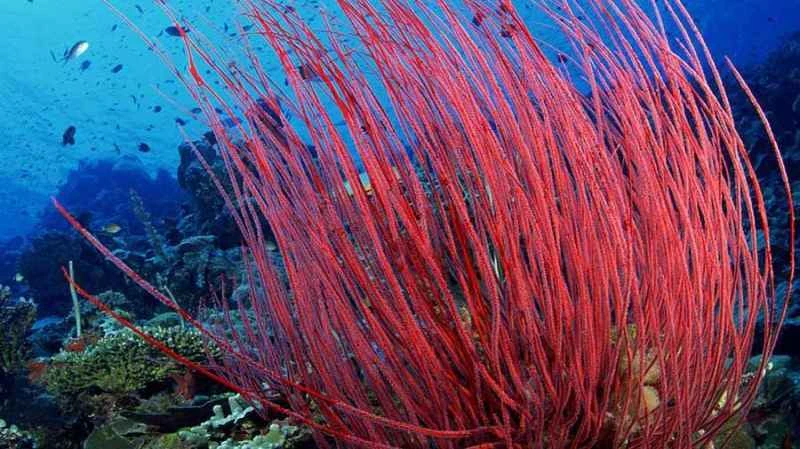 Sea whip corals are part of the beautiful gorgonian coral family.
The delicate, whip-like branches of the sea whip coral display a range of striking colors, including red, orange, yellow, and purple.
This reef species typically lives in deeper waters, inhabiting walls and rocks, and can grow up to 3 feet long.
If you are a keen macro enthusiast, keep an eye out for the tiny whip coral shrimp that inhabit the branches of this coral reef species.
| scientific name | Fine-leaved grass |
| Common name | Sea whip coral, colorful sea whip |
| type | soft coral |
| Size (maximum) | Height: 3.3 feet (1 meter) |
| Habitat (depth range) | 6-195 feet (1.8-60 meters) |
| Preserve the status quo | unknown |
8. Sun coral
 Sun coral is one of the most sought-after corals by underwater photographers.
Sun corals ( Tubastaea) grow in coral reef areas of the Red Sea, Indo-Pacific, western Indian Ocean, and South Pacific. They typically inhabit dark cliffs and caves where the water is nutrient-rich and has strong currents.
During feeding, the tentacles of this coral extend from its tubular base and fully open, ready to receive plankton.
These lively creatures have a range of vibrant colors, including yellow, orange, red, and pink.
| scientific name | tubular |
| Common name | Sun coral, sun polyp, tube coral |
| type | soft coral |
| Size (maximum) | Diameter: 5.5 inches (14 cm) |
| Habitat (depth range) | 0-360 feet (0-110 meters). |
| Preserve the status quo | endangered |
9. Fox Coral
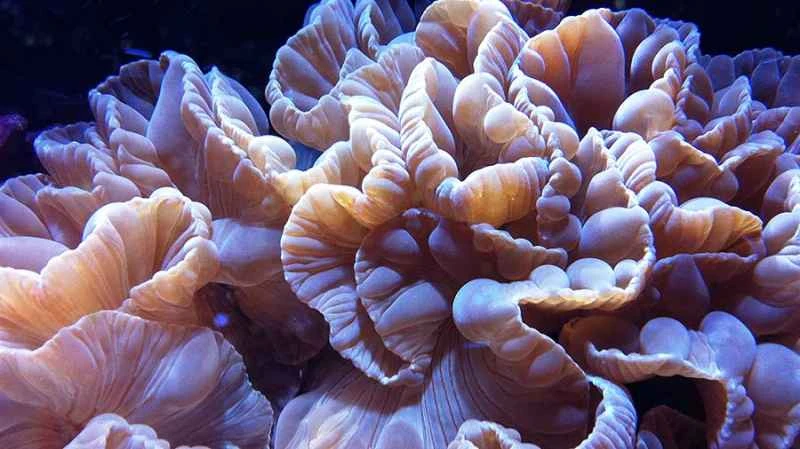 Fox coral's soft, organic form makes it one of the most beautiful coral reef species.
Fox coral, also known as jasmine coral or Nemenzophyllia turbida , is one of the most attractive coral reef species. These frilled corals come in a variety of colors, ranging from light pink to greenish-blue.
You will find fox corals living on sheltered reefs and under rock overhangs seeking protection.
Although fox corals are not listed as a threatened species, they remain relatively rare in the wild and typically inhabit coral reefs in the Indo-West Pacific Ocean, from the Philippines to Papua New Guinea.
| scientific name | Variegated orchid |
| Common name | Fox coral, jasmine coral, spine coral |
| type | soft coral |
| Size (maximum) | Diameter: 3 feet (1 meter) |
| Habitat (depth range) | 25-100 feet (8-30 meters) |
| Preserve the status quo | unknown |
10. Organ Coral
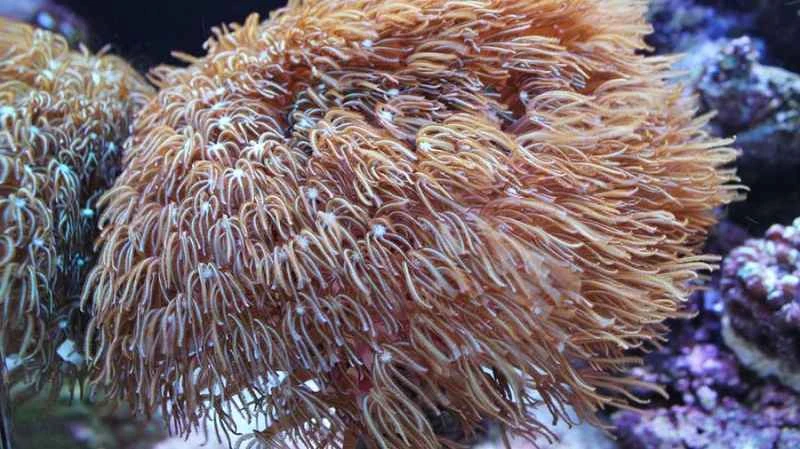 Each tube of a tubular coral has eight independent tentacles.
The organ coral ( Tubipora musica) is perhaps better suited to being appreciated in person.
They live in the tropical waters of coral reefs in the Indian and Pacific Oceans, and generally prefer sheltered areas in shallow water.
Although this reef species is classified as a soft coral, it possesses a hard skeleton containing numerous tubular vessels. Each vessel is equipped with feather-like tentacles used to capture plankton. Watching these fascinating tentacles work together to open and close is sure to amaze you.
| scientific name | Variegated orchid |
| Common name | Organ Coral, Organ Coral |
| type | soft coral |
| Size (maximum) | Diameter: 10 feet (3 meters) |
| Habitat (depth range) | 6-65 feet (2-20 meters) |
| Preserve the status quo | Near Danger |
11. Grooved brain coral
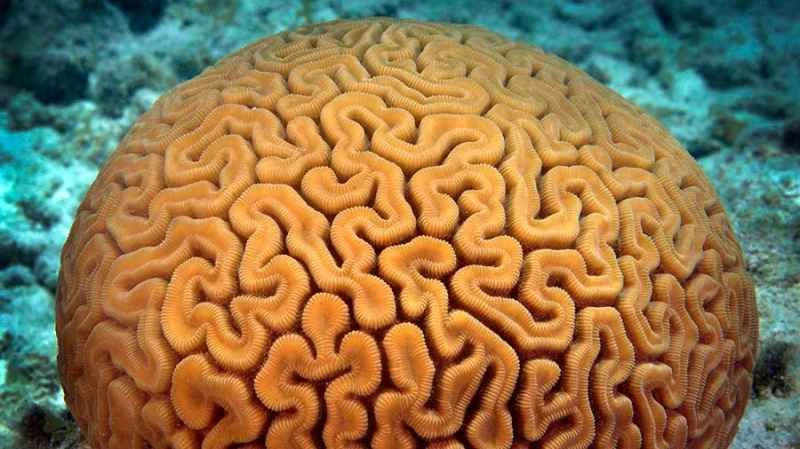 It is easy to see how the species got its common name.
The diploria labyinthiformis gets its name from its striking resemblance to the human brain. Its deep grooves and intricate folds also resemble a maze or labyrinth, hence the name .
Although these reef-building corals appear enormous, only the outermost few millimeters of their tissue are living. Groovy-type brain corals grow only a few millimeters per year, and many large corals can live for hundreds of years.
This species needs to inhabit depths where light can penetrate, and is therefore most commonly found in coral reefs at depths of 1 to 30 meters. At these depths, the barn coral is typically brown or yellow. However, in deeper waters, it may appear grey.
| scientific name | Labyrinthine Twin Algae |
| Common name | Trough-brain coral |
| type | Hard coral |
| Size (maximum) | Diameter: 6 feet (2 meters) |
| Habitat (depth range) | 3-165 feet (1-50 meters) |
| Preserve the status quo | Least concerned |
12. Branched finger coral
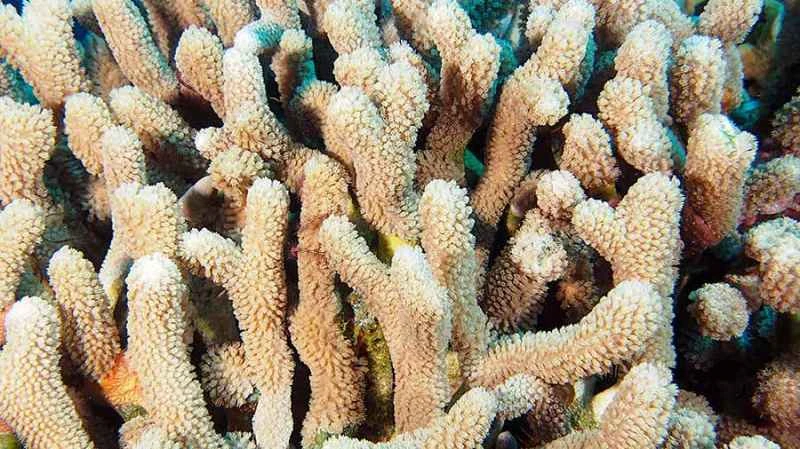 Thinner leaves are one of the distinguishing features of this species from other shore corals.
Dendritic corals are considered one of the oldest life forms on Earth due to their slow growth rate. Many scientists believe that some corals of this species can even live for up to 1,000 years. They typically grow in shallow to medium-slope coral reef environments, and can also be found in seagrass beds and at the base of mangroves.
Its common name comes from its appearance. Its leaves/branches are short and slender, with rounded tips, and are usually densely arranged, resembling human fingers. This coral is yellow or grayish-brown, and the interior of the coral is usually slightly purplish.
The branching finger coral ( Porites furcata) differs from other members of the genus Porites in that its leaf-like structure is more uniform in size, with a spherical tip. The diameter of the leaf-like coral can reach 0.4 to 0.8 inches (1 to 2 cm).
| scientific name | Rift Coral |
| Common name | Branched finger corals, hump corals, or finger corals |
| type | Hard coral, branching |
| Size (maximum) | Diameter: 16.5 feet (5 meters) |
| Habitat (depth range) | 3-66 feet (1-20 meters) |
| Preserve the status quo | Least concerned |
13. Bubble-fried sea anemone
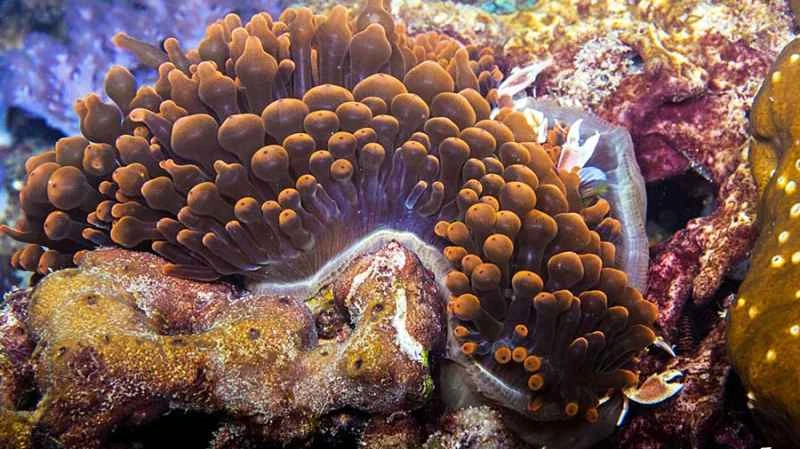 Bubble-headed sea anemones are among the larger sea anemones.
This type of coral is known as the bubble-tip anemone because of the unique spherical tips at the ends of its tentacles. They easily inhabit various clownfish , cleaner shrimp, and porcelain crabs.
The tips of sea anemones exhibit unique bulbs that adjust according to parameters such as water flow, light, bacterial count, color, and parasitic organisms. Some varieties have larger bulbs than others.
Nutrients are typically obtained through filter feeding via its 4-6 cm long tentacles, or by the waste and debris cleaned off its body by its companion, the clownfish. Unfortunately, this beautiful anemone is collected for the live aquarium trade.
| scientific name | Four-colored snapdragon |
| Common name | Bubble-tipped anemone, rose bubble-tipped anemone, ball-tipped anemone, ball-shaped tentacle anemone |
| type | soft coral |
| Size (maximum) | Diameter: 12 inches (30 cm) |
| Habitat (depth range) | 0-130 feet (0-40 meters) |
| Preserve the status quo | Least concerned |
14. Pink-tipped sea anemone
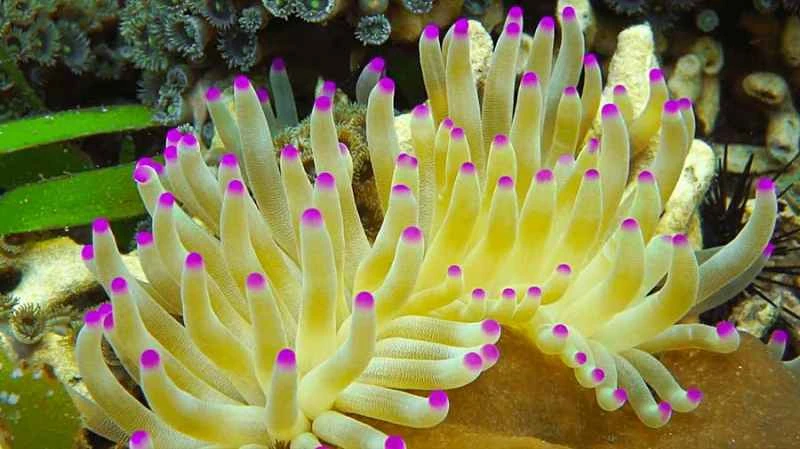 Its tentacles are beige with pink to purple tips, making them very easy to identify.
The pink-tipped anemone gets its name from the pink tips at the ends of its tentacles.
This species readily thrives in lagoons or inner reefs as individuals or loose colonies, but rarely forms groups. They typically attach themselves to hard objects in shallower waters and often mate with cleaner shrimp and porcelain crabs.
They possess both tenacious vitality and natural beauty, with powerful spines that effectively capture approaching fish. They also feed on fish, mussels, shrimp, zooplankton, and sea worms.
| scientific name | Megadon condyle |
| Common name | Pink-tipped sea anemone, sea anemone, giant Caribbean sea anemone, giant golden sea anemone |
| type | soft coral |
| Size (maximum) | Diameter: 20 inches (51 cm) |
| Habitat (depth range) | 0-90 feet (0-30 meters) |
| Preserve the status quo | Least concerned |
15. Saddle carpet sea anemone
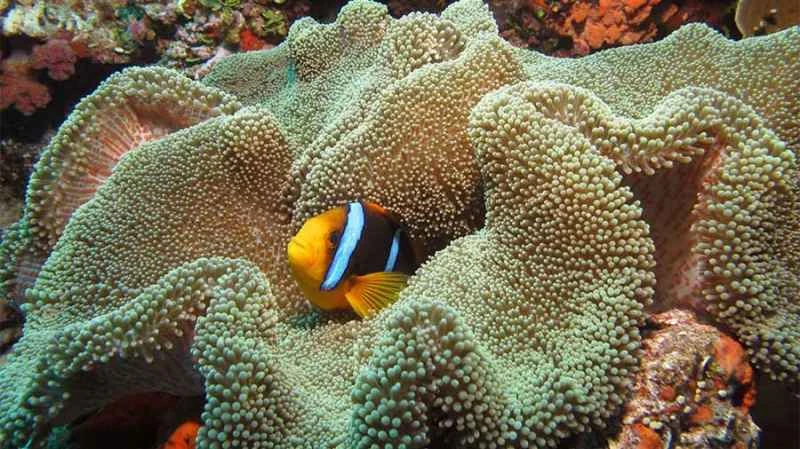 The saddle-shaped carpet anemone is the host of clownfish.
The saddle carpet anemone is one of the most brightly colored species inhabited by clownfish. Its colors range from brown to green, blue, and purple, with a sandy hue, and it is home to seven different clownfish species.
Saddle-shaped carpet anemones are easily distinguished from other anemones by their short, spherical, and sticky tentacles. They have large oral discs with closely spaced folds, giving them a wavy, carpet-like appearance.
Their tentacles are covered with stinging cells, and like many other sea anemones, they are carnivorous, feeding on a variety of invertebrates and capturing food particles suspended in the water for consumption.
This species is mostly found alone on coral reefs and soft sandy seabeds, and often takes root in the substrate. They do not usually move around, but they are capable of moving.
| scientific name | Echinops harzianum |
| Common name | Saddle-shaped carpet anemone, Ha's carpet anemone, saddle anemone |
| type | soft coral |
| Size (maximum) | Diameter: 2.5 feet (0.75 meters) |
| Habitat (depth range) | 13-130 feet (4-40 meters) |
| Preserve the status quo | Least concerned |
16. Open brain corals
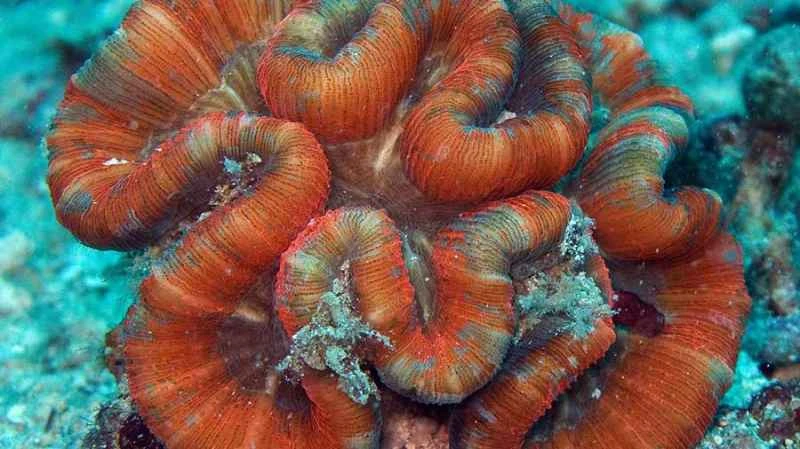 The brightly colored folds resemble a cabbage or a human brain.
Open brain coral is a free-living and brightly colored species, mainly distributed in the Indo-Pacific region. This species has a wide range of habitats, but typically lives in the deeper waters of coral reefs.
These corals are hourglass-shaped or multi-cleft, and their colors are usually very vibrant, some multicolored and some monochromatic, encompassing almost the entire spectrum of the rainbow. For a mesmerizing visual effect, shine a UV flashlight on them and watch them shimmer.
These are relatively small corals, rarely exceeding 20 centimeters in diameter, and one species of them is known to be a gall bladder crab. Open brain corals are threatened by overfishing in the aquarium trade, habitat loss, and global warming.
| scientific name | Ficus microcarpa |
| Common name | Open brain coral, folded brain coral, cabbage coral, banana coral |
| type | Hard coral |
| Size (maximum) | Diameter: 8 inches (20 cm) |
| Habitat (depth range) | 100-130 feet (30-40 meters) |
| Preserve the status quo | Near Danger |
17. Mushroom Coral
 Similar to mushrooms, they have rows of tiny spines and are usually brown in color.
Mushroom corals are found in all the world's oceans, typically inhabiting the upper layers of reefs in fast-flowing waters. Most live in tropical waters, but some varieties thrive in cold waters.
Unlike most corals, mushroom corals are solitary species, scattered across the seabed, and only attach themselves to coral reefs when they are still small.
The species gets its common name from its dense, oval, and radial skeletal walls (septa) that give this coral a mushroom-like appearance.
| scientific name | Palodontia pleuropneumoniae |
| Common name | Mushroom coral, plate coral, razor coral, fungus coral |
| type | Hard coral |
| Size (maximum) | Diameter: 10 inches (25 cm) |
| Habitat (depth range) | 0-130 feet (0-40 meters) |
| Preserve the status quo | Least concerned |
The difference between hard corals and soft corals
There are approximately six thousand species of corals worldwide. They can be divided into two categories: hard corals and soft corals.
Each type of coral consists of hundreds to thousands of coral polyps, which are very small, usually no more than half an inch in diameter.
The difference between hard and soft corals can be determined by examining the number of tentacles in each coral polyp.
Hard coral species
Hard corals have multiples of six tentacles.
As the name suggests, hard corals appear very hard because their polyps form a hard calcium carbonate skeleton.
There are approximately 800 known species of hard corals, also known as "reef-building" corals.
soft coral species
Soft corals typically have eight tentacles.
Soft corals typically resemble brightly colored plants, have a unique feathery appearance, and lack a hard, stony skeleton.
Soft corals do not participate in the formation of coral reefs because they do not produce the necessary hard calcified skeleton.