The hippopotamus (scientific name: *Hippopotamus amphibius*) is one of Africa's most iconic animals, renowned for its massive size, semi-aquatic lifestyle, and powerful jaws. Despite its ferocious appearance, many might be surprised to learn that the hippopotamus's diet is actually quite simple and primarily herbivorous. This article will systematically analyze the hippopotamus's diet, feeding behavior, digestive mechanisms, and their roles in the ecosystem from a zoological perspective.
I. General Overview: Are hippos herbivores?
1.1 Yes, hippos are primarily herbivores.
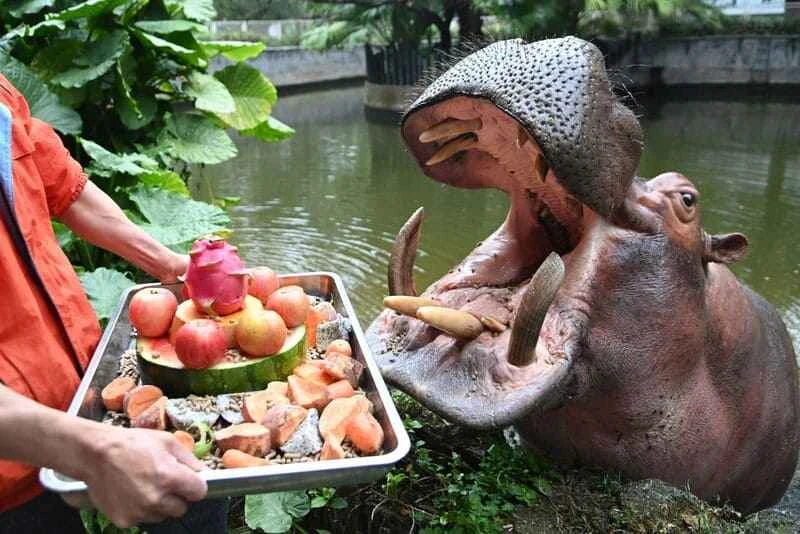
Hippos are herbivorous mammals, primarily feeding on various terrestrial herbaceous plants, and possess a specialized physiological structure for digesting high-fiber plants. Although there are occasional records suggesting that hippos may eat meat, this is considered an extremely rare and unusual behavior.
1.2 Daily food intake
Adult hippos can consume an average of 35 to 45 kilograms of plants per day, depending on their size, health status, and environment.
II. What do hippos actually eat?
2.1 Staple food: Various types of short grasses on the ground
Hippos primarily feed on short, grassy plants on land, such as:
Bermuda grass
Cynodon spp.
The natural pasture grasses on the African savanna are mostly foraged at night to avoid excessively high daytime temperatures.
2.2 Occasionally consumed foods
Although grass is their staple food, hippos may also consume other foods under certain circumstances:
Fallen fruit (very rare)
A small amount of aquatic plants (not a high proportion).
Crops such as corn and sugarcane (when near farmland) do not constitute their main food source.
III. Foraging Behavior Patterns of Hippos
3.1 Nocturnal feeders
Hippos leave the water after dusk and walk up to 10 kilometers to find grasslands, where they forage for 4 to 6 hours before returning to the water before dawn.
3.2 Obvious Domain Behavior
Male hippos are highly territorial, protecting prime foraging areas and driving away other individuals.
3.3 Eating methods
Hippos don't rely on sharp teeth to gnaw; instead, they use their strong lips to pull up grass. Their large canines are primarily used for fighting and defense, not for feeding.
IV. Digestive System and Nutrient Absorption
4.1 Ruminants
Although hippos are not true ruminants (like cattle and sheep), their stomachs have three chambers and possess a certain fermentation capacity, which is used to break down high-fiber plants.
4.2 Slow digestion process
Due to their slow metabolism and high fiber content in plant-based foods, hippos take a long time to digest and sometimes do not eat again the night after consuming a large amount of food the previous night.
V. Water and Food: Correcting Common Misconceptions
5.1 Hippos do not feed underwater.
Although hippos spend most of their daytime in the water, they eat almost entirely on land.
5.2 Why is underwater eating impractical?
Hippos have their eyes, ears, and nostrils located on the top of their heads, which is suitable for observing their environment at the water's surface, but they do not have the structural advantage of feeding underwater.
VI. Rare and Abnormal Carnivorous Behaviors
6.1 Occasional carnivorous behavior
During periods of drought or malnutrition, a very small number of hippos have been observed consuming carcasses or even attacking small animals. This behavior is believed to be a stress response to nutritional stress.
6.2 Not a routine behavior
These individual cases do not represent the typical diet of hippos, as they lack both teeth adapted to a carnivorous diet and a corresponding digestive system.
VII. The Conflict Between Hippopotamuses and Human Agriculture
7.1 Damage to crops
Hippos near human farmland will nibble on:
sugar cane
corn
Rice cultivation often triggers conflicts between humans and wild animals, especially during the dry season.
7.2 Mitigation Strategies
Common measures to reduce conflict include:
Install electric fence
Night patrol
Establishing ecological corridors and ensuring harmonious coexistence between humans and nature is crucial for the protection of hippos.
VIII. Ecological Role and System Impact
8.1 Adjusting vegetation structure
Through their preferred feeding habits, hippos influence the distribution and structure of grassland vegetation, thus helping to maintain biodiversity.
8.2 Nutrient Cycling
Hippos promote the growth of algae and plankton in rivers and lakes by converting terrestrial food into feces and excreting it into water, thus forming a "nutrient bridge from land to water".
IX. Conclusion: Simple Diet, Profound Impact
Although hippos primarily eat grass, they play a vital role in the ecosystem. As nocturnal herbivores, they not only influence plant structure but also play a crucial role in aquatic ecosystems.
Understanding the hippopotamus's diet not only helps reveal its physiological characteristics but also provides a scientific basis for coexisting with hippos and formulating conservation policies. The hippopotamus's "dietary philosophy," though simple, supports a corner of the African river ecosystem.