Table of contents
Introduction: Why compare crocodiles and hippos?
Physical characteristics: size, weight, and appearance
Table: Body Comparison of Crocodiles and Hipposos
Strength comparison
bite force
Speed on land and in water
Behavior and Aggression
Territoriality
Hunting and Defense
Interaction in the wild
Conflict scenarios: When will they clash?
Do crocodiles attack hippos?
Survival strategies
Hippos' defense mechanisms
Crocodile hunting techniques
Crocodile vs. Hippopotamus: Who will win the fight?
Wider ecological impacts: Their role in African rivers
Frequently Asked Questions: Questions about crocodiles and hippos
1. Introduction: Why compare crocodiles and hippos?
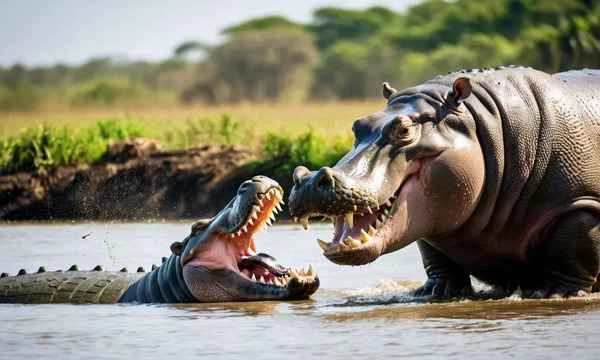
Crocodiles and hippos are two of the most iconic animals in African rivers. Both are extremely powerful and often share the same habitat, inevitably leading to conflict. Crocodiles are apex predators, while hippos are known for their territoriality and massive size. This article will delve into their strengths, weaknesses, and interactions in the wild.
2. Physical characteristics: size, weight, and appearance
Let's first look at their basic physical data. Crocodiles are streamlined, armored reptiles designed for stealth and surprise attacks, while hippos are giant mammals with tough skin.
Table: Body Comparison of Crocodiles and Hipposos
| feature | Crocodile | hippo |
|---|---|---|
| average weight | 500-1500 pounds | 3000-4000 pounds |
| length | 12-20 feet | 10-15 feet |
| skin | Thick, scaly | tough, smooth skin |
| life | 70-100 years | 40-50 years |
| teeth | Sharp, conical (approximately 80 beads) | Giant, tooth-like canines |
3. Strength Comparison
bite force
Crocodiles possess one of the strongest bite forces in the animal kingdom, reaching 3,700 pounds per square inch (PSI). While hippos have a slightly weaker bite force of 1,800 PSI, their massive size and powerful teeth allow them to easily crush a crocodile's body.
speed
**On land:** Hippos are incredibly fast, reaching speeds of 19-25 mph, while crocodiles can only reach speeds of about 11 mph on land.
**In water:** Crocodiles swim at speeds of 20-25 miles per hour, far exceeding the hippopotamus's speed of 5 miles per hour.
4. Behavior and Aggression
Territoriality
Hippos are known for their strong territorial instincts, especially in the water. They will attack any creature that enters their territory, including crocodiles. While crocodiles are fierce predators, they generally avoid unnecessary conflict with adult hippos.
Hunting and Defense
Crocodiles are stealthy predators, relying on ambush tactics to capture their prey. Hippos, on the other hand, are herbivores, but their size and strength are more than sufficient for defense.
5. Interaction in the wild
Conflict scenarios
Crocodiles often target hippo calves, leading to conflicts with adult hippos. Adult hippos are rarely prey due to their enormous size, but conflicts intensify during droughts and resource scarcity.
Do crocodiles attack hippos?
Yes, but usually only when forced to or when a weak or young hippopotamus is found to attack.
6. Survival Strategies
Hippos' defense mechanisms
The hippopotamus's size and strength are its greatest advantages.
Hippos primarily act in groups, utilizing numbers as a safety strategy.
The thick skin provides it with extra protection.
Crocodile hunting techniques
**Coverage and Surprise Attack:** Crocodiles typically lurk in the water to camouflage themselves.
**Bite and drag:** They use their powerful bite force to drag their prey into the water and drown them.
7. Crocodile vs. Hippopotamus: Who will win the fight?
If an adult crocodile were to fight an adult hippopotamus, the hippo would almost always have the upper hand. This is because the hippo's size, strength, and thick skin make it virtually immune to crocodile attacks. While the crocodile possesses a deadly bite force, it is powerless against the hippo's powerful strikes.
8. Broader ecological impacts: Their role in African rivers
Crocodiles play a vital role in controlling fish populations and maintaining the balance of aquatic ecosystems.
Hippos shape river environments by grazing on vegetation and creating wetland pathways, thus helping other species survive.
9. Frequently Asked Questions: Questions about crocodiles and hippos
Q: Do crocodiles eat hippos?
A: Crocodiles usually don't eat adult hippos, but they may prey on baby hippos.
Q: Are hippos more dangerous than crocodiles?
A: According to statistics, yes. Hippos cause far more human deaths each year than crocodiles.
Q: Can crocodiles and hippos coexist?
A: Yes, they often share habitats, but hippos usually have the upper hand in territorial conflicts.
This detailed comparative article showcases the advantages, behaviors, and interactions between crocodiles and hippos in the wild, revealing a fascinating showdown between two of Africa's biggest beasts!