Kubanochoeres are a group of large pigs with mound-shaped teeth that once lived in the Old World, mainly distributed from the Early to Middle Miocene, and found in Africa and Eurasia. For a long time, paleontologists have debated whether Kubanochoeres should be classified as a subfamily, and many questions remain regarding the classification and evolutionary relationships of Kubanochoeres fossils from different locations. Recently, Hou Sukuan and Deng Tao of the Institute of Vertebrate Paleontology and Paleoanthropology, Chinese Academy of Sciences, described a partially preserved skull fossil discovered in Hezheng County, Linxia Basin, Gansu Province, establishing a new species of the genus Kubanochoeres—*Kubanochoerus parvus* sp. nov., and systematically discussed the classification and evolution of Kubanochoeres fossils. Their research results have been published online in *Vertebrata PalAsiatica*.
Based on a comparison of known Kuban hog fossils, Hou Sukuan and Deng Tao argue that the African genus *Libycochoerus* is a synonym of the Eurasian genus *Kubanochoerus*. They classify the Eurasian Kuban hog material with horns into a single species—*K. gigas*, considering *K. robustus* and *K. lantienensis* to be synonyms of *K. gigas*. However, they believe there is insufficient evidence to support a subspecies classification of *K. gigas*. The new Kuban hog material from the Linxia Basin is relatively small, similar to *K. massai* from Africa and *K. minheensis* from Qinghai, China; its cheek teeth are wider, similar to *K. massai*; some advanced features, such as enlarged central incisors, fused premaxilla, significantly posteriorly extended palatine bone, and long P1? P2/p1? P2 interdental spaces, are similar to *K. gigas* from Eurasia. The new species is stratigraphically located roughly at the top of the Hujialiang Formation or the bottom of the Liushu Formation, and may be the last known Kuban pig fossil. The Eurasian *K. gigas* likely evolved from a more primitive type than *K. massai*; the new species may have evolved from *K. massai* or an even more primitive type, representing a separate lineage of Eurasian Kuban pigs; *K. minheensis* maintained a smaller body size, but its teeth showed a tendency towards sub-ridged dentition, representing another independent evolutionary lineage of Eurasian Kuban pigs.
This research was supported by the National Natural Science Foundation of China, the Key Research Program of Frontier Sciences of the Chinese Academy of Sciences, the Strategic Priority Research Program, and the International Partnership Program.
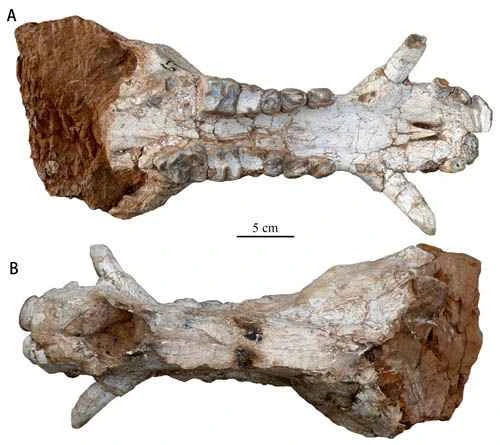
Figure 1. Skull of Kubanochoerus parvus sp. nov. (HMV 1985), a new breed of small Kuban pig from the Linxia Basin. Homotype specimen A. ventral side; B. dorsal side (Photo courtesy of Hou Sukuan)
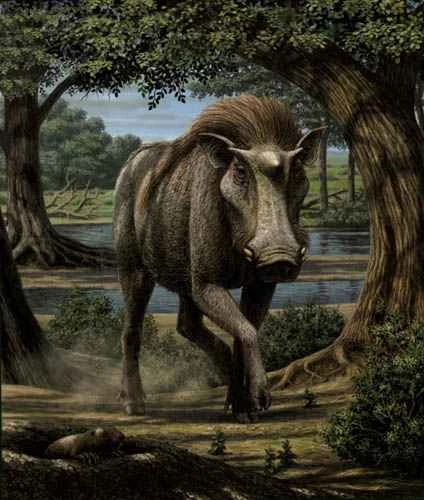
Figure 2. Reconstruction of the Kuban pig (drawn by Mauricio Antón)