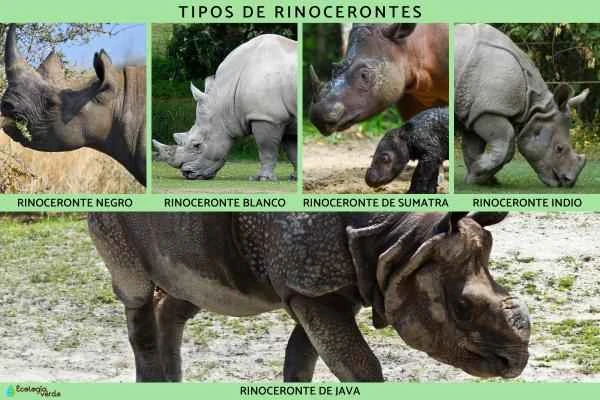
Rhinoceroses, also known as bulls, belong to the order Perissodactyla and the family Rhinocerotidae. They are large herbivorous mammals characterized by one or two horn-like horns on their noses. Currently, only five species of rhinoceroses remain in the world: the white and black rhinoceroses of Africa, and the Indian, Javan, and Sumatran rhinoceroses of Asia.
1. Sumatran rhinoceros (Dicerorhinus sumatrensis)
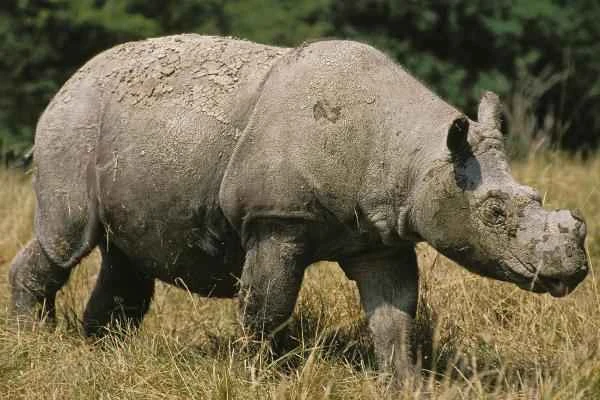
The Sumatran rhinoceros (Dicerorhinus sumatrensis) is the smallest and hairiest extant rhinoceros species. Three subspecies have been identified:
West Sumatran rhinoceros (Dicerorhinus sumatrensis sumatrensis).
Borneo rhinoceros or eastern rhinoceros (Dicerorhinus sumatrensis harrissoni).
Northern rhinoceros or Chittagong rhinoceros (Dicerorhinus sumatrensis lasiotis).
It inhabits dense tropical forests ranging from floodplains to mountainous regions. It prefers areas with diverse vegetation, including shrubs, shoots, fruits, and roots, and always stays near water and mineral salts for nourishment. It stands only 1.2 to 1.45 meters tall at the shoulder, measures 2.5 to 3.2 meters in length, and weighs between 500 and 960 kilograms. Its red skin is distinctly wrinkled and covered with hair ranging from short and stiff to thicker when kept in captivity. According to the IUCN Red List, the Sumatran rhinoceros is listed as "Critically Endangered."
2. White rhinoceros (Ceratotherium simum)
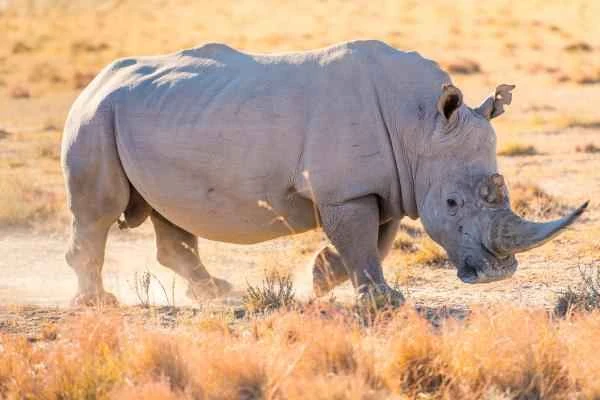
The white rhinoceros (Ceratotherium simum) is the second largest land mammal inhabiting Africa after the elephant. It has two subspecies:
Southern white rhinoceros (C. s. simum): Number approximately 17,000-20,000.
Northern white rhinoceros (C. s. cottoni): Only two individuals exist in the Ol Pejeta Conservancy in Kenya.
Its preferred habitat is open short and medium grass grasslands, where it uses its wide, square lips (hence the common name "square lips") to cut grass directly from the ground.
The white rhinoceros measures between 3.35 and 4.2 meters in length and 1.5 to 1.85 meters in shoulder height. Males can weigh over 3,000 kilograms (females can weigh up to 2,000 kilograms). Its grey skin is hairless except for its ears, eyelashes, and the tip of its tail. They need to drink water every 2-4 days and organize themselves into small, semi-social groups called "collapses," or, in the case of territorial males, live alone. According to the IUCN Red List, the white rhinoceros is listed as "Near Threatened."
3. Black rhinoceros (Diceros bicornis)
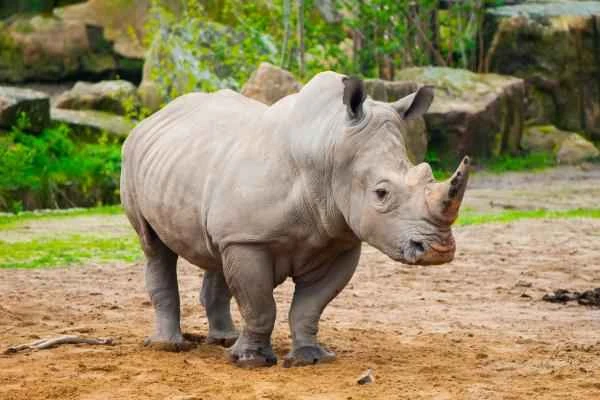
The black rhinoceros (scientific name: Diceros bicornis), also known as the hooked-lip rhinoceros, comprises four subspecies:
Central and southern regions (smaller).
East (michaeli).
Southwest (two-horned bird).
Western (long-legged worm, declared extinct in 2011).
It spans southern and eastern Africa, including countries such as Kenya, Tanzania, Namibia, South Africa, and Zimbabwe. Its habitat consists of semi-desert savannas, forests, wetlands, and scrublands, always near water and mineral springs.
It stands about 1.6 meters tall at the shoulder and weighs between 800 and 1,350 kilograms, smaller than the white rhinoceros. It has two horny horns and a hooked upper lip used for navigation. It feeds on buds, leaves, and low-lying branches, leaving angular edges on vegetation. Its diet allows it to coexist with white rhinoceroses without competition. It feeds day and night, rests during the hottest times, and marks its territory with urine and feces. According to the IUCN Red List, the black rhinoceros is listed as “critically endangered” and “severely depleted.”
4. Javan rhinoceros (Rhinoceros sondaicus)
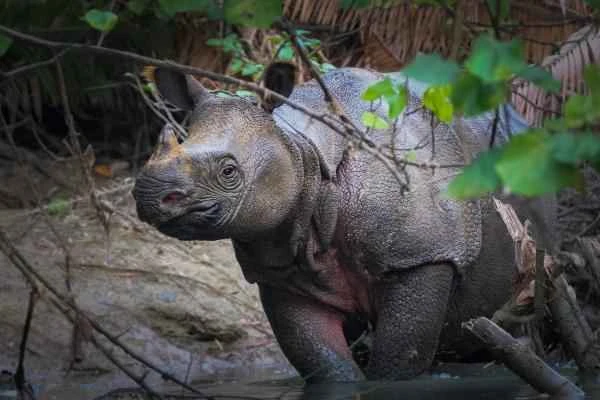
The Javan rhinoceros (Rhinoceros sondaicus) is one of the rarest and most endangered mammals in the world. Currently, only a scattered population of about 76 individuals survives on the Ujung Kulon Peninsula in western Java (Indonesia), and their numbers have been severely reduced due to poaching and habitat destruction.
This rhinoceros stands 1.4 to 1.7 meters tall at the shoulder, measures 3.1 to 3.2 meters in length, and weighs 900-2,300 kilograms. It primarily feeds on the leaves, buds, and twigs of hundreds of plants. It uses its long, pointed upper lip to pull out twigs and enter crevices created by fallen trees or landslides. Its preferred plants make up 40% of its diet. According to the IUCN Red List, the Javan rhinoceros is listed as "critically endangered."
5. Indian rhinoceros (Rhinoceros unicornis)
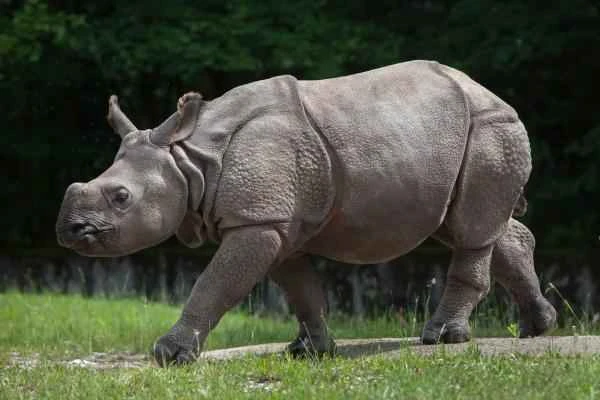
The Indian rhinoceros, or great one-horned rhinoceros (Rhinoceros unicornis), is now found in protected areas in the southern Himalayas, primarily in India (Assam) and Nepal, although its range previously extended from Pakistan to Myanmar and southern China. It prefers semi-aquatic habitats: flooded grasslands, swamps, and mineral-rich riparian forests where it can access water and natural salt sources.
Standing 1.75-2 meters tall at the shoulder and 3-3.8 meters long, the Indian rhinoceros is the second largest rhinoceros after the white rhinoceros. Their weight ranges from 1,800 to 2,700 kilograms, though records indicate they have reached as high as 3,500 kilograms. Their diet is unpredictable; they eat herbs, shoots, leaves, fruits, twigs, and aquatic plants, consuming approximately 1% of their body weight daily. Their diet includes over 180 plant species, and depending on the season, they also consume nearby pastures and crops. According to the IUCN Red List, the Indian rhinoceros is listed as "Vulnerable."