The binturong ( Arctictis binturong ), also known as the raccoon dog or bear civet , is an omnivorous mammal belonging to the subfamily Paradoxurinae of the family Viverridae. It has a strong "popcorn" smell and is relatively rare in the forests of southern Asia and Southeast Asia.
The appearance and characteristics of binturong
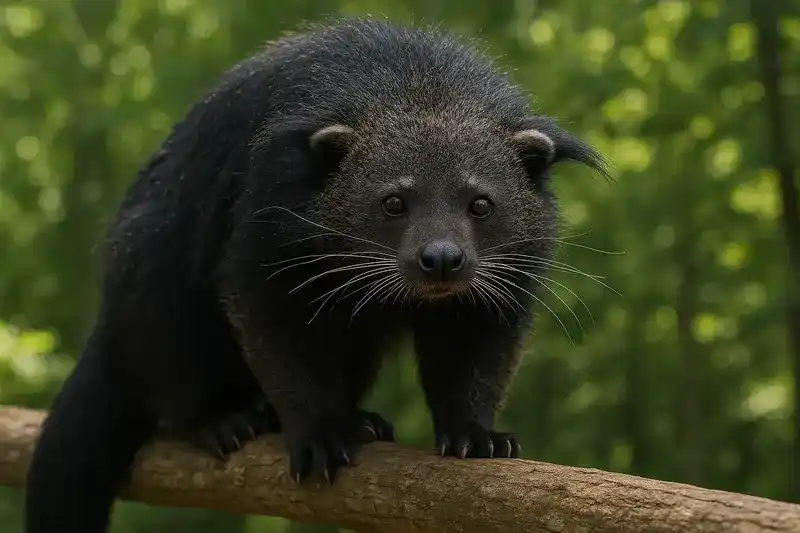
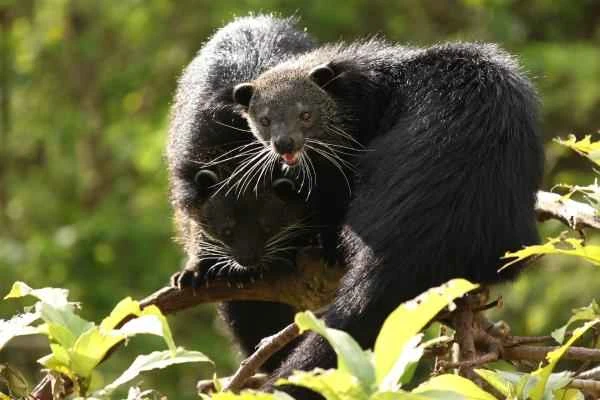
The binturong has a long and stout body with short but powerful limbs.
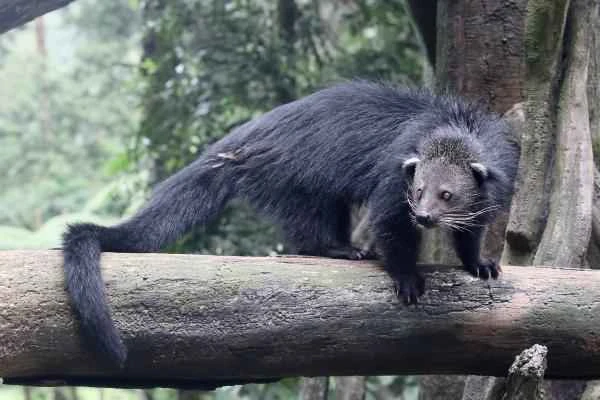
It has a grasping tail (curled tail) , which is thick at the base and gradually tapers at the end, and can curl inward to wrap around branches.
It has a short, pointed head, large, bright black eyes, and short, round ears with white edges and black tufts of hair.
Its entire body is covered with thick, dark fur, which helps it to camouflage itself in the forest; its limbs have sharp claws that can be used for defense.
It has excellent night vision, a keen sense of smell and hearing, and well-developed antennae on its nose to sense its surroundings.
Why do binturongs smell like popcorn?
Male binturongs have scent glands located between their scrotum and penis, while females have them on either side of their vulva. These glands secrete a substance that smells like popcorn , the main component of which is 2-acetyl-1-pyrroline , a substance also found in baked bread and popcorn.
Distribution and habitat of binturong
The binturong is native to South and Southeast Asia , and is distributed in India, Nepal, Bangladesh, Bhutan, Myanmar, Thailand, Malaysia, Cambodia, Vietnam, Yunnan Province in China, as well as Indonesia (Sumatra, Kalimantan, Java) and the Philippines. It prefers high-altitude forest environments between 0 and 3000 meters above sea level .
Dietary habits of binturongs
Although belonging to the order Carnivora, the binturong is an omnivorous animal that primarily feeds on fruits , with a particular fondness for figs (genus * Ficus *). Studies in northeastern India have documented binturongs consuming figs for several consecutive nights. It also consumes small mammals, birds, fish, insects, earthworms, and bird eggs.
Behavioral characteristics of binturongs
Binniles are highly arboreal animals , using their curled tails to move nimbly among the trees. However, due to their large weight, they have limited jumping ability and often need to descend to the ground to move through the forest.
It is typically a nocturnal or twilight-active animal , but in some areas lacking natural predators, it may also be diurnal. Furthermore, binturongs are excellent swimmers , enabling them to cross bodies of water in search of food or to escape threats.
It also emits a variety of vocal signals , such as grunting, screaming, and whistling, for warning, courtship, or communication. While generally docile, it can defend itself with its tail, claws, and powerful bite when threatened. However, the binturong's preferred survival strategy is stealth, moving silently through the canopy to avoid being detected .