Ophiuroidea (scientific name: *Ophiuroidea*) is a group of echinoderms that resemble starfish in appearance and inhabit a variety of environments ranging from sandy seabeds to rocky bottoms. Although they can reproduce asexually, most species are dioecious (separate sexes ). This article will introduce you to the definition, characteristics, representative species, ecological distribution, and reproductive methods of equinus.
What are snake-tailed animals?
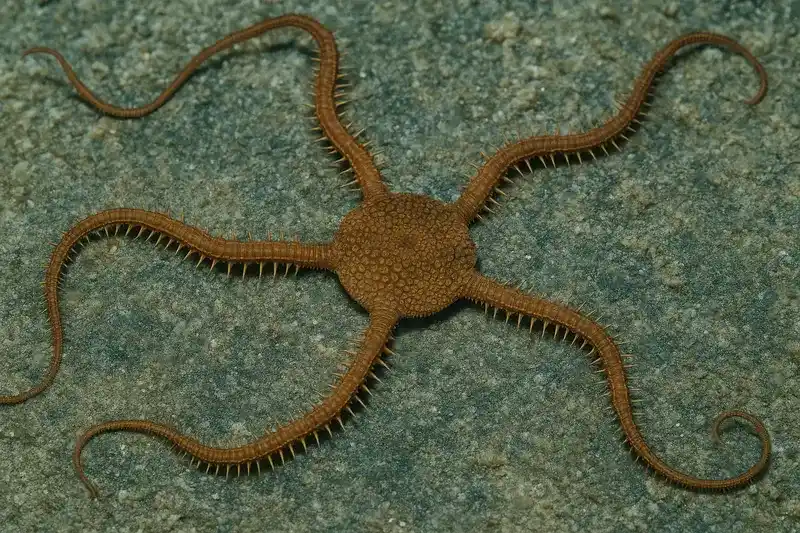
Ophiuroidea , a class of marine echinoderms (Echinodermata), are closely related to starfish but have distinct morphological differences. Their name comes from the Greek root " ophis " (snake) + " ura " (tail), referring to their slender, snake-like arms that move flexibly , hence they are often called " snake stars ."
They are often called "brittle stars" because of their fragile limbs. They are prone to limb loss when disturbed or entangled, but they can regenerate. The presence of brittle stars is usually an indicator of the health of their sedimentary environment .
Morphological characteristics of serpentine creatures
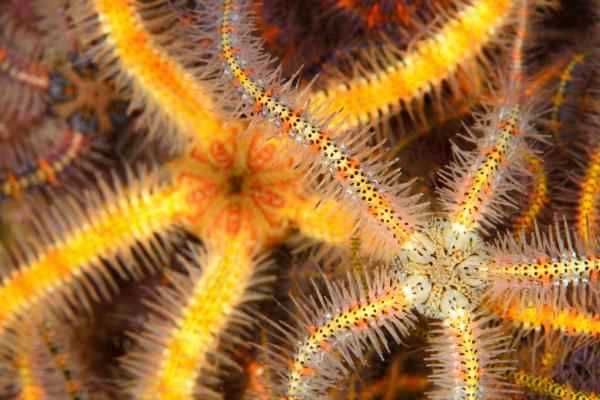
The central disc contains a calcium carbonate endoskeleton , from which five slender and flexible arms extend outwards, the longest of which can reach 60 centimeters.
Each carpal and pedicle is a highly articulated structure with extremely strong regenerative capabilities;
Unlike other echinoderms, brittle stars can move quickly using their brachiopods, and their tube feet are degenerate and not used for locomotion.
Its water pipe system has a unique structure : the sieve plate is located on the inlet surface and there are no tube foot expansion bladders;
The mouthparts consist of five movable bony plates, forming a primitive "jaw," but without a complete digestive tract;
Specifically, it has the ability to sense light and move to the shadows.
Common snake-tailed species
There are approximately 2,000 known species of brittle stars worldwide. Below are some representative species:
Amphipholis squamata : Small in size, with a central disc diameter of <5mm, arms about 4 times the length of the body disc, covered with scales, and each arm has 6-8 conical spines;
Ophiothrix fragilis (Crispy Snake Tail): Body length about 10cm, disc subpentagonal, covered with spines, lateral plates with 7 spines;
Astrospartus mediterraneus (Mediterranean feathered serpent's tail): large disc, brownish-pink, grooved, with branched arms and legs covered with granules;
Ophiopsila annulosa : Body disc approximately 14mm, slender arms 10 times the disc diameter, lateral plates with 11-12 flattened spines;
Ophiura ophiura : It can grow up to 10cm in length, with short and sturdy arms and legs, inconspicuous spines, and a grayish-orange body color.
Habitat
Bristletails are widely distributed on the seabed, from the intertidal zone to the deep sea, and their habitats include sandy areas, rocky areas, and seaweed beds . Some species can dig burrows in the sand by serpentine movement, and the burrows are often covered with mucus, with their tentacles extending out of the burrow to move around.
They are extremely common along the Mediterranean and Atlantic coasts , often appearing in shallow rocky shores, cracks between seagrass beds, and crevices in rocks.
feeding habits
Snakes feed on small organisms and organic detritus . Based on their feeding methods, they can be divided into:
Predatory species (such as Ophioderma ): use their flattened arms to capture small worms, mollusks, and crustaceans;
Suspended feeding species (such as Ophiothrix ): form a slimy web between their arms to capture floating objects in the water;
Saprophytic species : They feed on organic matter in sediments; some are highly selective about their food, while others are more indiscriminate.
Reproduction methods
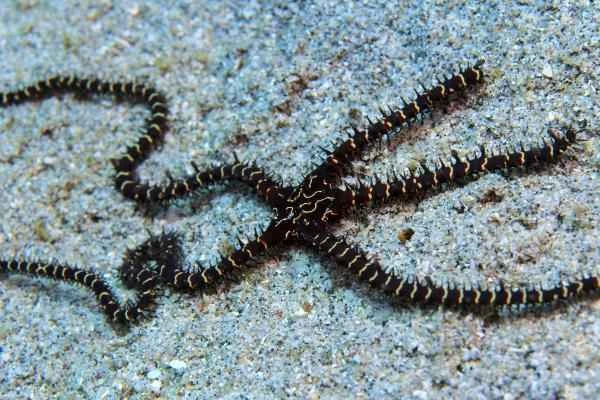
Most brittle stars are dioecious (gonochoric), with their gonads located on the walls of their bursa, which connects to their body cavity . Sperm and eggs are released through the bursa wall into the seawater, where fertilization occurs externally.
Some species are hermaphroditic , exhibiting a developmental pattern of male-to-female (originally male) development . They also possess asexual reproduction capabilities ; for example, an individual can regenerate a complete limb after it has been severed.
Difference from starfish
The arms of brittle stars are slender and clearly connected to the body disc , while those of starfish are short, thick, and gradually connected.
The oral surface does not have an open tube foot groove , but is closed and covered by bone plates;
Its tube feet lack suckers and are primarily used for feeding rather than locomotion;
The reproductive and digestive organs are concentrated in the body disc, while those of the starfish are distributed in the arms;
Its vascular system is simple, without valves , and more primitive than that of a starfish.