Sea snakes are a group of venomous snakes highly adapted to marine life, belonging to the subfamily Hydrophiinae within the family Elapidae. They are widely distributed in the tropical coastal waters of the Indian and Pacific Oceans , possessing a range of adaptive features such as paddle-shaped tails, the ability to breathe through their skin, and laterally flattened bodies . This article will introduce you to the ecological characteristics of sea snakes, representative species, and their dangers.
What is a sea snake?
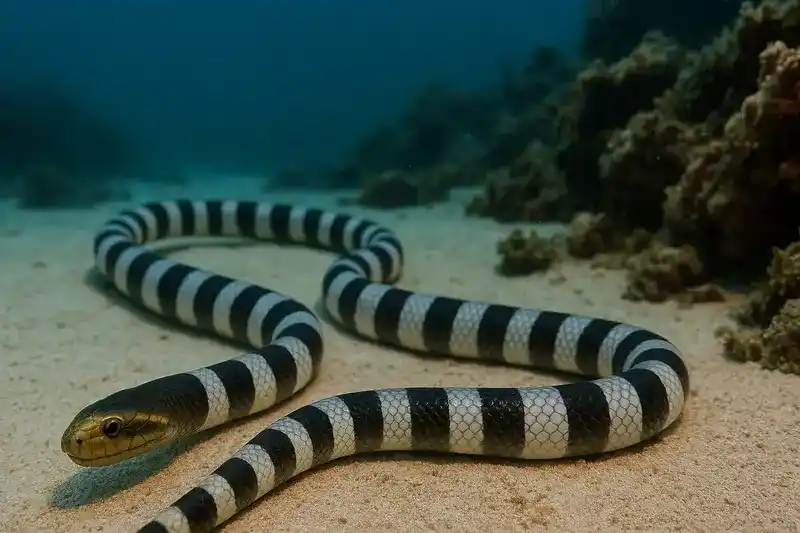
Sea snakes are vertebrates, belonging to the venomous snake family , and evolved from terrestrial snakes. The vast majority of sea snakes are entirely aquatic and unable to move on land. Only the genus *Laticauda* retains some primitive characteristics and can move slowly and reproduce on land.
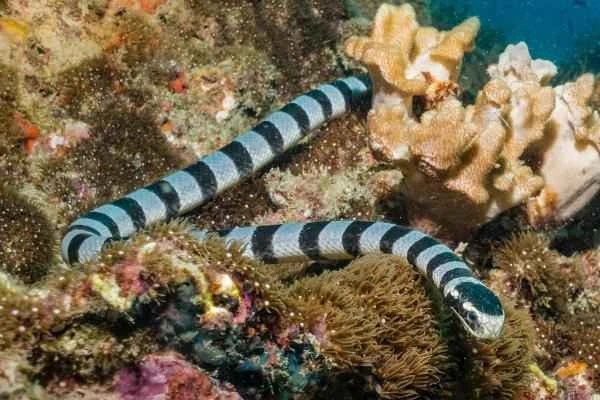
Key characteristics of sea snakes
The subfamily Hydrophiinae comprises approximately 62 species distributed across 17 genera.
Adults typically range in length from 120 to 150 centimeters, with the **spiral sea snake (Hydrophis spiralis)** reaching up to 3 meters in length.
It has no gills and breathes only through its lungs ;
The nostrils have a valve structure to block water, and the trachea can extend to the top of the mouth, which is conducive to breathing while floating on the water surface;
Some oxygen can be absorbed through the skin ; for example, the yellow-black sea snake ( Hydrophis platurus ) can obtain up to 25% oxygen through its skin.
It has sublingual salt-excreting glands , which help it expel excess salt from its body through the tongue;
Its tail has a paddle-like structure , which facilitates efficient swimming;
In most species, the ventral scales have degenerated and are no longer suitable for terrestrial movement, but the genus Laticauda still retains complete ventral scales;
They primarily prey on fish (especially eels) , and some species also consume shellfish and crustaceans;
Except for the genus Laticauda, other sea snakes are ovoviviparous (they hatch internally and give birth to live young directly).
Are sea snakes dangerous?
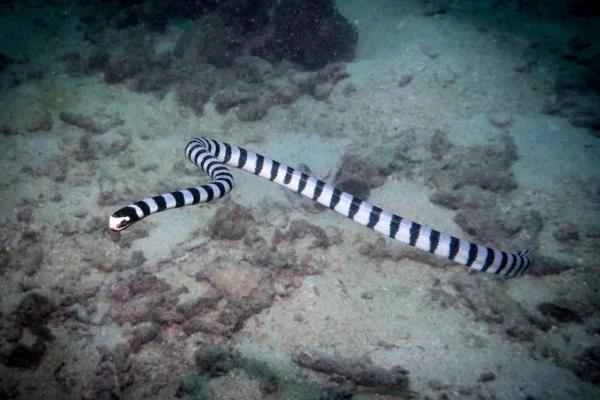
Sea snake venom is myotoxic and nephrotoxic , rapidly paralyzing prey and damaging muscle tissue and kidney function. The most venomous is that of the hook-nosed sea snake ( Enhydrina schistosa ) , where only 0.02 mg/kg of venom is fatal, making it more toxic than most terrestrial snakes.
Despite their potent venom, sea snakes are generally docile and do not actively attack humans . They mostly avoid people, only biting when accidentally scratched or subjected to strong provocation.
Sea snake species
1. Yellow-black sea snake ( Hydrophis platurus )
Widely distributed in the Pacific Ocean , it has a dark gray body with yellow stripes on its sides, narrow ventral scales, and a tail tip that is often yellow. It is highly venomous and faces environmental threats such as ghost fishing nets and pollution.
2. Striped sea snake ( Laticauda colubrina )
Living in the tropical waters of the Indo-Pacific , it has a slender body with a blue or yellow base and black bands. It can move and lay eggs on land. Although highly venomous, it is docile.
3. Large sea snake ( Hydrophis major )
Distributed along the coasts of the Indian Ocean and the western Pacific Ocean , it has a flattened body, ranging in color from yellowish-green to brownish-gray, with indistinct patterns, and primarily preys on fish.
4. Short-snouted sea snake ( Aipysurus apraefrontalis )
Native to northwestern Australia , it measures about 60 cm in length, has a short, pointed head, and dark purplish-brown stripes on its body. It was once thought to be partially extinct at Ashmore and Hibernia Reef, but remnant populations have now been found along the coasts of Exmouth and Broome.
summary
Despite their potent venom, most sea snakes are docile and important predators in marine ecosystems , helping to maintain the balance of fish populations. Research on them is of great significance for both marine conservation and human safety.