Bird colors are incredibly diverse, likely due to factors such as species cooperation, predator avoidance, and attracting mates. Furthermore, bird colors carry different symbolic meanings and interpretations in different cultures and traditions. Do you know which birds in my country are red? This article introduces some of the most auspicious birds in my country—red birds, including the Bloodfinch, Red-headed Trogon, Scarlet Minivet, Crested Oriole, Red-winged Laughingthrush, Great Rosefinch, Golden-eyed Laughingthrush, White-capped Water Robin, Blue-throated Sunbird, and Silver-eared Leiothrix. How many of these birds do you recognize? Let's take a look!

1. Blood Bird
The Bloodfinch is an uncommon resident bird in my country, found in southeastern Tibet, western and southern Yunnan. It inhabits evergreen or mature fir forests at altitudes of 1600-3400 meters, typically found in forest gaps or edges, alone or in small groups. It has a thick beak; the male is strikingly scarlet, with blackish flight feathers edged in red. The female has olive-brown upperparts, a yellow rump, and grey underparts with darker mottled markings. Juvenile males resemble females but have brown upperparts and a more orange-yellow rump. The iris is dark brown, the upper beak is pinkish-brown, the lower beak is horny-yellow, and the legs are pinkish-brown. The Bloodfinch is a beautiful ornamental bird; due to its extremely small population, hunting should be strictly prohibited for its conservation.
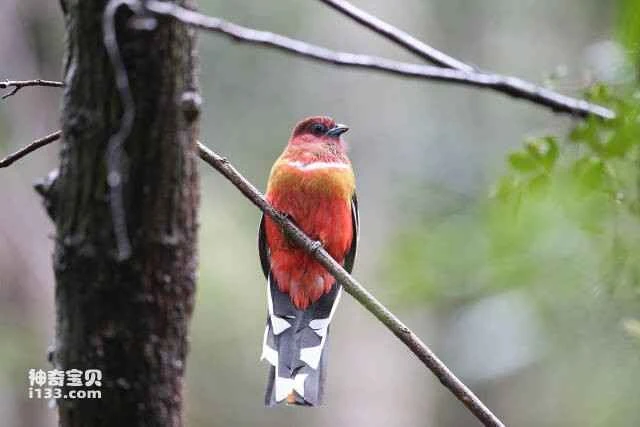
2. Red-headed Trogon
The Red-headed Trogon is 31-35 cm in length. It has a predominantly red body, is large, with a round head and long tail. The male has a red head, a narrow crescent-shaped white ring on its red breast, and lacks a collar on its back. The female has a yellowish-brown head, distinguishing it from other trogons; its red breast and abdomen are less vibrant than the male's, and it has a crescent-shaped white ring on its lower breast. Its iris is brown, the bare skin around its eyes is blue, its beak is nearly blue, and its legs are pinkish. In China, it is found in southwestern, central, and southern regions. It prefers to perch alone or in pairs on low branches in dense forests, taking flight from its roost to hunt for food. It is found in tropical and subtropical forests, up to an altitude of 2400 meters.
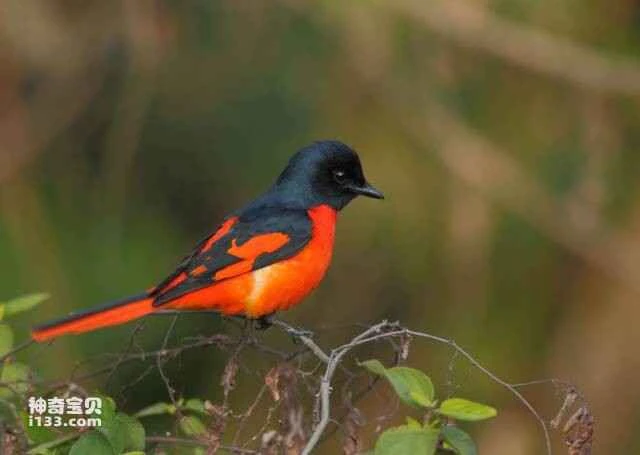
3. Red-crowned Minnow
The Scarlet Minivet, also known as the Red Cross Minivet or Crimson Minivet, is a species of miniature bird. The male is red, while the female is yellow. The male has red breast, belly, rump feathers, wing patches, and lateral tail feathers, while the rest is bluish-black; the wing patches are shaped like the character "刁" (diāo). The red parts of the male appear yellow on the female, with a grey crown and upper back, and orange-yellow forehead and cheeks. The wing patches distinguish it from other minivets. The iris is dark brown, the beak is black, and the legs are black. In my country, it is distributed in southeastern Tibet, Yunnan, Guizhou, Hunan, Guangxi, Guangdong, Fujian, and Hainan Island. It mainly inhabits broad-leaved forests, rainforests, and monsoon forests in hilly and plain areas at low to medium altitudes, and is also found in mixed coniferous and broad-leaved forests, coniferous forests, and shrublands. Outside the breeding season, it often flocks in the canopy.
4. Red Oriole
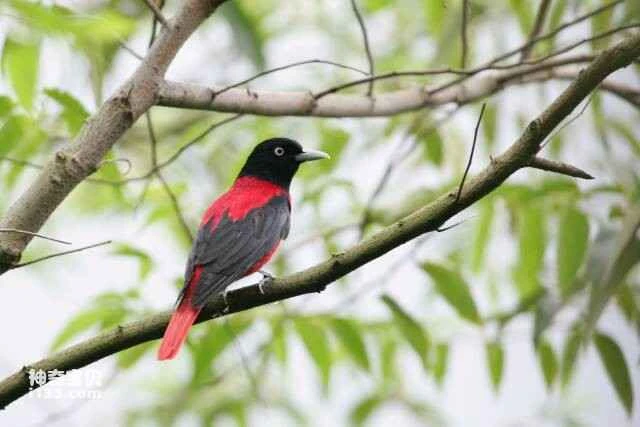
The Crested Oriole is a medium-sized bird, measuring 23-28 cm in length, with predominantly chestnut-red plumage. The male has a glossy black head, neck, and upper breast; black wings without wing patches; and the rest of its plumage is chestnut-red. The female has a chestnut-brown upper back, a chestnut-red rump, upper tail coverts, and rump; and white underparts with black streaks, resembling the female Magpie-Orioles but with a darker upperpart. The iris is yellowish-white, the beak is bluish-grey, and the legs are lead-grey. In my country, it is found in southeastern Tibet, eastern Yunnan, Hainan Island, and Taiwan. It inhabits a variety of habitats, including plains, hills, and mountain forests, and is found in broadleaf forests, mixed forests, and coniferous forests, primarily in the canopy.
5. Red-winged Bush Babbler
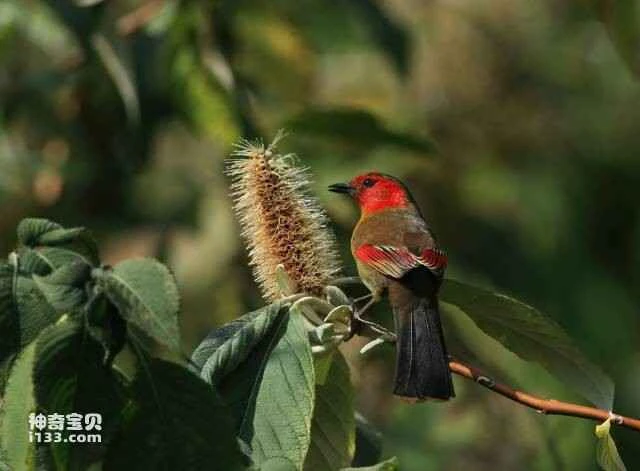
The Red-winged Bush Babbler is the largest of the bush babblers. It has an olive-grey crown, a bright red face, neck, chin, and upper throat, while the rest of its plumage is olive-green. Its wings have red and orange wing patches, white edges on the flight feathers, and a square tail with dark olive-brown uppertail coverts with fine black horizontal stripes, ending in a light brown tip. The iris is reddish-brown, the beak is horny black, and the legs are horny-grey. In my country, it is found in southwestern, southern, and southeastern Yunnan. It inhabits evergreen broad-leaved forests in low to medium altitude mountains, and is also found in secondary forests, plantations, and forest edge thickets. It is solitary or in small groups, foraging in the lower and middle layers of vegetation, and its song is melodious.
6. Great Vermilion Bird
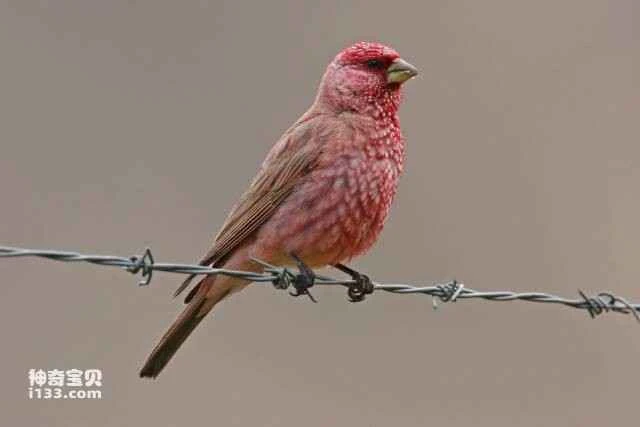
The Greater Rosefinch is larger and more robust than the Common Rosefinch, with a larger beak and longer wings and tail. Both males and females resemble the Lesser Rosefinch, but the male has a deeper red on its forehead, face, and upper chest, larger white spots, and more frosty white overall. Its cheeks, nape, upper back, and rump are a single shade of red or pink, and it has fewer longitudinal stripes on its upperparts. The female's underparts are greyish-yellow with dense longitudinal stripes, while the stripes on her upper back are sparser, and there are fewer stripes on her nape and rump. Individuals distributed in Xinjiang and northwestern Qinghai-Tibet Plateau are very pale in color. The iris is dark brown, the beak is horny yellow, and the legs are dark brown. In China, it is found in Xinjiang and the Qinghai-Tibet Plateau. In summer, it inhabits rocky scree slopes and alpine meadows above the treeline, and in winter it descends to villages and fields, often mixing with other rosefinch species.
7. Golden-eyed Babbler
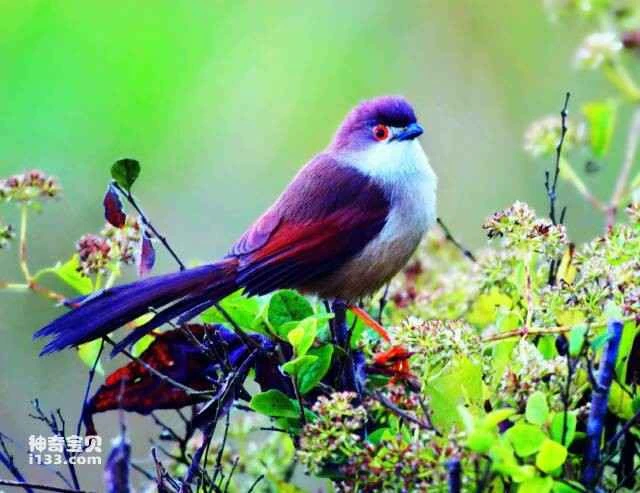
The Golden-eyed Babbler is a small bird of the warbler family, measuring 16-20 cm in length. Its head, cheeks, and upperparts are brownish-brown, with chestnut-red wings and a short, fine white supercilium. The lower cheeks, chin, throat, and lowerparts are white, while the flanks and undertail coverts are tinged with brown. It resembles the Baoxing Babbler but is larger. Its iris is yellowish-white with a distinct red eye-ring, its beak is black, and its legs are orange-yellow. In my country, it is found in western, southwestern, southern, and southeastern Yunnan, central and southern Guizhou, western Guangxi, and Guangdong. It is often found alone or in pairs in low-altitude mountainous areas and plains, in forest edges, wastelands, river valleys, and bamboo forests. It is also found in parks, farmland, nurseries, and reed beds. It is lively, with a loud and easily spotted song.
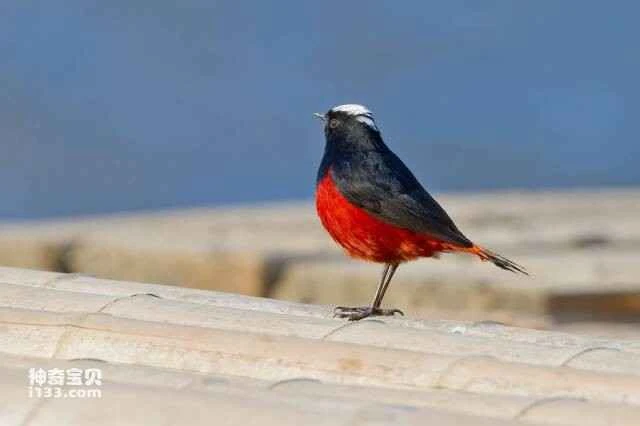
8. White-capped Water Robin
The White-capped Water Robin is relatively large, with males and females having similar plumage. The head, back, wings, chin, throat, and breast are black, while the crown and nape are white. The base of the tail and upper tail coverts are red with black tips, and the lower breast, abdomen, and undertail coverts are red. It resembles the Red-bellied Redtail Robin but lacks the white wing patches. The iris is black, the beak is horny black, and the legs are greyish-black. In my country, it is found in southern Tibet, far western Xinjiang, Qinghai, Gansu, Ningxia, and North, East, South, and Southwest China. It is often seen solitary in mountainous areas with many streams and small rivers. Outside the breeding season, some migrate to lower latitudes or plains to overwinter. When perched, its wings droop, and its tail is often held high. Its call is delicate yet penetrating.
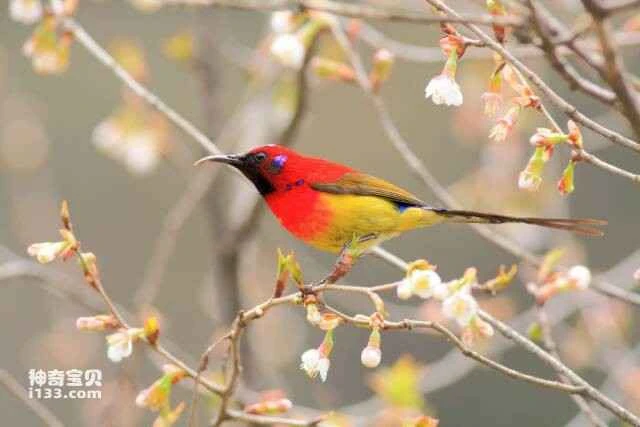
9. Blue-throated Sunbird
The Blue-throated Sunbird is slightly larger, with a long, curved beak. The male has a bright purplish-blue, fish-scale-like crown, eye stripe, and chin; the rest of the head and upper back are scarlet; flight feathers are olive; rump is yellow; tail is blue and elongated; the breast is a paler scarlet fading to bright yellow downwards. Individuals in the Himalayas have less red on the breast, only stripes. The female has olive upperparts, greenish-yellow underparts, and a smoky olive chin and throat. Iris is brown, beak is black, and legs are brown. In my country, it is distributed in the southwest region, commonly found in evergreen forests at altitudes of 1200–4300 meters. In spring, it often mixes with other birds to feed in rhododendron thickets; in summer, it is active in raspberry thickets and other berry-bearing thickets; and in winter, it migrates downwards.
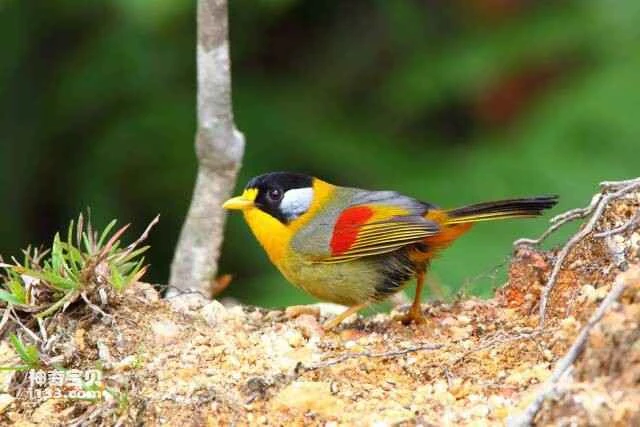
10. Silver-eared Lovebird
The Silver-eared Leiothrix measures 15.5-17 cm in length. It has a black head with silvery-white ear feathers, a bright yellow forehead, an orange-red chin, throat, breast, nape, and upper abdomen, a dark olive-grey upper back, bright red to bright yellow patches on its flight feathers, a brownish-red rump, grey flanks and lower abdomen, red rump feathers, and greyish-black tail feathers with yellow or red outer tail feathers. The tail feathers are square and indistinctly forked, unlike the Red-billed Leiothrix. It has a reddish-brown iris, an orange-yellow beak, and orange-yellow to pinkish-brown legs. In China, it is found in Yunnan, Guizhou, Guangxi, and southeastern Tibet. It usually inhabits alone or in small groups in low to mid-altitude evergreen broad-leaved forests, secondary thickets, and forest edges. It is also found in nurseries, orchards, and parks, and is active in the lower and middle layers of vegetation. It is lively and unafraid of humans, and primarily forages on the ground.
The above ten red birds are compiled based on relevant information and ranked accordingly. They are for reference only. If you have any questions, please feel free to comment/criticize at the end.