You may have seen a small animal with "extra legs" crawling quickly in the garden soil, under stones, beside piles of fallen leaves, or on damp paths. They mostly belong to a class of terrestrial invertebrates— myriapods (often simply called "myriapods") . This large class includes familiar creatures like centipedes and millipedes, as well as smaller, often overlooked, closely related groups.
What are myriapods?
Myriapods are a group of terrestrial invertebrates belonging to the phylum Arthropoda . Currently, over 16,550 species of myriapods have been recorded, some of which possess venom or secrete irritating defensive substances. In evolutionary history studies, some ancient arthropods have been discussed as possible early relatives or related lineages of myriapods, for example:
Examples of ancient arthropods that are frequently mentioned
Tokummia katalepsis (approximately 507 million years ago, Cambrian period)
Necrogammarus salweryi and Archidesmus loganensis (approximately 455 million years ago, Silurian period)
Main characteristics of myriapods
In ancient times, some fossil relatives of myriapods included members of enormous size (some exceeding 1 meter in length). Although modern myriapods are smaller overall, they still retain typical features of their basic body structure.
Body size range
The differences between species are enormous: ranging from about 0.2 millimeters to about 26 centimeters .
A few species can exceed 30 centimeters in length.
Exoskeleton
The body is covered by a hard exoskeleton , which provides support and protection.
Head structure
A pair of antennae .
Sensory structures such as the Tömösvary organ (found in many myriapods).
The large jaws are used for feeding.
Some species have ocelli , while others are completely eyeless .
Trunk and segments
The body is slender and consists of approximately 11 to 181 segments .
The legs are differentiated from the body segments, and the number and arrangement of the legs vary significantly among different taxa.
The four major groups of myriapods
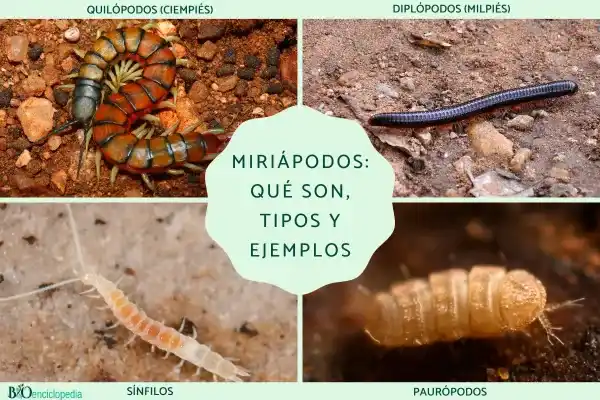
Modern myriapods are generally divided into four classes . They differ significantly in body size, leg arrangement, locomotion, and diet.
1) Chilopoda (centipedes)
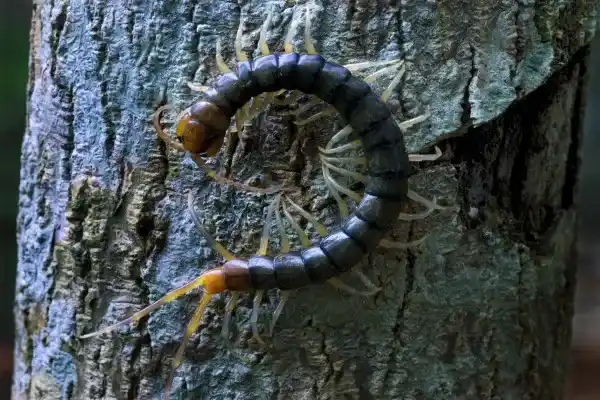
Centipedes are mostly predators with relatively flat bodies, and usually only one pair of legs per segment .
Body shape and structure
Common body length is 1–2 cm , with larger species reaching about 30 cm .
The number of trunk segments can vary between approximately 19 and 181 .
Many species commonly have about 15 pairs of legs , but there are significant differences between different lineages.
Sensation and Activity
They have well-developed antennae, and some species have simple eyes.
They are mostly active at night or in dimly lit environments and move quickly.
diversity
More than 2,500 species of centipedes have been described to date.
2) Diplopoda (millipedes)
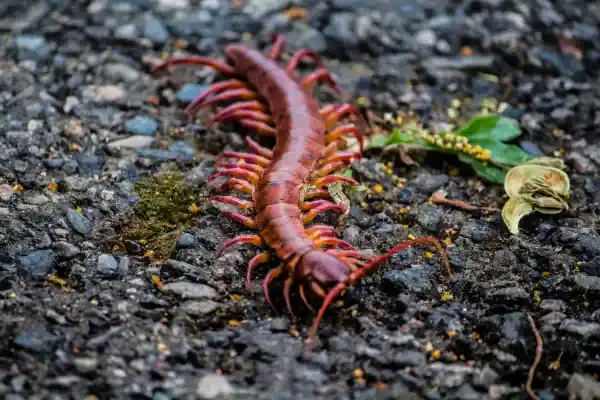
Millipedes are mostly cylindrical in shape, and their body segments often have a "two-in-one" structure, so a complex body segment often has two pairs of legs .
Body shape and structure
Their body length is mostly 1–30 cm .
Although commonly known as a "millipede," it actually has between 34 and 400 legs , not a true thousand.
diversity
More than 12,000 species of millipedes have been described to date.
3) Symphyla (short-legged insects)
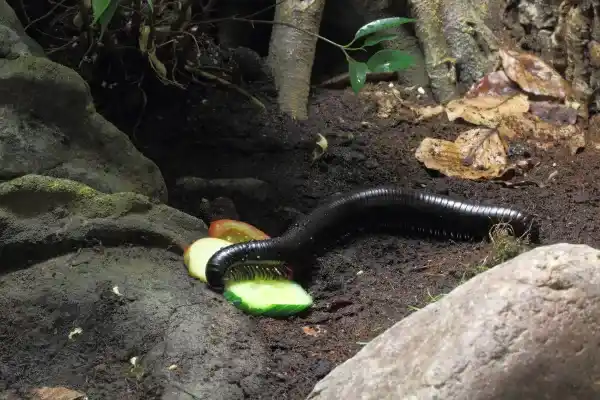
The centipede is extremely small and mainly lives in the soil and humus layer, making it difficult to see with the naked eye.
Body shape and structure
Typically, it does not exceed 8 millimeters .
It typically has 12 pairs of legs .
It has no eyes .
diversity
Approximately 200 species have been recorded.
4) Pauropoda (Synoptera)
Synpods are the smallest group of myriapods, and they mostly hide in moist soil and leaf litter.
Body shape and structure
Their body length is usually no more than 2 millimeters .
Antennae are often forked .
It typically has 9–11 pairs of feet .
It has no eyes .
diversity
Approximately 600 species have been discovered.
Habitat of Myriapoda
Most myriapods prefer moist environments because they are prone to water loss, and are therefore commonly found in soil, under decaying wood, under rocks, in piles of fallen leaves, and in damp crevices. However, a few species can adapt to arid or semi-desert conditions, typically relying on hiding in moist microenvironments to survive hot and dry periods.
Distribution characteristics
It is commonly found in tropical and temperate regions.
They are generally not found in cold, high-altitude areas or polar environments .
Behavioral characteristics of myriapods
Many members of the myriapoda are nocturnal , often hiding in dark and damp places during the day and coming out at night to forage or move around.
Common defense methods
They curl up to protect their softer ventral side (more common in millipedes).
Some species will bite people or predators , accompanied by irritating secretions.
Some types can release irritating chemicals or cause discomfort through their tiny structures.
Is it dangerous to people?
In most cases, defenses or bites from myriapods are not fatal , but can cause pain and skin reactions. In humans, common symptoms include swelling, erythema, and localized burning pain , which can last for one or two days, depending on the species and individual sensitivities.
What do myriapods eat?
Different groups exhibit significant differences in their diets, and they can act as predators, decomposers, or herbivores in the ecosystem.
Centipedes (Chemopoda)
Most are active predators .
It can subdue its prey by injecting venom through its specialized mouthparts.
Millipedes (Cyclopoda)
It is often associated with humus and decaying plants .
Some species may also opportunistically feed on small animals or other organic matter.
Oligopoda (Solidiopoda)
They primarily feed on plant-based foods and live in soil environments.
Synpoda (Synpoda worms)
They are mostly scavengers , preferring to feed on organic matter that is decomposing.
How do myriapods reproduce?
Myriapods primarily reproduce sexually, and their fertilization methods can be categorized into different strategies.
Method of fertilization
Direct mating : Sperm transfer is accomplished through specialized reproductive structures.
Spermatophore transfer : The male places the spermatophore near the female, who then retrieves it and fertilizes her inside her body.
Egg laying and egg protection
After fertilization, females often establish safe spawning sites in the soil or rock crevices.
Some species can lay about 300 eggs at a time.
In some groups, females will guard the eggs for a period of time, and the hatchlings may also stay close to the mother's activity area for a short period after hatching.
Examples of myriapods
The following are some examples of scientific names for myriapods (mainly centipede-related species) to demonstrate their species diversity:
Cormocephalus venezuelianus
Otostigmus carbonelli
Rhysida caripensis
Cryptops venezuelae
Newportia andina
Newportia autanensis
Newportia guaiquinimensis
Newportia pilosa
Ribautia tropica
Ribautia vivasberthier
Geophilus venezuelae
Koinethmus guanereus
Sphendononema guildingii
Notiphilides maximiliani
Titanophilus hasei
Cerethmus naiquatanus