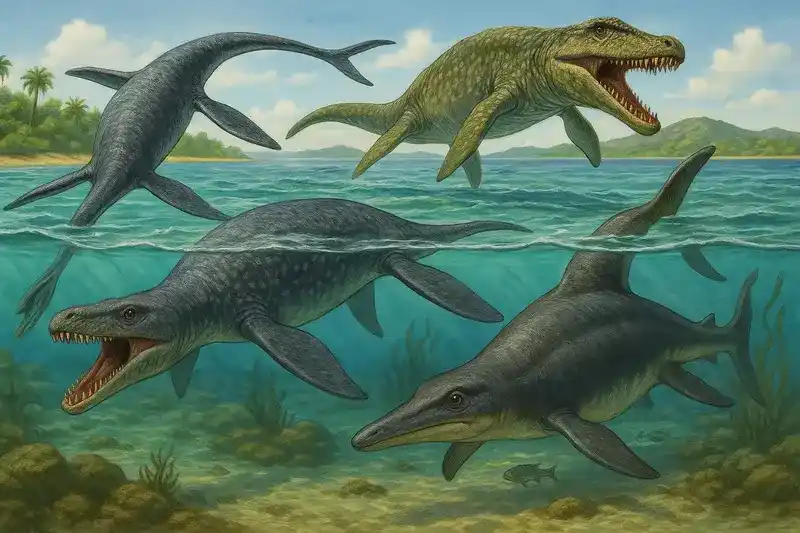
Aquatic reptiles are a group of cold-blooded animals adapted to both marine and freshwater environments . They possess dry, scaly skin and primarily breathe through their lungs. In water, they lower their metabolic rate to reduce oxygen consumption. Historically, many fossil species of aquatic reptiles have existed, such as ichthyosaurs, plesiosaurs, and mosasaurs . This article will introduce their main characteristics, respiratory methods, species, and representative examples from modern and prehistoric times.
What are aquatic reptiles? What are their characteristics?
Aquatic reptiles are reptiles that evolved from terrestrial ancestors and later adapted to aquatic environments . They include about 100 species of reptiles living in marine and freshwater environments , including 7 species of sea turtles and about 80 species of sea snakes.
Key features include:
Ephemerism (exothermicity) : Dependent on external temperature to regulate body temperature, thus they are mostly distributed in tropical and subtropical seas;
Dry, scaly skin : Prevents moisture loss and adapts to survival in saline water;
Salt gland function : Most marine species have salt excretion glands , which expel excess salt through a special structure;
The nostrils have valve-like structures : they can close to prevent water from entering when diving, and the lungs can store a large amount of air to prolong the time spent underwater;
Morphological evolution : such as the limbs evolving into flippers or the tail being laterally flattened, which facilitates swimming in water.
How do aquatic reptiles breathe?
Aquatic reptiles primarily breathe through their lungs and must surface to breathe oxygen. However, they possess various adaptations to extend their diving time:
Lowering the metabolic rate : reduces oxygen demand;
Anaerobic metabolism : ATP can be synthesized even without oxygen in the short term;
Oxygen absorption through the skin or mouth : Some sea snakes and freshwater turtles can absorb oxygen from the water through their skin or pharynx;
Elongated lungs : For example, the lungs of sea snakes can extend to most of their bodies, increasing oxygen storage.
For example:
Water snakes of the genera Acrochordus and Cerberus can dive for up to 30 minutes.
Green sea turtles (Chelonia mydas) can dive for up to 50 minutes;
Sea snakes (such as the Hydropis) sustain long dives by using long lungs.
Types of aquatic reptiles
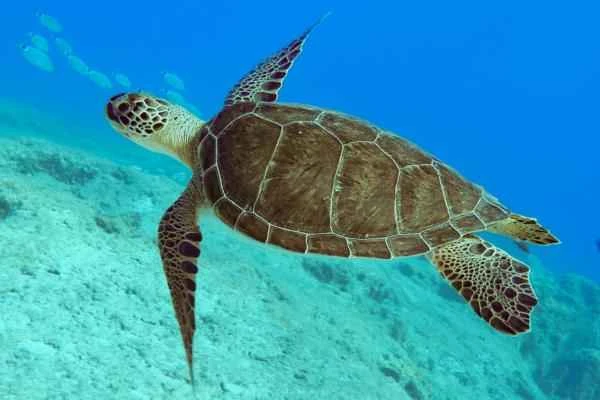
Sea turtles (such as leatherback turtles , Dermochelys coriacea )
They belong to the order Testudines; their limbs have evolved into flippers, adapted for swimming.
Distributed in oceans worldwide (except polar regions);
They have a diverse diet, ranging from seaweed and seagrass to crustaceans;
The largest individuals can reach a length of 2.2 meters and weigh over 700 kilograms.
Sea snakes (Hydrophiinae subfamily)
All species are poisonous, and their tails are laterally flattened and "paddle-shaped".
There are approximately 62 species, which mainly feed on fish and small marine organisms;
They are highly marine, with only the genus *Laticauda* still able to reproduce on land.
Marine iguana ( Amblyrhynchus cristatus )
Endemic to the Galapagos Islands, it is the only lizard that lives entirely in water ;
They feed on seaweed and will dive into the sea to feed.
Saltwater crocodile/Brine crocodile (such as Crocodylus porosus)
One of the largest reptiles, it can live in both saltwater and freshwater;
They are carnivorous, and their prey includes fish, birds, and crustaceans.
Although it is possible to enter the sea, I prefer mangroves and estuaries.
Modern and prehistoric representatives of aquatic reptiles
Modern representatives:
Sea turtles: Caretta caretta (log turtle), Chelonia mydas (green sea turtle), Eretmochelys imbricata (hawksbill turtle)
Sea snakes: Hydrophis platurus , Hydrophis belcheri , Laticauda colubrina
Marine iguana: Amblyrhynchus cristatus
Saltwater crocodile: Crocodylus porosus , C. palustris , C. acutus
Prehistoric representative:
Ichthyosaurs : They appeared in the Triassic period, with a form between fish and dolphins, ranging in length from 1 to 26 meters, and possessing conical teeth and large eyes;
Placodonts : Triassic reptiles with flat, plate-like teeth, feeding exclusively on mollusks, measuring 1–3 meters in length;
Plesiosaurs : Jurassic period, with four flipper-like limbs, divided into long-necked and short-necked types;
Thalattosuchia : Marine crocodiles from the Early Jurassic period, with flippers and smooth skin;
Mosasaurus : A marine monitor lizard from the Late Cretaceous period, resembling a giant monitor lizard, viviparous, and possessing a powerful propulsive tail fin.