Cervidae is a highly diverse family of mammals, including deer, reindeer, elk, and sambar deer . They generally possess antlers , which are bony structures used for competition and display during the mating season.
This article will give you a comprehensive understanding of the classification system of deer, the characteristics of each subfamily, representative species, and their geographical distribution and habitat.
Taxonomic status of deer (Cervidae)
Cervidae belong to the order Artiodactyla, and are one of the most representative groups of ungulates. Their basic classification is as follows:
Kingdom: Animalia
Phylum: Chordata
Class: Mammalia
Order: Artiodactyla
Family: Cervidae
The Cervidae family is divided into three main subfamilies:
Cervinae (Old World Deer)
Capreolinae (New World Deer)
Hydropotinae (Subfamily Salamanderinae)
Cervinae (Old World Deer)
This subfamily, also known as the "Protoceratops subfamily," is mainly distributed across Eurasia , with some individuals introduced to other regions by human activities. They range in size from medium to large and are adapted to a variety of ecological environments, from high mountains to tropical forests.
feature:
Males typically possess well-developed antlers and exhibit significant sexual dimorphism.
Some species, such as those in the genus *Muntiacus*, have short antlers and well-developed canines (especially in males).
Their habitats are diverse, including forests, mountains, grasslands, and tropical regions.
Representative species:
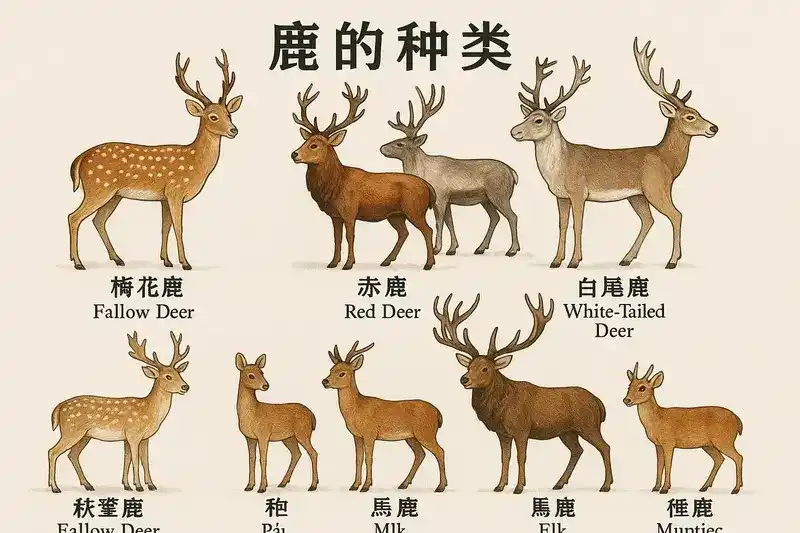
Cervus elaphus (European red deer/common deer)
Cervus nippon (sika deer)
Dama dama (spotted deer/Dama deer)
Elaphodus cephalophus (Serow/Crowned Deer)
Capreolinae (New World Deer)
This subfamily, also known as the "Cervidae" or "Cervidae", is mainly distributed in the Americas , but also includes Eurasian species such as the **caribou (Rangifer tarandus)**.
feature:
Deer antlers are usually straight with few branches;
Sexual differences were less significant in Cervinae;
It is distributed from the Arctic tundra to the tropical rainforests of South America;
They exhibit a high degree of flexibility in ecological adaptation, habitat range, and body size.
Representative species:
Odocoileus virginianus (White-tailed Deer)
Odocoileus hemionus (mule deer)
Rangifer tarandus (reindeer/caribou)
Alces alces (moose/elk)
Hydropotinae (Subfamily Salamanderinae)
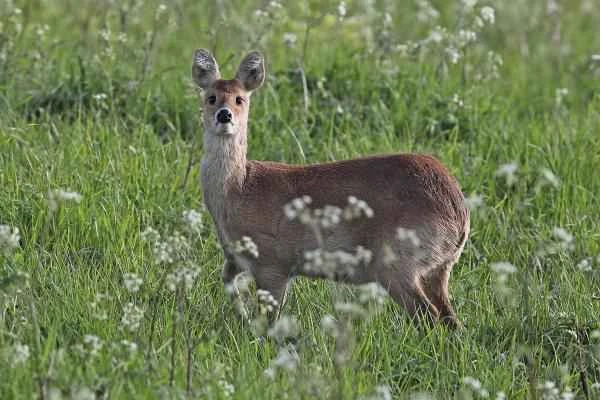
This subfamily contains only one extant species— the Chinese water deer (Hydropotes inermis) .
feature:
Distributed in China and the Korean Peninsula;
Inhabits wetlands, swamps, and riverbanks ;
Unlike other deer, the sambar deer does not have antlers ;
Males have prominent canines (fangs) used for fighting;
Small in size, it is a typical elusive species.
Geographical distribution and habitat of deer
Cervidae are widely distributed across all continents except Antarctica, Australia, and some islands. They inhabit a variety of ecosystems, including:
Tundra and frigid regions : Possessing thick fur and large hooves;
Forests (both frigid and temperate zones) : Adapted to seasonal food changes;
Tropical rainforests : smaller in size, adapted to dense vegetation;
Grasslands and savannas : Long limbs, fast running speed;
Mountainous and rocky terrain : the hoof shape is adapted for rock climbing;
Near wetlands and water bodies : such as water deer, which are capable of swimming.