In 1861, the oldest known bird fossil was discovered in the Upper Jurassic limestone (i.e., limestone strata formed in the Late Jurassic period) of Solnhofen, Bavaria, Germany. Not only were the skeletons preserved, but traces of feathers were also found. It was named Archaeopteryx. Since then, a total of seven Archaeopteryx fossils have been unearthed in Solnhofen.
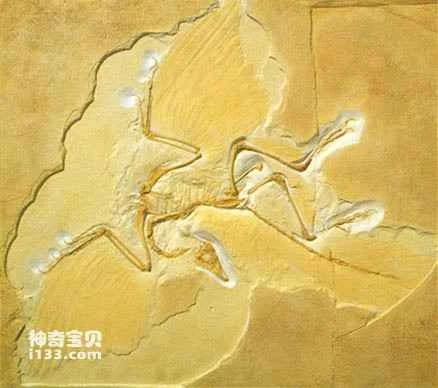
Archaeopteryx
Archaeopteryx was about the size of a crow. It retained many reptilian features: for example, it had teeth instead of the horny beaks of modern birds; a long tail composed of 21 caudal vertebrae; its three metacarpal bones on its forelimbs were separate and not fused into carpal metacarpals; it had claws at the tips of its fingers; and its skeleton lacked air fossae; etc. However, it already possessed feathers, and had differentiated into primary flight feathers, secondary flight feathers, tail feathers, and coverts—all avian characteristics. Furthermore, it exhibited other avian or transitional skeletal features, such as its third metacarpal bone being fused with the carpal bone, while the second and first metacarpal bones were not. Some scientists believe this reflects the beginning of fusion of metacarpal bones into carpal metacarpals in birds. Because avian features evolved and developed based on reptilian characteristics, some jokingly refer to birds as "aestheticized reptiles."
Because Archaeopteryx's skeletal structure is so similar to that of a small carnivorous theropod dinosaur called Coelurosaurus, some have long believed that birds originated from Coelurosaurus and speculated that birds inherited their high metabolic rate from those dinosaurs, meaning that some small carnivorous dinosaurs may have already been warm-blooded. Others have even speculated that the development of feathers was not necessarily related to flight, and that it may have already been common in primitive theropod dinosaurs.
The numerous reptile-like features preserved in Archaeopteryx indicate that its mechanisms for flight were still far from perfect, suggesting it could only glide at low altitudes. So how did Archaeopteryx transition from walking on land to gliding through the sky? Scientists have two opinions on this.
One theory suggests that it was originally an animal adept at running. Starting with running, it used its forelimbs to flap the air and increase speed. During this process, variations of the primitive feathers that evolved from scales on its forelimbs gradually improved, eventually developing feathered wings. From these wings, it began to leave the ground and glide through the air. This theory is known as the "running theory" of the origin of avian flight.
Another view holds that Archaeopteryx was originally arboreal, and gliding through trees using its feathered wings was an advantageous mode of activity. This gave the variants of primitive feathers, which evolved from scales on the forelimbs, more opportunities for survival and reproduction, eventually leading to the development of feathered wings and the ability to fly. This theory is known as the "arboreal theory" of the origin of avian flight.
Later, based on the fifth Archaeopteryx specimen, it was found that it not only had claws on its wings, but also sharp, curved claws at the end of its hind toe. These claws were not conducive to running, but were advantageous for climbing branches. This seems to support the arboreal theory.