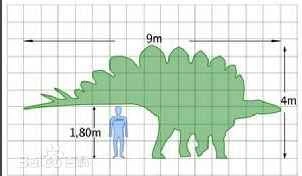
Stegosaurus is one of the most well-known dinosaurs, appearing in movies, cartoons, comics, and toys. A large, herbivorous dinosaur that lived during the Late Jurassic period, Stegosaurus was one of the most numerous and famous dinosaurs. Its most distinctive features were a row of triangular bony plates along its back and four sharp spikes on its tail, which served as a menacing defense against predators. It measured approximately 7-9 meters long, 2.35 to 3.5 meters tall, and weighed 2 to 4 tons.
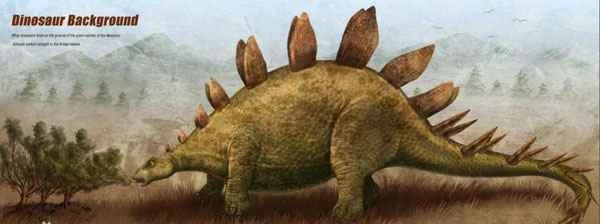
A well-preserved skull obtained in the 1880s revealed that Stegosaurus had a very small brain, possibly the smallest of all dinosaurs. In fact, when an animal weighed more than 4.5 metric tons, its brain would weigh no more than 80 grams. This phenomenon led people in the past to believe that dinosaurs were rather stupid animals, but this idea has been widely refuted.
I. Physical Characteristics of Stegosaurus
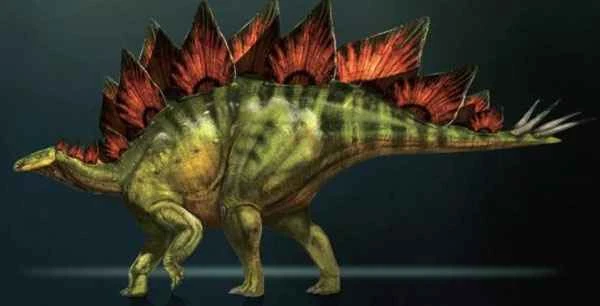
Stegosaurus had a bird-like, sharp beak without teeth, but with some small teeth on the sides of its mouth. Its back had 17 plate-like bones, and its tail had long spikes at the tip. These spikes were 4 feet long. Its forelegs were shorter than its hind legs, with five toes on the forelegs and three on the hind legs. Stegosaurus walked on four legs.
The enormous Stegosaurus had a very small head, with a brain even smaller than a small dog's, leading scientists to believe it was a rather dull dinosaur. Stegosaurus was a typical herbivorous dinosaur. It was 7 meters long in total, and if the height of its bony plates is included, its height could reach 3.5 meters. Its entire body was like an elephant's, but it had only a pitifully small head, with a brain only the size of a walnut.
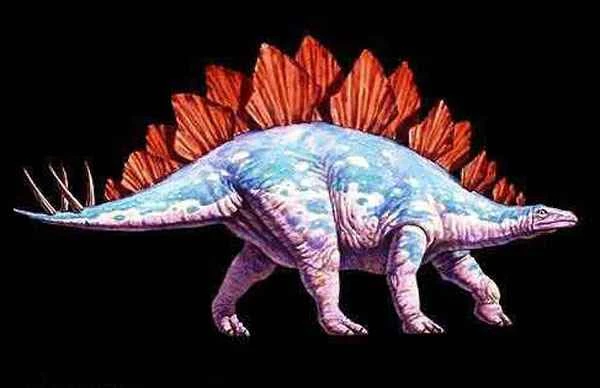
Stegosaurus had four legs: three toes on its hind legs and five on its forelegs. All four limbs were supported by the pads of its feet located behind the toes. The hind legs were longer and stronger than the forelegs, giving them a posture that was lower in the front and higher in the back. Their tails were significantly higher than the ground, while their heads were relatively close to the ground, never exceeding one meter off the ground. This indicates that they could not walk very fast, as the movement of their hind legs was limited by their forelegs; their fastest speed was approximately 6 to 7 kilometers per hour.
II. Discovery of the Origin of Stegosaurus
Osnier Charles Marsh named Stegosaurus because the remains of primitive Stegosaurus and its ancestors are still scarce, so the origin of Stegosaurus remains unclear. Stegosaurus was one of the first dinosaurs to be collected and described, and paleontologists worldwide have studied it for over 100 years, during which time most discovered Stegosaurus fossils were fragmented. In 1886, a complete Stegosaurus skull was discovered in Colorado, USA. Since then, a complete Stegosaurus skeleton had not been found. In 1980, a Stegosaurus named *Taibai Huayanglong* was discovered in Dashanpu, Zigong City, Sichuan Province, including several skeletons and two intact skulls. The discovery of Huayanglong was of profound significance.
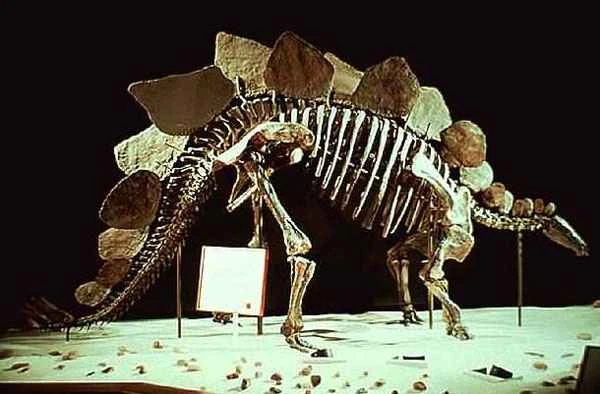
Stegosaurus fossils have been found in Europe, North America, East Africa, and East Asia. Asia has yielded the most discoveries and can be considered its cradle. Most of the Asian Stegosaurus fossils have been found in my country, with nine different species discovered to date, accounting for half of the world's known total. This makes China the country with the richest stegosaurus fossil reserves in the world, representing five different evolutionary stages. The discovery of Early and Middle Jurassic primitive types in my country, in particular, provides important fossil evidence for the theory that East Asia is the cradle and primary evolutionary center of stegosaurus.
On March 9, 2015, the United States discovered the world's most complete Stegosaurus skeleton: it weighed 1,600 kilograms when it died.
On March 7, 2022, it was learned from the Chongqing Municipal Planning and Natural Resources Bureau that the oldest stegosaur fossil in Asia has been discovered in Chongqing, adding new evidence to the theory that stegosaurs originated in China. "Research shows that it lived 169 million years ago and is one of the four oldest stegosaur species in the world."
III. Stegosaurus's Living Habits
Stegosaurus, like its close relatives, was herbivorous, but its feeding strategy differed from other herbivorous ornithischian dinosaurs. Stegosaurus teeth lacked flat surfaces, preventing them from closing properly and limiting their jaw movement to horizontal. Paleontologists believe their diet included moss, ferns, horsetails, cycads, conifers, and some fruits. They also believe that Stegosaurus could only reach food up to one meter above the ground.
Stegosaurid footprints discovered in Colorado indicate that they lived in groups. One group of footprints shows four to five juvenile stegosaurs moving in the same direction, while another group shows a juvenile individual moving with an adult.
IV. Film and Television Works of Stegosaurus
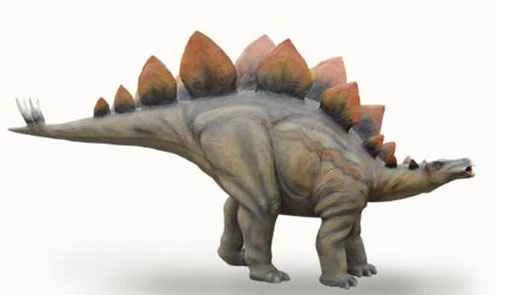
Stegosaurus has appeared in many movies and often fought with large carnivorous dinosaurs.
In the 1954 film "Journey to the Beginning of Time," he battled a Ceratosaurus.
Fighting a Tyrannosaurus Rex in the 1978 film "Planet of Dinosaurs".
The action of using the spikes at the tail for defense was first seen in the 1940 Disney animated film Fantasia.
It also appears in the classic 1933 film "King Kong".
The Lost World, Jurassic Park, Dinosaur Era, Dancing with Dinosaurs, The Allosaurus Mystery, Jurassic Fight Club
Stegosaurus has also appeared in many children's programs or animations, such as "Adventures of Little Dinosaurs" and "Power Rangers".
Stegosaurus also appeared in the 2009 film Ice Age 3, but was incorrectly depicted in the film as walking on two legs, similar to Parasaurolophus.
Stegosaurus is one of the three dinosaur designs created by Toho Co., Ltd. when creating the Japanese monster Godzilla. The other two are Iguanodon and Tyrannosaurus Rex.