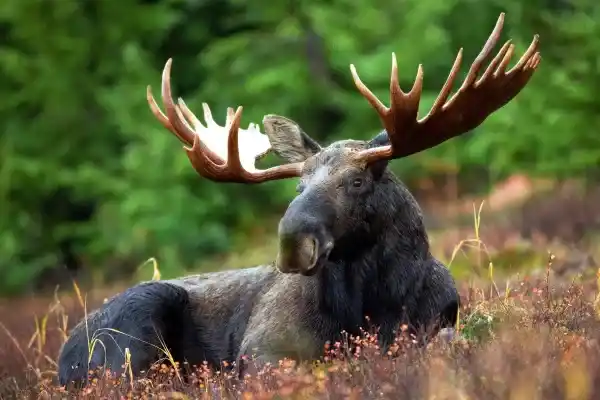
Moose ( Alces alces ) are typical northern coniferous forest animals, large in size, and able to survive long, harsh winters and thick snow. However, these "snow giants" are actually very sensitive to heat; they can die from heatstroke in temperatures that humans find comfortable.
Below are 10 interesting facts to help you get to know this "giant deer" that lives in cold forests.
1. Due to their geographical distribution, they are often regarded as "Christmas animals".
In Christmas and winter-themed scenes, you'll often see some recurring combinations:
Polar bears, penguins, reindeer, and sometimes moose also appear.
This is related to their actual distribution:
Moose live in high-latitude continental regions of the Northern Hemisphere , and typical countries where they are distributed include:
Russia
Canada
Norway
Mongolia
Siberia and other places
These regions have long winters and frequent snowfall, which is what we imagine them to be "ice and snow".
Therefore, in various illustrations and decorations, the moose naturally becomes one of the symbolic animals of cold regions, winter, and the Christmas atmosphere .
2. They really "need" to be safer in places with snow.
Moose are not only used to snowy areas, but they will actively move to areas with snow cover , which is related to their need to avoid predators.
One of the moose's main predators is the wolf .
In the deep snow:
Moose's long legs and specialized hooves allow them to walk relatively nimbly.
Wolves are prone to getting stuck in the snow, which slows them down and makes them much harder to catch.
The structure of a moose's hoof is crucial:
When landing, the hooves spread out to increase the contact area and reduce the sinking.
It lifts up and then folds back up , making it easier to take a step.
Combined with their long legs, moose can easily wade through thick snow, while for wolves, this layer of snow is like a natural "defense wall".
Therefore, snowy areas are actually safer for moose, effectively reducing the risk of predation .
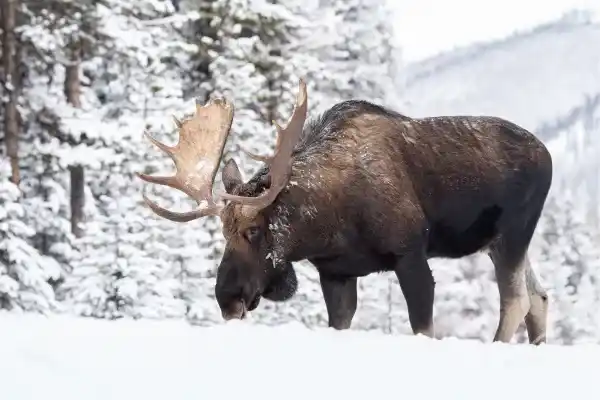
3. Temperatures above 27℃ may cause death from heatstroke.
For humans, 27°C is at most a bit hot, but still a tolerable temperature.
But for moose, this temperature is close to fatal heat stress .
Moose are typical "cold-adapted" mammals; they have difficulty dissipating heat for reasons including:
Double-layered dense fleece :
The outer layer of rough wool is waterproof and windproof;
The inner fleece layer has excellent heat insulation properties.
The heat generated during rumination and digestion :
They rely on fermentation in their stomachs to break down high-fiber plants, a process that generates a lot of heat.
I hardly sweat :
Lacking an effective sweating and heat dissipation mechanism, it is difficult to actively cool down.
Huge size :
Its relatively small surface area to volume ratio makes it less conducive to heat dissipation.
Therefore, when the temperature is slightly high, moose must stay in the shade, soak in water, or reduce their activity , otherwise they are prone to heatstroke or even death.
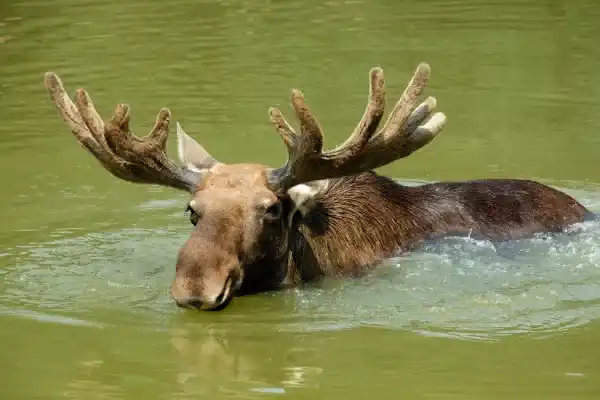
4. He is an excellent swimmer.
Although moose look clumsy and "landy," they are actually very good swimmers .
They utilize the aquatic environment primarily for three purposes:
Cooling down :
During the relatively warm season, moose will voluntarily go into the water to let the cold water help them dissipate excess body heat.
Insect repellent :
In summer, there are many blood-sucking insects such as mosquitoes and horseflies. Soaking in water can temporarily get rid of these annoying bites.
Foraging for aquatic plants :
Moose will dive down to eat the aquatic plants.
The shape and position of their nostrils help prevent water from entering the airway.
Despite their large size, crossing lakes and wide rivers is not a difficult task for moose .
5. The world's largest deer species.
Moose belong to the family Cervidae , and are familiar to us as follows:
Various types of deer (such as red deer and sika deer)
Elk
Caribou (North American caribou)
They belong to the same family.
The moose is the largest member of this family. Approximate dimensions are as follows (slight variations may occur depending on region and sex):
Body length : approximately 2.4–3.1 meters
Shoulder height : Approximately 1.5–2.15 meters
Total width, including antlers : up to 2.5–3.5 meters.
Weight : Approximately 200–850 kg
Therefore, in northern coniferous forests and wetlands, moose can definitely be called "forest behemoths".
6. Possesses the largest antlers of all mammals.
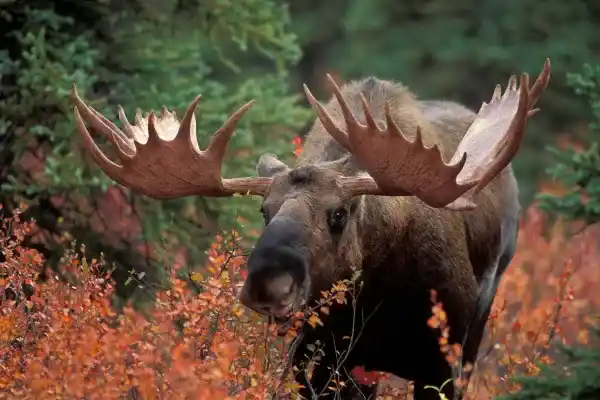
Adult male moose have the largest antlers of any living mammal .
The maximum span between the two ends of the antlers can reach 3.5 meters ;
A complete set of deer antlers can weigh around 35 kilograms .
The moose's antlers are very distinctive in shape:
The bottom is wide and fan-shaped (palm-like) , like a flat plate unfolded;
Many forked branches grow outwards from the edge;
During their growth period, the antlers are covered by a soft, vascularized "velvet" velvet skin , which provides them with nutrients.
These enormous antlers are primarily used for:
Showcase health and strength to attract females ;
During the mating season, they confront or compete with other males.
7. Suede shoes originally came from moose hide.
The "suede shoes" or "fur-lined shoes" that we often hear about are actually related to moose skin .
Traditionally, "ante" refers to a type of soft leather used with the inside of the leather turned outwards .
In Spanish, "alce" (moose) is also called "anta / ante," so the leather was named "ante."
Today, suede available on the market can come from:
moose
sheep
ox
deer, etc.
Historically, however, moose hide is considered one of the earliest and most typical sources of suede , as it is soft, durable, and suitable for making shoes and gloves.
8. Moose will lick cars, road signs, and even windows.
In the roads and parking lots of some northern countries, a strange scene occasionally unfolds:
A moose is licking a car, a road sign, and glass with its tongue.
This is not because they are "too curious," but rather because of insufficient mineral intake .
The diet of moose is low in fiber and minerals .
They are very picky and selective "refined herbivores" :
It mainly eats aquatic plants, lichens, and tender branches.
Consuming too much high-fiber foods like hay can cause problems and even be fatal.
To replenish minerals (especially salt), moose will:
Licking salty stones ;
They lick the surfaces of vehicles, road signs, railings, and windows that have been coated with de-icing salt during the winter.
Therefore, if you encounter moose licking your car in a snowy country, do not get too close to take pictures. It is not only unsafe, but may also encourage their dangerous behavior of approaching the road.
9. The upper lip is as flexible as a "little hand".
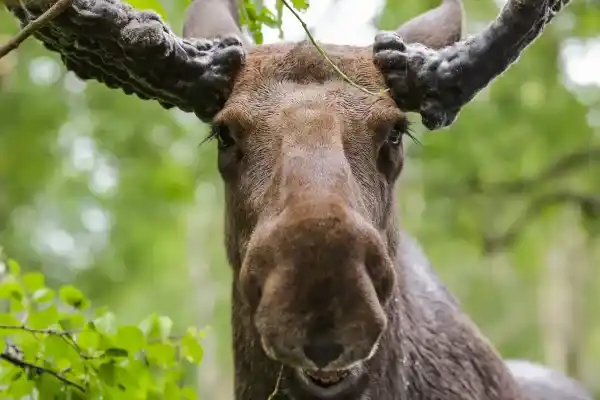
The upper lip of a moose is very distinctive:
Large and thick, it hangs noticeably in front of the lower lip ;
With its keen sense of touch and agile movements, it can almost be used as a "little hand".
What is the purpose of this "moving upper lip"?
Moose lack upper incisors and upper canines ;
The upper lip then serves as an additional feeding tool , helping to:
Precisely hooked onto the tree branch
Tear off the tender buds and leaves
With their powerful molars, moose can efficiently graze on various shrubs and aquatic plants.
10. Male moose shed a new pair of antlers every year.
Male moose do not grow a single set of antlers for their entire lives; instead, they grow a new set each year and shed a new one .
The general process is as follows:
Spring and Summer :
Under the influence of hormones, the antlers grow rapidly, covering the velvet skin, and the blood supply is sufficient.
Autumn mating season :
Displaying physique to attract females
Fighting against other males
When antlers reach their maximum length, they are used for:
Around the time of winter's arrival :
Reduce physical burden
Reduce excess energy consumption during the winter months when food is scarce and a lot of energy is needed to keep warm.
The antlers fall off after fulfilling their "courtship mission".
This allows:
The following spring, they will grow new antlers again. In healthy individuals, the antlers are often larger and more spectacular the following year .
Moose may look like just "big deer living in the snow," but they actually have a whole set of highly specialized adaptation mechanisms to cold, heat, minerals, and predation stress. From being afraid of heat to being able to swim, from licking cars to replenish salt to replacing their huge antlers every year, every detail makes this "giant neighbor" of the northern forests exceptionally interesting.
References
De Bord, D. (2009) Alces alces. Available at: https://animaldiversity.org/accounts/Alces_alces/
Woodford, R. (2025) Ask a Wildlife Biologist: Why do moose lick cars?. Alaska Fish & Wildlife News. Available at: https://www.adfg.alaska.gov/index.cfm?adfg=wildlifenews.view_article&articles_id=4124...