Chinese name: Monoclawed Dragon
Latin name: Mononykus
Age of existence: Late Cretaceous
Fossil origin: Mongolia
Physical characteristics: 1 meter in length
Diet: Carnivorous
Type: Theropod
Meaning: A lizard with one claw
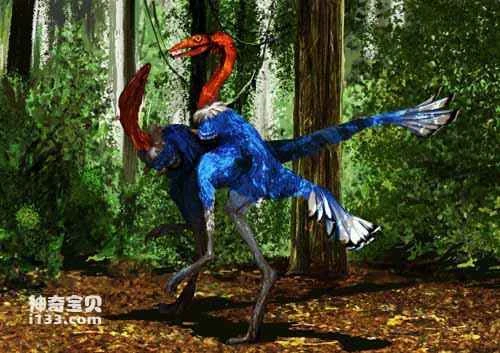
Monoclawed dinosaur was a small theropod dinosaur related to birds. It lived during the Late Cretaceous period, about 70 million years ago, and was mainly distributed in southwestern Mongolia.
Its discovery dates back to the 1920s, when the Third Central Asian Expedition, led by Andrews of the American Museum of Natural History in New York, entered the desolate Gobi Desert of Mongolia. This expedition was highly successful, one of the most groundbreaking discoveries being the first nest of dinosaur eggs in the history of dinosaur research. In 1923, the expedition discovered an incomplete fossil in the Gobi Desert, consisting of vertebrae, hind limbs, and a pelvic girdle described as resembling an "unknown bird-like dinosaur." Paleontologists initially considered it a common theropod fossil, and after being brought back to the United States, it remained largely undiscovered.
In the 1990s, paleontologists returned to the Gobi Desert in Mongolia. This time, they found a dinosaur fossil the size of a turkey, with bird-like hind limbs and tiny forelimbs. This fossil belonged to the same species as the long-forgotten fossil discovered in 1923. After initial research, they realized they had discovered a new species of theropod dinosaur and excitedly named it "Mononychus." There's an interesting anecdote about the naming: Mononychus was initially named "Mononychus," but paleontologists later learned that "Mononychus" was the name of a beetle genus, so they changed it to "Mononykus."
A close examination of the Monoclawed Dragon reveals a slender skeleton, a long tail, and graceful legs. Most striking is its single-clawed forelimb. This robust claw is disproportionately large, directly connecting to the dragon's only finger. The phalanges, ulna, and humerus of the Monoclawed Dragon are very close in length, while its sternum has a large keel, suggesting extensive pectoral muscles attached to it. Based on these characteristics, the discoverers of the Monoclawed Dragon speculate that its microhabitat (the smallest unit of distribution within a species' unique habitat) may have been similar to that of modern aardvarks or anteaters, using its short, powerful forelimbs to dig through the soil and excavate underground ant nests or termite mounds. The slender hind limbs and flexible neck of the Monoclawed Dragon suggest it was a high-speed runner, perhaps a means of escaping predators.
Among the vast family of modern birds, some are flightless, and most of them have strangely shaped wings. Birds of the order Platyhelminthes, such as ostriches, emus, and rheas, all have extremely small, flightless wings; penguins have wings that allow them to "fly" in water (the ancestors of penguins were originally seabirds skilled in flight—resembling modern petrels or puffins—whose wings gradually evolved to be short and fin-like, allowing them to propel themselves quickly through the water to adapt to aquatic life). The discoverers stated, "At least the ancestors of Monoclonal dinosaurs possessed this ability (Sinornithosaurus and Iberianornithosaurus appeared 40 million years earlier than Monoclonal dinosaurs and already possessed the ability to fly), and then one branch evolved into Monoclonal dinosaurs." However, most paleontologists and dinosaur paleontologists believe that Monoclonal dinosaurs belonged to the near-avian dinosaurs, and that its burrowing habits led to its keel-like protuberances similar to those of birds.