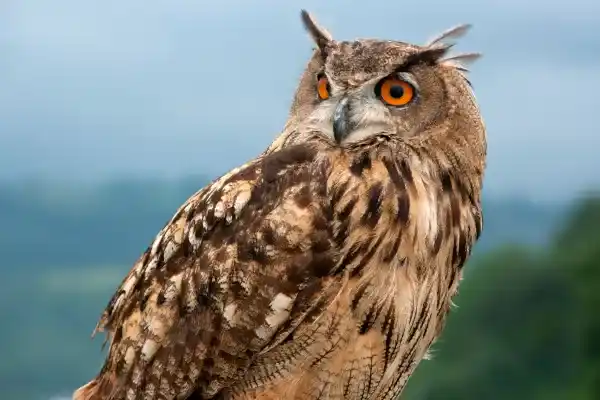
The deep, drawn-out "hoo-hoo" call at night always immediately brings to mind owls. There are approximately 200 species of owls, but the most regal of them all is the Eurasian Eagle Owl —scientific name * Bubo bubo *. With its large size, sharp eyes, and striking ear tufts (which resemble fluffy ears), it is highly recognizable.
The following Chinese content is written from the perspective of users' most frequent searches: how to identify, where to live, what to eat, how to hunt, how to reproduce, what threats to face, and some interesting facts , making it easy to publish directly or reorganize.
Basic Information Overview
Chinese name : Eurasian Eagle Owl (also often called "Eurasian Eagle Owl")
Scientific name : Bubo bubo
Size : Approximately 58–70 cm (standing height)
Weight : Approximately 1.5–4.2 kg
Activity time : Primarily nocturnal
Lifestyle : Mostly live alone, with a strong sense of territory.
What are the physical characteristics of the Eurasian Eagle Owl? How can it be identified quickly?
The eagle owl belongs to the large owl family, and many people think it looks like a large raptor wearing camouflage when they see it for the first time.
Typical characteristics
They are very large : typically standing 58–70 cm tall. In most areas, females are often larger and heavier than males , who are relatively smaller.
The most striking feature is the "ear tufts" : a prominent tuft of feathers stands up on each side of the head, resembling "ears" or "horns." These are not ears, but rather feather structures that help express emotions and camouflage silhouettes.
Strong camouflage : The body is mostly covered with gray, black and brown spots, with the chest being relatively lighter, and the overall pattern resembles tree bark or rock texture.
The orange eyes are striking : the eyes are usually deep orange with black, round pupils and the owl's typical "facial disc" (a flat, feathered disc) on the outside.
His temperament is "fierce yet composed" : he stands tall with strong facial expressions, often giving people the feeling of a "king of the night".
Where do eagle owls live? What is their distribution range?
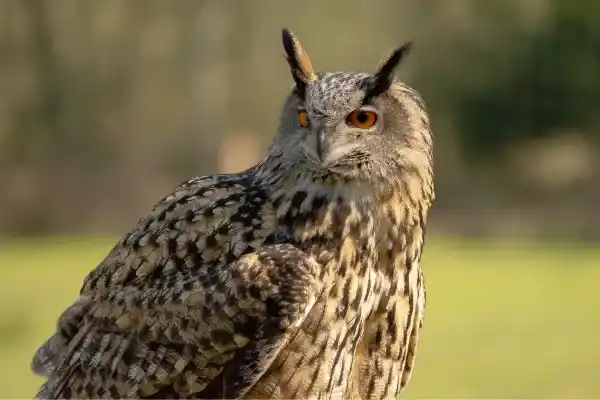
The Eurasian eagle-owl is also often called the Eurasian eagle-owl because it is widely distributed across Europe and Asia . Among many owls, it is one of the most widely distributed , not only in terms of geographical range but also in its adaptation to a wide variety of habitats.
Common Habitat
Forests and forest edges
grasslands and open shrublands
Wetlands and surrounding rivers and lakes
Mountains, hills, rock walls
It may also occur in colder regions (or areas close to tundra environments).
They usually prefer
Areas with well-preserved ecosystems
A quiet environment away from human settlements
In areas with complex terrain and difficult access (such as rock walls, steep slopes, and valleys), it is easier to reduce disturbance and risk.
Due to their extremely wide distribution, eagle owls in different regions may exhibit slight differences in plumage coloration, which is usually related to the local environmental hues.
What do eagle owls eat? What are their main prey?
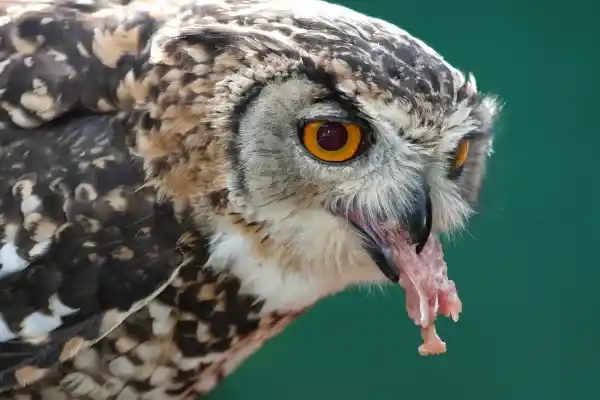
The eagle owl is a typical nocturnal bird of prey , relying on its strong claws and hooked beak to hunt. It prefers prey that is not too large and can provide a substantial meal.
Main food
Rodents : All types of mice (including larger mice, voles, etc.)
Rabbits : hares, rabbits
Hedgehogs (in some areas they prey on animals).
They also prey on some birds (such as smaller birds and corvids).
Opportunistic supplements: other vertebrates such as lizards, frogs, and fish.
Recipes change with the seasons
What it eats often depends on the season and the abundance of prey . If large prey is hard to find, it may switch to eating large insects (such as beetles) to supplement its energy.
How do eagle owls hunt? What are their hunting methods?
The eagle owl's hunting strategy is characterized by "steadiness, accuracy, and ruthlessness".
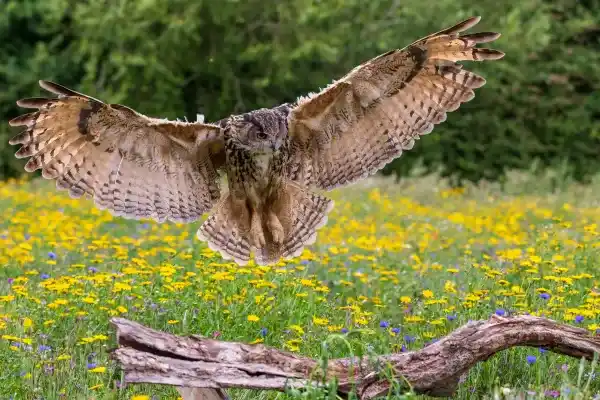
Ambush from a high place : They often perch on trees or high rocks, patiently waiting for the prey to pass by, and then pounce.
Aerial interception : When encountering birds, it is also possible to capture them directly in flight.
Foraging near water : They will catch fish or amphibians near the water; if necessary, they will approach the water's surface to catch them.
Its advantages are: excellent night vision and hearing, quiet flight, and strong grip , making it difficult for prey to escape even if they react quickly.
Eagle owl behavior: When are they most active? Why do they call out?
Predominantly nocturnal
Eagle owls are primarily nocturnal , but can sometimes be seen at dusk . During the day, they usually hide in:
caves, crevices
dense canopy
A secluded, dark area for rest and to avoid disturbances.
The significance of the cry: more than just being frightening.
The deep, mournful "whoo-whoo" call of the eagle owl is often used for:
Declaring territory : telling other eagle owls, "There are people here."
Communicating with other birds of the same species : especially during the breeding season.
Deterring potential threats : It can also serve as a "warning" function to some extent.
Typically, the male's call is deeper , while the female's is slightly higher. They may also engage in call-and-response singing to locate each other. Since eagle owls are mostly solitary animals, their calls help them find mates or avoid conflict .
How do eagle owls reproduce? Where are their nests located? How long does it take for chicks to learn to fly?
Breeding season
They breed in most regions during the spring , but the specific month can vary depending on geographical location and climate.
Nesting preferences: Rocky terrain is important
Eagle owls are particularly reliant on rocky environments , often building their nests on cliffs and rocky ledges for a straightforward reason:
More difficult for predators or humans to approach
They have a wider field of vision, are safer, and may reuse the same nesting site for many years .
Egg laying and hatching
A clutch typically contains 4–6 eggs.
They typically produce one every 3 days.
The incubation period is approximately one month.
Brooding and Independence
Newborn chicks are covered in fine, gray downy feathers. In many cases:
The male bird is responsible for the main hunting and feeding.
Female birds spend more time guarding the nest and caring for the chicks.
Around 7 weeks old , the chicks begin to try to fly away from the nesting area and gradually learn to survive independently.
Threats and Protection: Is the Eagle Owl Endangered?
Overall, the eagle owl is not usually considered an "endangered species" at the global level and is often regarded as being in a relatively stable state, although there have been significant declines in some areas in history.
Reasons for the historic decline (in some regions)
In the 20th century, the number of eagle owls declined in some areas, and even disappeared in some places. Common reasons include:
Human intervention and hunting : Some believe that eagle owls prey on rabbits and wild birds, which may affect hunting resources or poultry.
Traffic and infrastructure risks : vehicle collisions, collisions with power lines/cables, etc.
Effects of poisoning and rodenticides : The use of rodenticides may lead to indirect poisoning or food chain risks.
Changes in prey composition and disease factors : For example, a decrease in rabbit populations in certain areas can affect their food sources.
Recovery and stabilization
In some European countries, with increased wildlife conservation efforts, ongoing recovery initiatives, and an increase in rodent populations in certain areas, some eagle owl populations have gradually stabilized or even rebounded.
Fun Facts about Eagle Owls
Its plumage resembles tree bark : its patterns closely resemble tree trunks and rock walls, allowing it to blend perfectly into its environment.
Excellent night vision, but not necessarily better at close range : It excels at spotting distant targets in low-light environments, but close-up details are not always an advantage.
They are large and strong : weighing over 4 kilograms, making them outstanding owls in both size and strength.
An ecosystem "rodent control expert" : It can effectively control the number of rodents, indirectly protecting vegetation and farmland ecology.
Moonlight and activity : Brighter moonlight provides better visibility and may lead to more frequent activity; young birds may also make bolder flight attempts on brighter nights.
Competition within the nest can be brutal : when resources are scarce, competition among chicks can become even more intense.
The fine feathers around the beak provide "tactile assistance" : the fine feathers near the beak help it sense the movement of prey at close range, compensating for the fact that close-range observation is not as good as long-range observation.
References
Eurasian Eagle Owl, from Cornell Ornithology Laboratory's *Birds of the World* (undated). URL: https://birdsoftheworld.org/bow/species/eueowl1/cur/introduction?login
Martínez, JA, Martínez, JE, Mañosa, S., Zuberogoitia, I., & Calvo, JF (2006). How to manage human-induced mortality in the eagle owl (Bubo bubo). Bird Conservation International, 16(3), 265–278. [Link: https://www.cambridge.org/core/journals/bird-conservation-international/article/how-to-manage-human-induced-mortality-in-the-eagle-owl-bubo-bubo/6C388FD6D2BA1C8526B5AA1DA15B5BA2]