You may never have seen a school of fish in person, but that doesn't diminish their captivating charm in photos, movies, or videos. Undoubtedly, understanding this ecological phenomenon—fish population dynamics—is a fascinating research topic in marine biology. First, we can define a school of fish as a group or aggregation of fish swimming together. This is considered a common collective behavior among many fish species and is believed to serve multiple functions, such as predator defense, foraging, and reproduction.
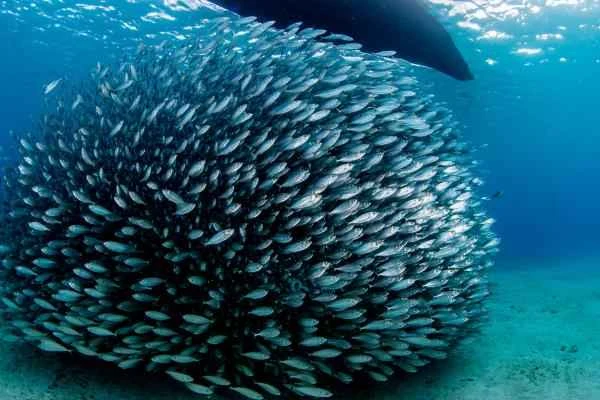
Table of contents
What are schools of fish (Cardúmenes)?
Reasons and benefits of fish schools
The difference between a school of fish (Cardúmenes) and a swarm of fish (Banco de peces).
1. What is a school of fish (Cardúmenes)?
Fish schooling refers to the collective behavior of many individual fish moving and acting in a highly coordinated and unified manner. Members of a school are typically similar in size and age, and this homogeneity contributes to improved overall coordination. Fish schooling behavior is particularly common in fish such as sardines, anchovies, herring, tuna, and even some sharks (like hammerhead sharks). This behavior is not only a visual spectacle but also an important subject of study in marine ecology.
2. Reasons for and benefits of fish school formation
The formation of fish schools offers many obvious benefits to fish, including:
Defending against predators : Schools of fish can confuse predators and reduce their chances of being preyed upon through dense and synchronized movements. Large groups make it difficult for predators to target a single individual.
Improved foraging efficiency : Fish can use clues from their companions to find food faster, and improve the overall catch rate through cooperative hunting.
Increased reproductive success rate : The large number of individuals gathered together increases the probability of finding a mate, which is beneficial for synchronous reproduction and population growth.
3. The difference between a school of fish (Cardúmenes) and a swarm of fish (Banco de peces).
Although these two terms are often used interchangeably in everyday life, they are actually quite different in a biological sense:
Schools of fish (Cardúmenes) : Fish move collectively in a highly coordinated manner, maintaining relative distances and behaving in a uniform manner. They are often composed of one or several similar species.
Fish clumps (Banco de peces) : This refers to a large number of fish gathering in the same area, but lacking coordinated movement among individuals. It is more often formed due to environmental conditions or concentrated resources, and can vary in species and size.
Simply put, a school of fish is more like a disciplined dance troupe, while a cluster of fish is like a crowd gathering in a shopping mall.
Further Reading
Fish schooling behavior is a phenomenon of great research value in marine ecosystems. It not only provides fish with a survival advantage but also offers rich inspiration for understanding animal collective behavior and artificial intelligence. If you would like to learn more about plankton (nectons), gregarious animals (Gregarismo), and other related topics, please browse our more popular science articles!