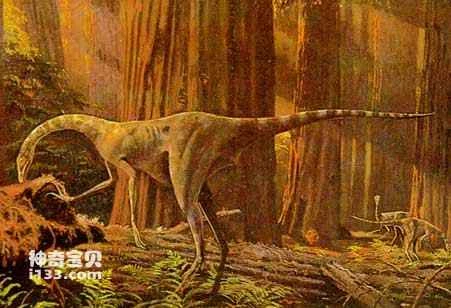
Millions of years ago, Earth's environment was vastly different from today, with an incredibly rich and mysterious climate, ecology, and biodiversity. It is through the fossil record that we can unveil the mysteries of the prehistoric world and learn about the giant animals and strange creatures that once dominated the Earth. Prehistoric animals refer to all kinds of animals that lived on Earth before the emergence of humans and written records (more than 5,000 years ago), including extinct dinosaurs, mammoths, and megalodons, as well as "living fossils" that still exist today. This article will provide a systematic understanding of the types, characteristics, and representative extinct and extant species of prehistoric animals.
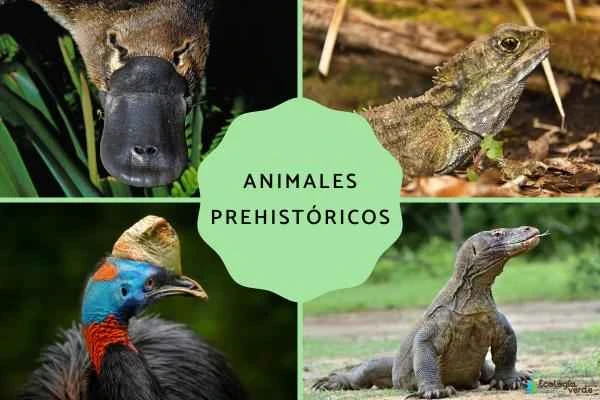
Definition and main characteristics of prehistoric animals
Prehistoric animals were not limited to dinosaurs; they encompassed a wide range of species, from ancient marine invertebrates to reptiles, early mammals, flying animals, and aquatic behemoths. Their main commonalities included:
Animals that existed in prehistoric times : that is, before the emergence of human writing (about 5,000 years ago).
Highly adaptable to the environment : It has continuously evolved according to environmental changes in different eras (such as Paleozoic, Triassic, Jurassic, Cretaceous, Quaternary, etc.).
Diverse distribution : covering multiple ecological niches including ocean, land, and sky.
Diverse body shapes or structures : including giant bodies (such as dinosaurs and mammoths) and unusual structures (such as giant tusks, bony plates, and jawless structures).
Some species possess extremely strong adaptability : they have survived to this day even amidst dramatic environmental changes, becoming "living fossils".
Why were prehistoric animals once enormous?
The "gigantification" of prehistoric animals is often referred to as "prehistoric behemoths" or "prehistoric megafauna." The reasons for this may include:
Cool climate (Bergmann's Law) : The larger the body size, the easier it is to keep warm.
Unique skeletal structure : For example, dinosaurs had hollow bones to reduce weight and facilitate increased body size.
Resources and competition : Animals tend to grow larger when food is plentiful and predators are few on isolated islands.
Reduced predation and survival pressures : When there are few natural enemies and the environment is relatively simple, increased body size is beneficial for survival.
Human hunting and climate change led to extinction : Human expansion and climate change were the main reasons for the extinction of most prehistoric megafauna.
Representative of extinct prehistoric animals
More than 90% of prehistoric animals worldwide have become extinct. Below are some of the most famous extinct prehistoric animals:
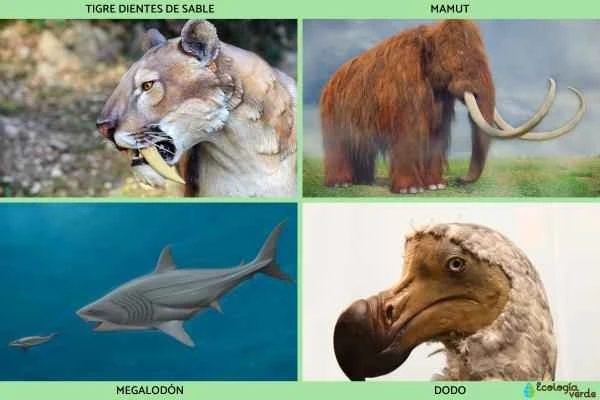
1. Saber-toothed tiger (Smilodon spp.)
Living in the Pleistocene, their most distinctive feature was their two enormous upper canines. Some species weighed up to 300 kilograms and were among the top prehistoric predators.
2. Mammoth (Mammuthus spp.)
Closely related to modern elephants, mammoths were covered in thick, long hair and could reach a height of 5 meters. They eventually went extinct due to climate change and human hunting.
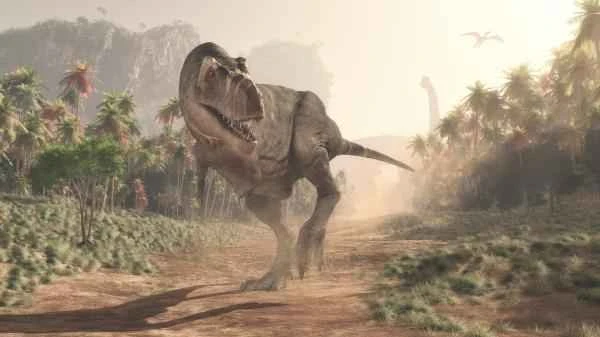
3. Tyrannosaurus rex
The most famous carnivorous dinosaur of the Late Cretaceous period, it was 11 meters long and weighed 7.5 tons. It was one of the last large dinosaurs to go extinct among prehistoric creatures.
4. Megalodon (Carcharocles megalodon)
The largest shark in history, reaching 15-20 meters in length, with a single tooth measuring 18 centimeters long, was the apex predator of the ancient ocean.
5. Dodo (Raphus cucullatus)
The flightless birds of Mauritius went extinct in 1690 due to human hunting and the invasion of alien species.
6. Other extinct animals
Primitive horse (Protorohippus sp.)
Archaeopteryx lithographica
Ichthyosauria
Giant sloth (Megatherium spp.)
The earliest whale (Pakicetus spp.)
Prehistoric canines (Hesperocyon spp.)
Giant dragonfly (Meganeura spp.)
Prehistoric whale (Leviathan melvillei)
Titanoboa cerrejonensis
Giant rhinoceros (Paraceratherium spp.)
Existing "living fossils"—living prehistoric animals
Some ancient animals have survived millions of years of changes and are known as "living fossils," for example:
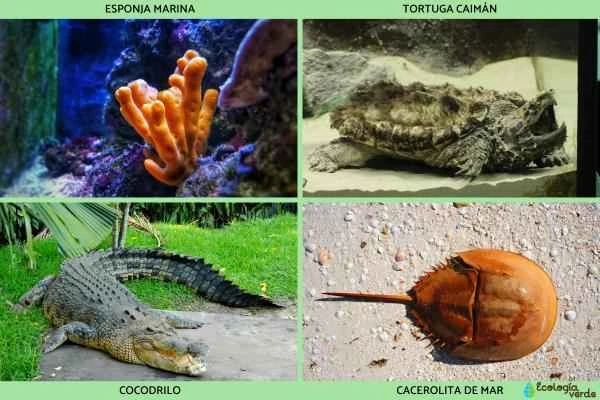
1. Sponges
Sponges are the oldest multicellular animals, with a fossil record dating back 635 million years, and are representative of the ancestors of the animal kingdom.
2. Platypus (Ornithorhynchus anatinus)
Monotremes are one of the only mammals that lay eggs, and they retain many primitive characteristics of early mammals.
3. Snapping turtle (Macrochelys temminckii)
Appearing 3.5 million years ago, it has a hard body, a hooked mouth, and a thick, long tail, and is one of the oldest living freshwater turtles.
4. Hagfish (Mixines)
Jawless ancient fish, whose origins can be traced back more than 500 million years.
5. Crocodile (Crocodylus spp.)
These species have existed for 25 million years and have changed very little in appearance, making them living fossils of reptiles.
6. Other extant prehistoric animals
Horseshoe crab (Limulus polyphemus)
Komodo dragon (Varanus komodoensis)
Tapir (Tapiridae)
Pig-nosed turtle (Carettochelys insculpta)
Cassowary (Casuarius spp.)
Coelacanth (Latimeria spp.)
Nautilus spp.
Solenodon spp.
Tree frog (Latonia nigriventer)
Sphenodon spp.
Summarize
The world of prehistoric animals is far richer, more wondrous, and more diverse than we imagine. Their emergence, evolution, extinction, and continuation bear witness to the magnificent tapestry of life on Earth. Whether they are extinct giants or still existing "living fossils," they all deserve our respect and study. If you'd like to learn more about prehistoric animals, dinosaurs, extinct animals, or living fossils, please follow our paleontology special!
References
Shimada, K., Maisch IV, et al. (2022). A re-examination of the size trends and breeding ranges of Neogene megalodon (Otodus megalodon, order Lamniformes: family Otodus) reveals that Bergmann's law may have enhanced its size in colder waters. Historical Biology, 1-10.
Hekkala, E., Gatesy, J., Narechania, A., Meredith, R., Russello, M., Aardema, ML, and Amato, G. (2021). Paleogenomics elucidates the evolutionary history of the extinct Holocene Madagascar crocodile (Voay robustus). *Communications Biology*, 4(1), 1-11.
Beatty, R., Beer, A., and Deeming, C. (2010). The Book of Nature. Grand Brittany: Dorin Kindesley.