The Northern Garland Ibis (scientific name: * Geronticus eremita *), also known as the Hermit Ibis , is an extremely rare bird with a unique appearance and interesting behavior, but it also faces many survival challenges. This article will provide a comprehensive introduction to the Northern Garland Ibis, from its physical characteristics to its cultural significance, exploring its ecological habits, current status, and conservation importance.
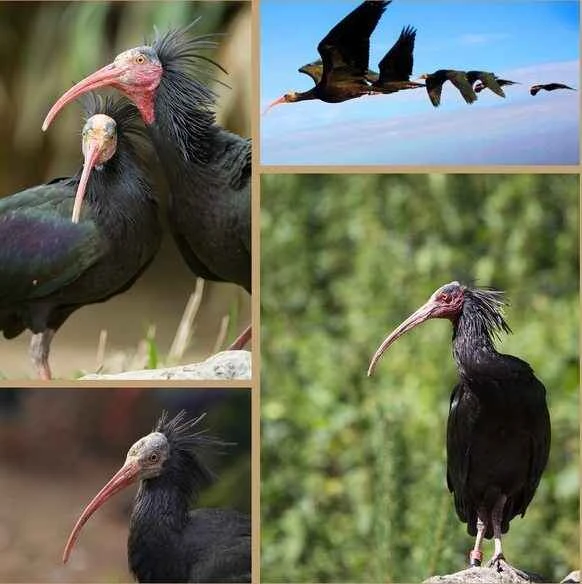
Appearance, size, and weight of the Northern Bald Ibis
Unique appearance
The Northern Marabou Ibis has a smooth, featherless, red head, making it look like a "little old man," hence the "bald" in its name. Its feathers are mostly black with a metallic purple and green sheen, making them particularly dazzling in sunlight. In addition, it has a tuft of long feathers hanging down its neck like a beard, adding to its mystique.
body shape and weight
The Northern Marabou Ibis measures approximately 70-80 centimeters in length, has a wingspan of 120-135 centimeters, and weighs between 1.0 and 1.3 kilograms. While not particularly large, its flight over cliffs is still impressive.
Diet, Feeding and Reproduction of the Northern Bald Ibis
Birds that love to eat small animals
The Northern Martyrs ( Geronticus eremita ) plays a unique role in the ecosystem, and its diet, husbandry characteristics, and reproductive methods are fascinating and of great scientific value. Understanding these aspects not only helps in the conservation of the Northern Martyrs but also provides a better understanding of its important position in the ecosystem.
Dietary habits: Prefers small prey
The diet of the Northern Marabou Ibis mainly consists of invertebrates, including:
Insects : locusts, beetles, fly larvae, etc.
Mollusks : Snails and slugs are its favorites.
Other prey : Occasionally, they also catch lizards, small rodents, and even bird eggs.
The Northern Marabou Ibis prefers to forage in places with soft soil, such as farmland, grasslands, and riverbanks, using its curved red beak to turn over the soil in search of hidden prey.
Special foraging methods
Northern ibises typically forage in flocks, pecking rapidly at the ground as they walk, their movements nimble yet highly efficient. This group foraging behavior increases both the success rate of food acquisition and enhances their ability to defend against predators.
Rearing Environment: The Importance of Artificial Protection
Due to the scarcity of wild Northern Caryatids, captive breeding has become an important means of their conservation. When raising Northern Caryatids, the following points should be noted:
Confinement Area <br />The Northern Marabou Ibis adapts to a dry climate but requires an open foraging area and a high nesting environment. In captivity, they are typically provided with large enclosures that mimic their natural environment, while also featuring sandy floors and artificial cliff-like structures to meet their natural needs.
Dietary Management <br/>When raising Northern Martyrs, their artificial diet is diverse, including insects, eggs, small fish, and small amounts of fruits and vegetables to supplement vitamins and minerals. This diet is designed to be as close as possible to the food available in their wild environment.
Disease Prevention <br />The Northern Crested Ibis is susceptible to parasite infections in captivity, therefore regular health checks and vaccinations are particularly important. In addition, it is important to avoid overly humid environments to reduce the growth of bacteria.
Reproductive Habits: Dedicated "Parents"
The breeding season for the Northern Marabou Ibis is generally in spring and summer, and its breeding behavior has the following characteristics:
Nest building behavior
The Northern Marabou Ibis prefers to build its nest on cliffs, which allows it to stay away from predators on the ground and use its high vantage point to monitor its surroundings. The nest is usually made of dry grass, twigs, and feathers, and is simple in structure but very sturdy.
Egg laying and hatching
The female lays 2-3 eggs per year, with an incubation period of approximately 28 days. During this time, both male and female birds take turns incubating the eggs and foraging for food. The parents of the Northern Marabou Ibis are very responsible, doing their utmost to protect the chicks even in harsh weather conditions.
The growth of young birds
Over the next 6-7 weeks after hatching, the chicks' feathers gradually grow in, and they begin to learn to fly independently. By two months old, they are able to forage for themselves and begin to attempt independent living. However, they typically continue to maintain contact with their family until they are fully mature.
Successful cases of artificial breeding
Significant progress has been made in the artificial breeding of the Northern Cinereous in several countries. For example:
Morocco : Established multiple breeding centers and successfully released captive-bred Northern Marabou ibises back into the wild, rebuilding the wild population.
Europe : Through artificial breeding programs, the Northern Clawed Ibis has been able to re-establish migratory behavior in Germany, Austria, and Spain, gradually forming stable populations.
These artificial breeding programs have not only supported the population recovery of the Northern Clawed Ibis, but also provided valuable experience for the protection of other endangered species.
The Triple Balance of Diet, Feeding and Reproduction
The Northern Crested Ibis's dietary habits determine its dependence on the ecological environment, while scientific breeding and husbandry methods provide strong support for the conservation of this endangered species. Through the joint efforts of humans and nature, the future of the Northern Crested Ibis looks brighter. This is not only a continuation of a bird species, but also a successful example of ecological conservation.
Comparison of the Northern Bald Ibis with other birds
Compared to many birds, the Northern Martyrs' Ibis has a very unique appearance and habits. It is very similar in appearance to its close relative, the Southern Martyrs' Ibis ( Geronticus calvus ), but the Southern Martyrs' Ibis has white markings on its face, while the Northern Martyrs' Ibis is entirely red. Compared to other ibises that prefer wetland environments, such as the Crested Ibis, the Northern Martyrs' Ibis prefers dry mountainous and rocky areas.
Comparison of appearance and features
Appearance of the Northern Bald Ibis
Feathers and color : The Northern Marabou is covered in metallic feathers ranging from deep purple to black, with a featherless head and bare red skin. This bald head design is quite rare among birds, similar to that of a vulture, and helps it keep clean.
Beak characteristics : The Northern Marabou Ibis has a long, curved, red beak that was designed specifically for catching insects and small animals.
Comparison with the white ibis
The white ibis ( Eudocimus albus ) is a close relative of the northern ibis. Their plumage is primarily white, and their beaks are curved, but they do not have the pronounced baldness of the northern ibis.
Ecological habits : The white ibis is more active in wetlands and its food source is mainly fish and amphibians, while the northern crested ibis prefers dry areas and mainly preys on insects and invertebrates.
Comparison with Crested Ibis
The crested ibis ( Gerontica calvus ), a relative of the northern bald ibis, is found in southern Africa. Both are featherless on their heads, but the crested ibis is slightly smaller and better adapted to dry grasslands.
Comparison of lifestyle habits
Foraging methods
Northern Marabou Ibis : It prefers to search for insects, snails and small vertebrates in open grasslands or sandy soil, using its long beak to probe for prey in the soil.
Crested Ibis ( Nipponia nippon ) : The crested ibis is another rare bird species in China. It forages in wetlands and rice paddies, catching small fish, shrimp and aquatic insects.
social behavior
Northern Marabou Ibis : Highly gregarious, they prefer to forage and roost in groups, and even during migration they exhibit a strong spirit of group cooperation.
Ostriches : Although they are large, ostriches do not live in groups, only forming small groups during the breeding season. Their social nature is far less than that of the Northern Marabou Ibis.
Habitat selection
Northern Marabou Ibis : Prefers rocky cliffs and dry, semi-desert areas.
Grey heron ( Ardea cinerea ) : Prefers lakes and wetlands, and its habitat is quite different from that of the Northern Marabou ibis.
Comparison of migration behaviors
Migration characteristics of the Northern Bald Ibis
The Northern Marabou Ibis is a partially migratory bird. European Northern Marabou Ibis migrate to North Africa during the winter, while populations in the Middle East and Morocco are mostly resident.
During migration, the Northern Marabou Ibis exhibits strong teamwork, typically forming a "V" shape to conserve energy.
Comparison with wild geese
Geese are typical migratory birds and also use a "V" formation, but their migration routes often span longer distances, while the migratory range of the Northern Marabou Ibis is smaller.
Comparison with pigeons
Although pigeons can fly long distances, they migrate less and usually stay in their fixed habitats.
Comparison of ecological functions
Ecological role of the Northern Bald Ibis
The Northern Marabou Ibis regulates the populations of these species in the ecosystem by preying on insects and small invertebrates, thus helping to maintain ecological balance.
The Northern Clawed Ibis inhabits mostly semi-arid regions, and its role in the food chain is particularly important to the local ecosystem.
Ecological role of the crested ibis
Crested ibises are mostly found in wetlands and play an important role in maintaining wetland ecosystems, especially when they prey on overpopulated aquatic insects.
Comparison with birds of prey
Birds of prey such as the golden eagle ( Aquila chrysaetos ) are apex predators in the ecosystem, while the northern crested ibis is in the middle of the food chain, mainly playing the role of preying on insects and small prey.
A comparison of cultural significance and conservation importance
Cultural significance of the Northern Bald Ibis
The Northern Marabou Ibis was considered a lucky symbol in European and Middle Eastern history and was even deified in ancient Egyptian art.
However, with habitat loss and human disturbance, the Northern Clawed Ibis has gradually become an endangered species, making its conservation particularly significant.
Cultural Comparison with the Crested Ibis
The crested ibis is considered an auspicious bird in traditional Chinese culture, similar in status to the northern crested ibis. However, due to its more limited distribution, the crested ibis receives relatively greater protection.
Comparison with albatross
Albatrosses are often seen as a symbol of marine culture, and their conservation efforts mainly focus on the marine environment, while the conservation of the Northern Marabou ibis relies more on the management of its terrestrial habitat.
The uniqueness of the Northern Bald Ibis
A comparison with other bird species reveals the unique characteristics of the Northern Garnet (Symplocos henryi) in terms of appearance, habits, and ecological role. It is a vital component of arid and semi-arid ecosystems and a valuable subject for scientific research and cultural preservation. Understanding the differences between the Northern Garnet and other bird species allows for a deeper appreciation of natural diversity and contributes more to the protection of endangered species.
Habitat distribution and migration behavior of the Northern Garbage Ibis
Distribution map of the Northern Bald Ibis
The Northern Crest-billed Ibis was once widely distributed across Europe, the Middle East, and North Africa, but today its wild population is almost entirely confined to certain areas of Morocco. Currently, there are also some captive-introduced populations in Europe, Turkey, and the Middle East.
Migration behavior research
The Northern Crested Ibis is a partially migratory bird. For example, the population in Morocco is mainly resident, while the captive-introduced European Northern Crested Ibis migrates to warmer regions in the autumn. This migration behavior has shown very interesting patterns in scientists' monitoring, such as their preference for avoiding high mountains and large bodies of water during migration.
Reasons for population changes in the Northern Bald Ibis
Changes in historical quantities
Ancient quantity
During the Middle Ages, the Northern Marabou Ibis was widely distributed in southern Europe, North Africa, the Middle East, and Asia Minor, with an estimated population of hundreds of thousands .
Historical documents indicate that the Northern Marabou Ibis was considered a sacred bird in ancient Egyptian and Middle Eastern cultures and was frequently depicted in works of art, suggesting that the population was quite abundant at the time.
The number has decreased sharply in modern times
17th-18th centuries : With the expansion of human activities, the habitat of the Northern Marabou Ibis was extensively destroyed, and the population began to decline significantly. Specific numbers are not recorded, but its distribution range shrank considerably.
Early 20th century : By the early 1900s, the global wild population of the Northern Marabou Ibis had dwindled to less than 5,000 individuals , with only small populations remaining in places like Morocco, Syria, and Turkey.
In the 1970s , the Northern Marabou Ibis nearly became extinct in the wild, with only about 70-100 individuals remaining in the wild in Morocco and less than 10 in the wild in Syria.
Contemporary Quantitative Statistics
Current population size (2024 data)
Global wild population : approximately 700 individuals , with about 600 in Morocco and 100 in reintroduced areas such as Austria, Italy, and Spain.
Captive populations : There are approximately 1,500-2,000 Northern Marabou Ibis in captivity at zoos and conservation centers around the world. These birds are central to population rebuilding and reintroduction programs.
Key areas of quantity change
Morocco : Agadir and Souss-Massa National Parks are important habitats for the Northern Marabou Ibis and are currently home to the world's largest wild population. In recent years, through conservation and management, the population in Morocco has steadily increased from 250 in 1990 to more than 600 today.
Middle East : The number of Northern Marabou Ibis in Syria was reduced to only 3 wild individuals in 2014, and it has since been confirmed to be completely extinct.
Europe : Reintroduction projects in places like Austria and Italy have successfully established small populations over the past 20 years, with approximately 100 individuals currently in the wild.
The main reasons for the change in quantity
Habitat loss
Agricultural expansion : Vast grasslands, deserts, and rocky cliffs have been cleared for farmland, destroying the northern marmoset's foraging and breeding grounds.
Urbanization : Urban construction and infrastructure expansion have compressed their habitats, particularly in Europe and North Africa.
Hunting and persecution
Historically, the Northern Marabou Ibis was believed to have magical or medicinal value due to its unique appearance, leading to extensive hunting.
In modern times, illegal hunting and bycatch (such as bird hunting) remain threats, especially along migration routes.
Environmental pollution
Pesticide use : Insecticide and pesticide pollution affects the food supply of the Northern Marginal Ibis and can also lead to poisoning.
Climate change : Climate change destabilizes the food chain, especially in arid regions, where food resources are further reduced.
Migration barriers
The Northern Crimson Ibis is a partially migratory bird, and high-voltage power lines and wind turbines along its migration route pose a deadly threat to them. Each year, a number of individuals die from collisions or electrocution.
Natural enemies and competition
Predators such as eagles and foxes threaten the nests and chicks of the Northern Marabou Ibis, especially in areas with reduced human activity.
Effectiveness of protective measures
Reintroducing the project
Reintroduction programs implemented in Europe have bred healthy wild populations from captive individuals. For example, the population in Austria has grown from a few experimentally released individuals in 2002 to approximately 100 today.
International cooperation and legal protection
The Northern Bald Ibis is listed in Appendix I of the Convention on International Trade in Endangered Species of Wild Fauna and Flora (CITES), which completely prohibits its international trade.
Morocco and several European countries have raised public awareness of the conservation of the Northern Marabou Ibis by establishing protected areas and conducting public education campaigns.
artificial breeding and release
Breeding centers around the world are expanding, such as the LIFE project in Spain, which uses artificial breeding and training to acclimate the Northern Marabou Ibis to the wild.
Outlook and Goals
Although the Northern Clawed Ibis population has recovered somewhat thanks to conservation projects, there is still a long way to go before it is completely out of danger. Future goals include:
By 2030, the global wild population will reach more than 1,500 .
Establish safer migration routes and reduce human-caused threats .
Expand population size outside of Morocco to avoid over-reliance on a single habitat .
The population of the Northern Crested Ibis has plummeted from hundreds of thousands in history to just a few hundred today, a result of a combination of human and environmental factors. While proactive conservation measures have shown signs of recovery globally, continued efforts from countries and organizations are still needed to ensure this ancient and unique bird can return to the wild and maintain a stable population.
The sharp decline in the number of Northern Marabou ibises is the result of a combination of factors:
Human activity : Historically, the Northern Marabou Ibis was overhunted, and its feathers were used for decoration.
Habitat destruction : Agricultural expansion and urbanization have led to a sharp reduction in their habitats.
Climate change : Habitats are becoming drier, exacerbating the difficulty of foraging.
Predation threats : In addition to humans, predators such as foxes and eagles also pose a threat to their reproduction.
The Northern Bald Ibis's position in the food chain and its natural enemies
The Northern Marabou Ibis primarily serves as a "mid-level predator" in the ecosystem, preying on small invertebrates, but it can also become a target for birds of prey.
Main natural enemies
The main natural enemies of the Northern Bald Ibis include:
Golden eagle : It will directly attack adult birds and chicks.
Foxes : raid the nests of the Northern Marabou Ibis during the breeding season.
Human threats : Although direct hunting has decreased, habitat destruction remains a major threat.
The history and cultural heritage of the Northern Bald Ibis
The Northern Bald Ibis in History
The Northern Cinereous was once widely distributed across the Middle East, North Africa, Southern Europe, and Central Europe, with a fossil record dating back at least 1.8 million years. It disappeared from Europe more than 300 years ago, despite ongoing reintroduction programs in the region. In 2019, there were approximately 700 wild Cinereous ibises in southern Morocco, and fewer than 10 remained in Syria. The Cinereous ibise was rediscovered in Syria in 2002, but its numbers have steadily declined in the years since, possibly reaching zero.
The Northern Marabou Ibis has a place in many cultures. In ancient Egypt, it was seen as a symbol of wisdom and protection, and even appears in ancient murals.
Cultural Value
In medieval Europe, the Northern Marabou Ibis was considered a "lucky bird," its appearance seen as a harbinger of a bountiful harvest. In modern society, it has become a symbol of ecological conservation, reminding people to pay attention to the future of endangered species.
Northern Bald Ibis in historical records
Sacred symbols of ancient Egypt
The Northern Marabou ibis was considered a sacred bird in ancient Egypt and associated with the image of the sun god Ra.
In murals and artifacts, the Northern Marabou Ibis is often depicted alongside the Marabou Stork or the Crested Ibis as a messenger of the sky, symbolizing death and rebirth.
Mythological figures in the Middle East and Asia Minor
In the Middle East, the Northern Marabou Ibis is considered a messenger of the gods and is used in sacrificial and divination activities.
In Turkish tradition, the Northern Marabou Ibis is known as the "sacred desert bird," believed to be able to predict weather changes and migration directions.
Observational records of medieval Europe
During the Middle Ages, the Northern Marabou Ibis was widely distributed in southern Europe, and early naturalists such as Albertus Magnus provided detailed descriptions of the bird's habits.
In some European traditions, the Northern Marabou Ibis, with its bald head and curved beak, was mistakenly considered an "unlucky bird" and associated with misfortune.
Cultural symbol of the Northern Bald Ibis
A symbol of life and wisdom
The Northern Marabou Ibis has a long lifespan and is often described as a wise bird. In Arabic culture, it is known as a "guardian of wisdom," believed to be able to sense changes in nature.
Migration symbolizes unity and hope.
The migration of the Northern Marabou Ibis is associated with unity and rebirth, particularly in Morocco and Türkiye, where the bird's migration is used to pray for a bountiful harvest and peace.
The sign of ecological balance
In modern culture, the endangered status of the Northern Marabou Ibis has become a symbol of human destruction of nature and is used by many environmental organizations as a warning and educational image.
The Northern Bald Ibis in Art and Literature
Ancient murals and sculptures
In ancient murals in Morocco and Egypt, the Northern Marabi often appears as a "messenger of the sky," with its feathers and posture repeatedly depicted by artists.
In rock carvings in Cappadocia, Turkey, the Northern Marabou is associated with the local mythological figure of the "guardian of the harvest."
Modern Literature and Painting
In the wave of ecological conservation in the 20th century, many writers and painters created poems, novels and artworks on the theme of the Northern Marabou Ibis, reflecting its unique form and endangered status.
For example, North African poets have used the northern vulture as a symbol to express their longing for the lost natural landscape of their homeland.
Religious and Ritual Roles of the Northern Bald Ibis
Sacred Bird in Islam
In Islamic culture, the Northern Marabou ibis is considered a blessed creature and is used in certain rituals, especially in southern Türkiye.
Legend has it that Muhammad's followers witnessed the migration of the Northern Marabou Ibis and believed that they guided the pilgrims in the right direction.
Roles in traditional Turkish festivals
In Türkiye, the annual "Northern Crested Ibis Migration Festival" in spring is an important local cultural event, where people express their reverence for nature by celebrating the migration of these birds.
The Northern Marabou Ibis in Modern Conservation Culture
As a symbol of ecological protection
The Northern Crested Ibis has become an iconic bird for endangered species conservation, and international organizations such as the World Wildlife Fund (WWF) and BirdLife International use it as a representative in their educational activities.
In Sossous-Massa National Park in Morocco, the Northern Marabi is used as an important symbol for environmental protection campaigns.
The continuation of cultural heritage
The conservation of the modern Northern Cinereous is not only a matter of biological preservation, but also a matter of cultural heritage transmission.
The Moroccan government is collaborating with international organizations to integrate the conservation of the Northern Crested Ibis with local cultural tourism, such as increasing conservation funding through ecotourism while also promoting its cultural value.
A model of transnational cooperation
The reintroduction program in Europe, which involves cooperation between different countries to protect the Northern Crested Ibis, is not only an environmental protection measure but also promotes cultural exchange among nations.
A Prospect of the Impact of the Northern Cinereous on Human Culture
As a unique bird species, the Northern Crow Ibis holds significant historical, cultural, and ecological value, making it a distinctive symbol of the relationship between humans and nature. In the future, with continued conservation efforts, the Northern Crow Ibis is expected to continue playing an important role in both the natural world and culture. Through education, artistic creation, and the revival of traditional culture, the legacy of the Northern Crow Ibis will be perpetuated, telling future generations the story of the harmonious coexistence of humans and nature.
The Northern Crested Ibis is not only an endangered bird, but also a witness to history and culture. From an ancient mythological symbol to modern ecological conservation, the story of the Northern Crested Ibis spans multiple eras and regions. Protecting this bird is not just about saving a species, but also about safeguarding our cultural bond with nature.
Scientific research progress and prospects of the Northern Bald Ibis
Ecological and Habitat Research
Habitat characteristics and adaptation
Scientists have discovered that the Northern Marabou Ibis mainly lives in arid semi-desert environments and plateau areas, and its habitats typically have open foraging areas and nesting sites near rock walls.
Studies show that the Northern Crested Ibis can utilize different ecological environments, such as the dry grasslands of Sossus-Massa National Park in Morocco and the mountainous areas near Balıkesır in Türkiye.
The impact of habitat loss
Numerous habitat studies have shown that urbanization, agricultural expansion, and environmental pollution are among the main reasons for the habitat loss of the Northern Caryatid.
Research addressing these issues provides a scientific basis for restoring suitable habitats. For example, in Morocco, projects to restore grassland ecosystems have provided more foraging grounds for wild Northern Marabou ibises.
Migration behavior and navigation research
Exploration of migration routes
Using satellite tracking technology, scientists have mapped the migration routes of the Northern Caryatid and discovered that its migration routes are mainly concentrated in Europe, North Africa, and the Middle East.
For example, the northern crested ibis populations in Austria and Turkey seasonally migrate to their wintering habitats in Ethiopia and Sudan, while the Moroccan population remains in the country.
Research on navigation capabilities
The Northern Marabou Ibis demonstrates highly precise navigation capabilities during migration, with scientists observing its use of the sun's position, the Earth's magnetic field, and topographical clues to complete long-distance flights.
The experiment also found that young birds need to rely on adult birds to gradually learn migration routes, and this "cultural inheritance" has made researchers pay more attention to the importance of protecting population structure.
Migration barriers and countermeasures
The Northern Marabou Ibis is often threatened by hunting, electric fence damage, and habitat loss during its migration.
To address this issue, scientists have proposed establishing "green corridors" or "safe migration zones" and promoting the transformation of power grids with visualization technology to reduce bird casualties.
Protective genetic research
Genetic diversity analysis
Scientific research shows that the genetic diversity of the Northern Caryatid population is extremely low, especially in captive European populations. This genetic bottleneck effect reduces its ability to adapt to diseases and environmental changes.
DNA analysis helps identify which individuals are suitable as gene pool sources for population reconstruction, thereby optimizing artificial breeding programs.
Artificial breeding and gene exchange
Through gene editing and pairing optimization techniques, scientists are working to reduce the impact of inbreeding on populations. For example, a gene exchange project between Northern Marabou ibis populations in Europe and Morocco has shown initial success.
Future Gene Protection Program
Researchers are exploring the construction of a "cryogenic gene bank" to preserve the genetic resources of the Northern Marabou Ibis. By freezing sperm, eggs, and embryos, scientists hope to use advanced technologies to achieve population revival in the future.
Behavioral and social structure research
Foraging behavior and social interaction
The Northern Marabou Ibis primarily feeds on insects, lizards, and small mammals. Studies have found that they are highly social, often foraging in small groups with a clearly defined leader.
Behavioral experiments have shown that the Northern Marabou Ibis exhibits a high degree of adaptability in its food choices, a characteristic that helps it survive in changing ecological environments.
Research on reproductive behavior
The Northern Marabou Ibis is a monogamous bird, with a pair of breeding birds typically sharing the same nest for several consecutive years. Studies have also found that they engage in complex courtship dances and vocal communication during the breeding season.
In artificial breeding environments, scientists use "acoustic simulation" to help breeding birds establish mating relationships and improve breeding success rates.
Adaptation studies in artificial environments
Studies of the behavior patterns of the Northern Marabou Ibis in captivity provide data support for reintroduction projects. For example, the "soft release technique," which trains birds to adapt to the wild environment, significantly improves the success rate of reintroduction.
Scientific Prospects for the Conservation of the Northern Bald Ibis
Comprehensive strategy for ecological protection
Future conservation efforts for the Northern Clawed Ibis will rely more heavily on interdisciplinary collaboration, including the integration of biology, ecology, sociology, and economics.
Building a “network of protected areas” will be key to providing a more coherent ecosystem for the Northern Marabou Ibis by connecting habitats in different countries.
Applications of Artificial Intelligence and Technology
Scientists are developing an AI-based monitoring system to track the activities of the Northern Clawed Ibis, analyze behavioral data, and predict population dynamics.
Drone technology has also been introduced into habitat monitoring and migration route planning to improve conservation efficiency.
Public participation and promotion of education
Research indicates that raising public awareness is crucial for the conservation of the Northern Crested Ibis. Future conservation projects will integrate more community education and ecotourism, enhancing the sustainability of conservation efforts through collaboration with local residents.
Response to global climate change
As climate change intensifies, the migration patterns and habitat selection of the Northern Cinereous (Callic Ibis) may be severely impacted. Scientists are working to predict population distribution under future climate conditions in order to develop conservation plans in advance.
Future Vision for the Conservation of the Northern Bald Ibis
Significant progress has been made in scientific research on the Northern Crested Ibis, from habitat ecology to genetic conservation and in-depth analysis of behavioral patterns. This research has laid a solid foundation for the protection of this endangered species. Future conservation efforts require global cooperation, combining advanced technology with community participation to ensure the continuation of the Northern Crested Ibis population and contribute to ecosystem restoration. The Northern Crested Ibis is not only an object of scientific research but also a beacon of hope for ecological conservation; its story will inspire humanity to cherish the diversity and wonders of nature even more.
The Northern Crested Ibis is not only a part of nature, but also an important witness to human history and culture. Through scientific research and conservation efforts, we have hope of enabling the Northern Crested Ibis to once again soar in the skies around the world.