The Snowy Owl (scientific name: *Bubo scandiacus*), also known as the White Owl, is a bird of prey found in polar regions, renowned for its striking white plumage and large size. As one of the most easily recognizable and beautiful owls in the world, the Snowy Owl attracts attention not only for its unique appearance but also for its special ecological role and lifestyle. This article will provide a comprehensive analysis of the Snowy Owl's morphological characteristics, habitat, migratory behavior, primary food sources, and reproductive methods.
Morphological characteristics of snowy owls
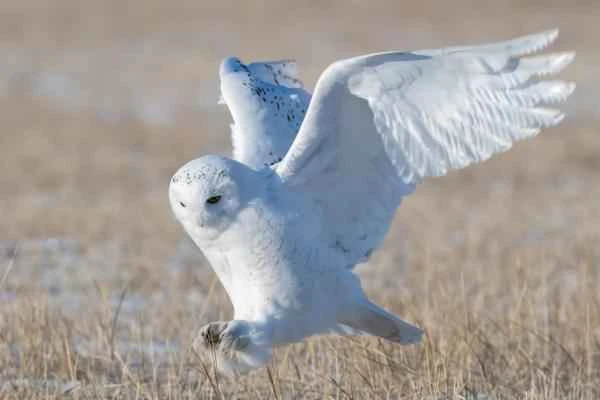
Feather color and sex characteristics : Snowy Owls are covered in snow-white feathers. Males are usually pure white with occasional black spots; females have more dark horizontal bars, making them easy to distinguish.
Strong ability to withstand the cold : In order to resist the extreme cold of the polar region, the snowy owl has particularly dense and long feathers, and even its beak and feet are covered with thick feathers. This unique "down coat" can effectively prevent the loss of body heat.
Hunting weapon : The snowy owl has strong, powerful toes and sharp claws, which are suitable for catching and tearing prey.
Highly perceptive : Its large, bright yellow eyes, facing forward, possess exceptional visual discrimination abilities, enabling it to hunt efficiently even in dim environments.
Huge size : The snowy owl is one of the largest owls in existence. Females are 54-71 cm long with a wingspan of up to 159 cm and weigh 1.4-2.4 kg; males are slightly smaller, with a body length of 52-64 cm and a wingspan of 147 cm.
Long lifespan : In the wild, it can typically live up to 10 years, and in captivity, it can live up to 23 years.
Special habits : Unlike most nocturnal owls, the snowy owl is a diurnal bird of prey, and is more active and forages more frequently during the day.
Snowy Owl's Distribution Area and Habitat
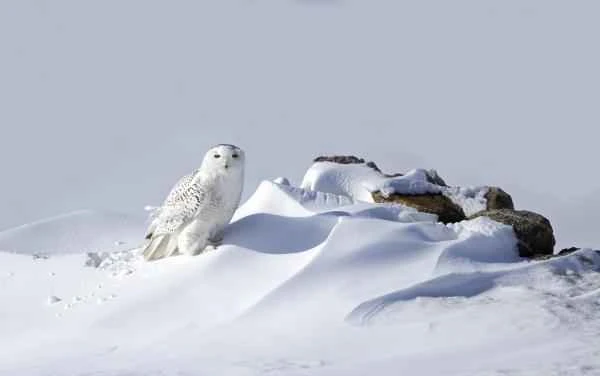
Polar representative species : Snowy Owl is mainly distributed in the Arctic Circle and surrounding tundra, grassland and sand dune areas, covering polar and subpolar regions of Europe, Asia and North America.
Perfect camouflage : The snowy owl's white feathers blend perfectly with the icy environment, helping it to conceal itself during hunts and increasing its success rate.
Adapting to migration : Snowy owls migrate with the seasons and food availability. In winter, they migrate south in search of richer food sources; during the summer breeding season, they return to the Arctic tundra.
Snowy Owl Migration Behavior
Although snowy owls can adapt to cold environments, they will migrate long distances when food is scarce or the weather is extreme.
Some individuals can even fly thousands of kilometers, from the Arctic tundra to the plains and farmlands of temperate regions.
Migratory behavior is closely related to food abundance and reproductive needs, making it a typical migratory bird of prey.
Snowy Owl's Dietary Structure
Main prey : Lemmings (Lemmus spp.), a single snowy owl can prey on up to 1,600 lemmings per year.
Diverse diet : When lemming populations decline, snowy owls also prey on small mammals such as hares, squirrels, moles, and voles, as well as birds such as ptarmigans, ducks, and gulls. Sometimes they will also eat fish or animal carcasses to survive famine.
Hunting methods : Snowy owls often ambush prey, waiting for them to approach, or they will quickly pounce on prey after circling low above the ground. Small prey will be swallowed whole, while indigestible bones, feathers, etc., will be regurgitated in clumps.
Snowy Owl Breeding Habits
Reproduction is greatly affected by food : When food is plentiful, snowy owls will increase the number of eggs they lay and have a higher reproductive success rate.
Courtship and Nest Building : During the breeding season, males attract females through flight displays. After mating, females build nests on the ground and lay eggs, one per day, for a total of 5-13 eggs.
Hatching and raising chicks : The incubation period is about one month. After hatching, the chicks are fed by both the male and female. They can leave the nest and live independently after about one month.

Snowy Owl's Fame and Cultural Influence
Thanks to her appearance as "Hedwig" in the Harry Potter film series, the snowy owl became a star bird followed by fans worldwide. In reality, "Hedwig" in the movies was a male snowy owl.
Recommended keywords : Snowy Owl, White Owl, Snowy Owl Distribution, Snowy Owl Food, Snowy Owl Breeding, Polar Raptors, Snowy Owl, Snowy Owl Migration, Lemming Predator, Harry Potter Snowy Owl
References
Lleó, A. (2015) The Evolution of the Sun and the Earth: The Brotherhood of All Life on Earth. Madrid: Polytechnic University of Madrid.
Julivert, M. (2013) Birds of Prey. Barcelona: Parramón Paidotribo.