The beluga whale (scientific name: *Delphinapterus leucas*), renowned for its pure white appearance, is one of the most recognizable whales in the polar oceans. Beyond its unique appearance, it possesses numerous special abilities adapted to its cold environment. This article will provide a detailed introduction to the beluga whale's morphological characteristics, habitat, echolocation, diet, and reproductive habits, helping you gain a deeper understanding of this Arctic star animal.

Key characteristics of beluga whales
Classification : Beluga whales belong to the Monodontidae family, which includes only two whale species: beluga whales and narwhals.
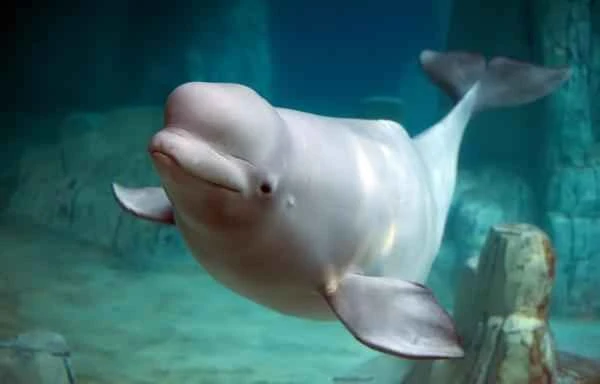
Body color : Adult beluga whales are pure white, the most unique color among all whales. Newborn calves are gray or cream-colored, gradually turning white as they age. "Beluga" means "white" in Russian.
Body structure : Beluga whales do not have a dorsal fin, have a distinct rounded protrusion on their head (called a "melon"), and have a flexible neck; these features are relatively rare among cetaceans.
Size : The body length is usually between 3 and 5.5 meters, which is considered a medium-sized whale.
Highly social : Beluga whales are highly social animals, often living in groups of 10-25 individuals, or even larger. They communicate through physical contact and a rich vocalization system, hence their nickname "canaries of the sea."
Respiratory characteristics : As mammals, beluga whales rely on their lungs to breathe and need to surface periodically to breathe, holding their breath for up to 15 minutes.
Swimming speed : Average speed is about 10 kilometers per hour.
Distribution and Habitat of Beluga Whales
Circum-Arctic Distribution : Beluga whales are mainly distributed in the Arctic and sub-Arctic waters, including the shallow seas, bays, estuaries and fjords along the coasts of Canada, Alaska, Greenland, Russia and Norway.
Migration : Some populations migrate south to avoid the ice according to seasonal changes, and then return to the north to reproduce in the summer.
Adaptation to polar environments : Many beluga whales live or move under ice, relying on a thick layer of blubber (bone) for insulation, heat preservation, and increased buoyancy.
Freshwater River Explorers : Sometimes, beluga whales also venture into large freshwater rivers such as the Yukon River in Canada and the Amur River in Russia in search of food.
beluga whales' echolocation ability
Beluga whales possess an exceptionally sophisticated echolocation ability, one of their most remarkable skills.
The melon organ : The round protrusion on the head is called the "melon," which is rich in fat and is the main structure for echolocation, used to focus and modulate sound waves.
Positioning principle : Beluga whales emit a series of clicking and whistling sounds through their nasal cavity. These sound waves reflect off objects underwater and are received and analyzed by their nasal organs. In this way, beluga whales can "see" their surroundings, find prey, communicate with their companions, and even navigate and hunt precisely in the dark environment under ice.
Social "language" : Beluga whales have a rich variety of calls, which are used not only for navigation but also for communication within the group, earning them the reputation of "singers of the ocean".
Beluga whales' food and hunting methods
Omnivorous predators : Beluga whales have a wide range of prey, including fish (such as salmon and cod), shellfish, crustaceans, octopus, worms, etc.
Collective hunting : Sometimes beluga whales will hunt in groups to improve their hunting efficiency.
Unique foraging techniques : They use echolocation to find prey on the seabed, or they spray water to stir up the seabed sediment, "washing" buried creatures out for them to eat.
Natural enemies : Polar bears are one of the main natural enemies of beluga whales, and many beluga whales bear the marks of polar bear attacks.
Beluga whale breeding and calving
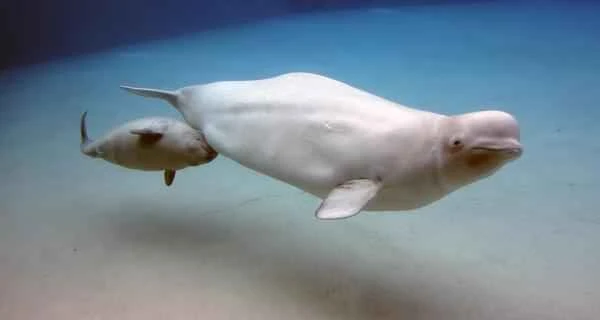
Long gestation period : The gestation period of a female whale is 14-15 months, and she only gives birth to one calf at a time. The calf is about 1.5 meters long at birth.
Birth location : Choosing to give birth in shallow, warm waters near the coast helps the calf survive.
The mother and calf have a close bond : the mother whale nurses her calf for about two years, and the calf maintains a close relationship with its mother until it becomes completely independent.
Growth process : After the baby whale grows teeth, it begins to eat solid food such as small fish and small squid.
Breeding cycle : They reproduce once every 3 years, and female whales can generally reproduce for about 20 years.
Other interesting facts and current conservation status
Strong breath-holding ability : Beluga whales can hold their breath for up to 15 minutes.
Bulbar insulation : The blubber layer not only provides insulation but also increases buoyancy, helping it adapt to the extremely cold Arctic environment.
Population status : Some beluga whale populations are stable, but in some areas they are threatened by climate change, pollution, and human hunting. Many Arctic countries are strengthening protection measures.
Recommended : Beluga whales, Beluga whale characteristics, Beluga whale distribution, Beluga whale echolocation, Beluga whale diet, Beluga whale reproduction, Polar cetaceans, Arctic animals, *Delphinapterus leucas*, Cetacean encyclopedia
bibliography
Beatty, R., Beer, A., and Deeming, C. (2010). The Book of Nature. Dorling Kindersley, UK.
Prevost, J. (1995). Moby-Dick. Minnesota: Abdo & Daughters.
Furgang, K. (2019). Moby-Dick. Enslow Publishing, New Jersey.