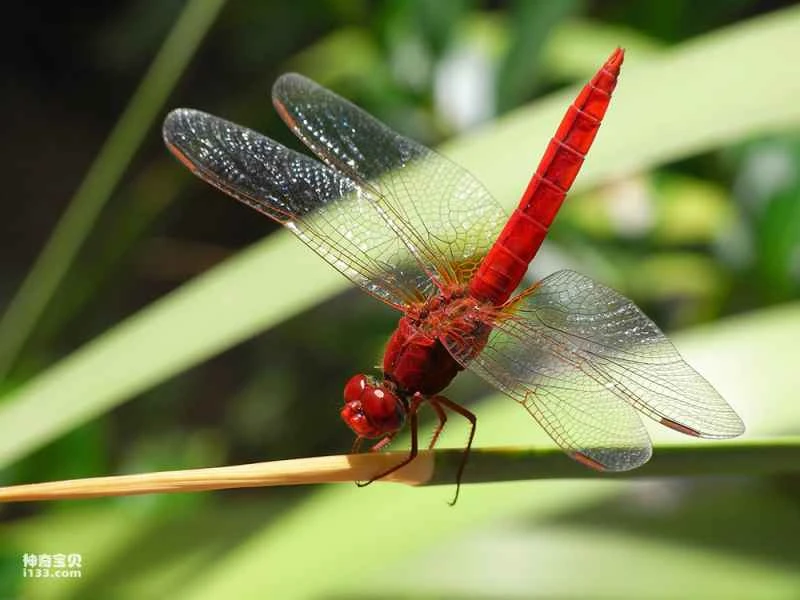
A Japanese research team reported in the latest online edition of the Proceedings of the National Academy of Sciences of the United States of America that they have discovered that dragonflies have an unusually large number of genes related to color discrimination and can use different combinations of color vision genes depending on different environments. This discovery could help in the development of light sensors that adapt to different lighting conditions.
After light is converted into electrical signals by photoreceptor cells in the eye, the information is processed in the brain. These photoreceptor cells contain opsins that function as light sensors; the synthesis of these opsins is guided by different opsin genes.
Researchers at Japan's National Institute of Advanced Industrial Science and Technology (AIST) explained that many animals possess only three to five types of opsin genes. Humans, for example, have three types of opsin genes, forming "light sensors" that respond to the three primary colors of blue, green, and red, enabling them to recognize various colors based on these three primary colors. This allows humans to see red and purple, but not ultraviolet light. Bees and fruit flies, however, possess opsin genes that respond to ultraviolet light, but lack opsin genes that respond to red light; therefore, they can see ultraviolet light but not red.
Dragonflies have large eyes, which occupy most of their heads. They have three simple eyes and compound eyes composed of 28,000 ommatidia, giving them excellent vision. Dragonflies have degenerated hearing and smell, relying more on vision than other insects. However, the molecular mechanisms underlying color vision in dragonflies remain unclear.
A team led by Akira Futahashi, chief researcher at the National Institute of Advanced Industrial Science and Technology (AIST) in Japan, collaborated with other institutions to analyze the chromosomes of various dragonflies and discovered that dragonflies have a wide variety of opsin genes, ranging from 15 to 33.
Experts, through detailed research on a species of autumn dragonfly, discovered that the small eye facing its back in its compound eyes contains a highly active rhodopsin gene, which easily perceives the blue of the sky. In the small eye near its abdomen, the rhodopsin gene can distinguish between red and green food. Akira Futaba suggests that dragonflies may have evolved more types of rhodopsin genes for better survival.
This study shows that dragonflies can utilize different combinations of opsin genes depending on the lighting conditions. In the future, the research team plans to analyze dragonfly photoreceptor cells in detail, clarify the specific function of each opsin gene, and reveal the molecular basis of color vision evolution and adaptation to different lighting environments.