Chinese and American researchers said on the 12th that two fossils discovered in northern China show that in the Jurassic period, about 160 million years ago, when dinosaurs ruled the land, early mammals had already learned to climb trees and dig burrows in the ground, demonstrating diverse ecological adaptations and thus successfully securing a place on Earth.
Both fossils come from a primitive mammal called a columnodont. One, named *Climbing Dexterus*, lived 165 million years ago and is the earliest known arboreal mammal. The other, named *Short-fingered Digging Columnodon*, lived 160 million years ago and is the earliest known burrowing mammal. The journal *Science* published two papers that day introducing the discoveries.
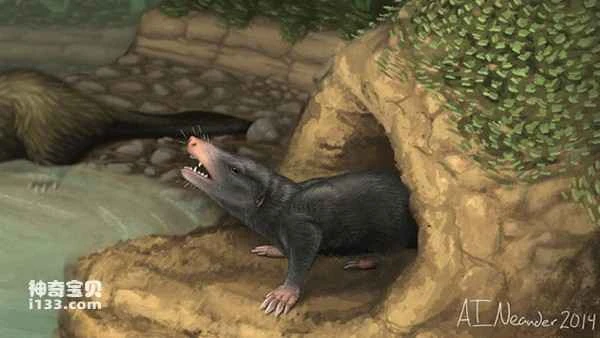
The earliest known burrowing mammal: a reconstruction of the short-fingered cylindrodon.
Luo Zhexi, a paleontology professor at the University of Chicago who participated in the research, told Xinhua News Agency that the *Climbing Agile Coccygeosaurus* fossil was discovered in Ningcheng, Inner Mongolia in 2011, while the *Short-Fingered Excavated Coccygeosaurus* fossil was discovered in Qinglong County, Hebei Province in 2012. "Both new fossils have very distinctive finger and toe features. The *Climbing Agile Coccygeosaurus* lived in trees and had specialized teeth that allowed it to eat tree sap. The *Short-Fingered Excavated Coccygeosaurus* lived underground and had teeth that allowed it to eat worms and insects."
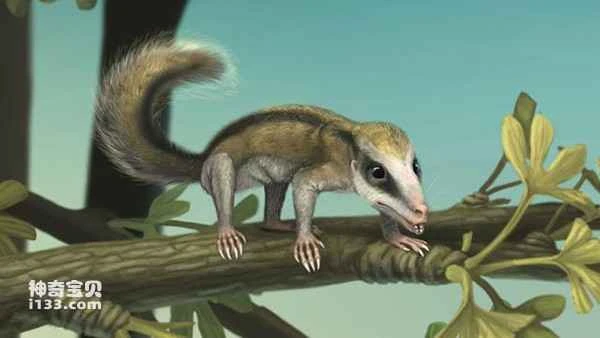
Reconstruction of the earliest known arboreal mammal: the climbing agile columnodon.
He said that columnodonts are extinct relatives of extant mammals, existing only in the Jurassic and subsequent Cretaceous periods. Their morphological characteristics represent primitive morphological features in the evolution of mammals. The two columnodont species discovered in China exhibit diverse ecological adaptations, "indicating that the earliest primitive mammals were more diverse and had a wider range of differentiation, and also suggesting that the dominance of dinosaurs over the Mesozoic Era (including the Triassic, Jurassic, and Cretaceous periods) was not as great as previously thought."
Another researcher, Meng Qingjin, director of the Beijing Museum of Natural History, said that the climbing agile columnodon is "the earliest and most primitive known climbing arboreal mammal." The short-fingered digging columnodon is "the first verifiable primitive mammal with a burrowing-like specialized lifestyle."
In 2006, a semi-aquatic swimming fossil of a cypriniform mammal was discovered in Inner Mongolia. Meng Qingjin said that these discoveries "show that the functional diversity and evolutionary differentiation of the earliest mammals far exceeded previous expectations."
The new study was conducted by a research team consisting of Luo Zhexi, Meng Qingjin, and Ji Qiang from the Institute of Geology, Chinese Academy of Geological Sciences. Both newly discovered fossils are now housed at the Beijing Museum of Natural History.