In the cold, high-latitude regions live some stunning seabirds that have evolved unique survival skills to thrive in harsh environments. The Atlantic Puffin (scientific name: Fratercula arctica ) is one of them. Its clown-like colorful beak and penguin-like black and white plumage make it one of the most iconic seabirds of Northern Europe.
So, are Atlantic puffins penguins? Where do they live? And what do they eat? This article will provide you with a detailed introduction to the physical characteristics, habitat, diet, and breeding behavior of Atlantic puffins, giving you a comprehensive understanding of this adorable yet resilient seabird.
I. Physical Characteristics of the Atlantic Puffin
Scientific name : Fratercula arctica
Other names : Puffin, Sea Clown, Puffin
Medium size : Adult individuals are about 30 cm in length and have a wingspan of up to 60 cm.
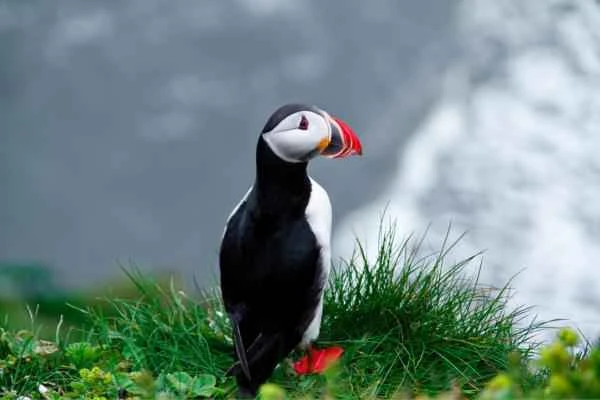
Bright and eye-catching beak : Adult birds have a large beak with red, black and yellow stripes during the breeding season, which is very striking.
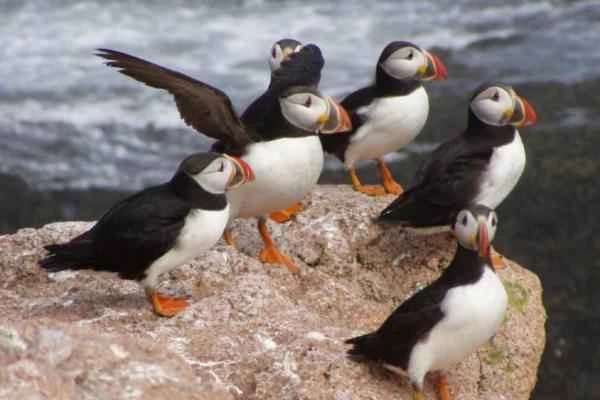
Its plumage features a striking contrast : a black back and white cheeks and belly, giving it the appearance of wearing a monk's robe, hence the name "Fratercula" (meaning little monk).
It is highly amphibious : it can fly in the air (up to 90 km/h) and is also adept at swimming underwater using its short wings.
Webbed feet : The hind limbs are webbed, which is used for turning and accelerating when swimming in water.
Not related to penguins : Although they look like penguins, puffins belong to the order Charadriiformes and are not related to penguins (Sphenisciformes).
Almost silent : Adult puffins rarely make a sound, except when caring for their chicks.
II. Habitat of the Atlantic Puffin
Atlantic puffins are typical birds of the North Atlantic coast , with a distribution range including:
Main distribution countries/regions : Iceland (world's largest breeding ground), United Kingdom, Ireland, Norway, Greenland, Canada, northern France, Scandinavia.
Winter migration : During winter, they move away from land and inhabit the high seas; during the spring and summer breeding season, they return to coastal cliffs or small islands.
A frequent visitor to Spain during the winter : it can be seen in coastal cities such as Valencia, Alicante, and Murcia.
During the breeding season, they often dig burrows on cliff edges, grassy slopes, or islands as nests. Their habitat must be close to the sea to facilitate fishing and raising their young.
III. Diet of the Atlantic Puffin
As seabirds, puffins primarily feed on marine life , including:
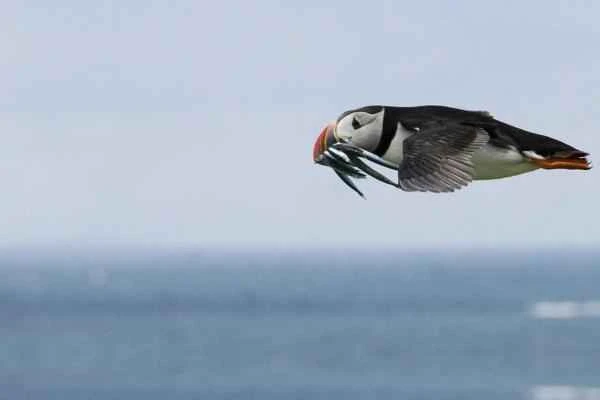
Small fish : such as anchovies, capelin, sardines, etc.
Crustaceans : including small shrimp.
Hunting method : It can dive to a depth of 60 meters and use its wings to paddle and chase prey.
Swallowing mechanism : After capturing prey, it swallows it whole immediately to avoid being eaten by other birds. Its tongue has special grooves that allow it to hold multiple small fish at once.
IV. Breeding Habits of Atlantic Puffins
Breeding season : Spring and summer. During this time, the beak becomes more vibrant to attract mates.
Nest building : Rabbits dig burrows on grassy slopes, islands, or cliff edges, sometimes using abandoned rabbit burrows, and return to the same location to build their nests each year.
Reproduction method : A pair of parent birds share one egg, with an incubation period of about 40 days, during which the parent birds take turns incubating the egg.
Chick growth :
They can move around within a few hours of hatching.
The parents feed the small fish.
The chicks can leave the nest independently after 40 days.
Young puffins have darker plumage and black beaks, and develop typical adult colors around 2 years old.
bibliography
Spanish Encyclopedia of Birds. (Undated). Atlantic Puffin. Website: https://seo.org/ave/frailecillo-atlantico/
Kauffman, K. (2005). A Field Guide to Birds of North America. New York: Hillstar Editions.
SEO/BirdLife. (Dateless). Atlantic Puffin. URL: https://atlasaves.seo.org/ave/frailecillo-atlantico/