More than 20,000 photographs were submitted for the 2022 Bird Photographer of the Year competition. This year, photographers from 115 different countries submitted images to compete for a £5,000 cash prize and a prestigious title.
single file
Ben Krank, South Africa. Category: Best Portrait.
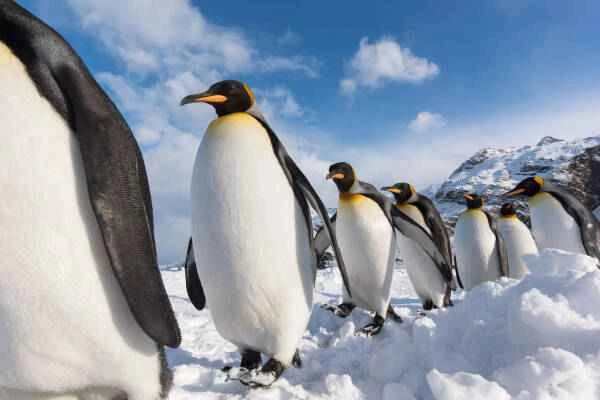
On land, king penguins are often habitual animals, typically following paths frequented by humans when returning to their nests from the ocean. I used this behavior to capture this image, concealing the camera at the edge of one of these paths and camouflaging it with snow. I took the photo using a wireless trigger as the birds marched in an orderly line.
The Nikon D810 comes with a Nikon 18–35mm f/3.5–4.5 lens. Focal length 23mm; 1/500 sec; f/11; ISO 200.
The cartoon bird raises its "hand".
Liu Yongqiang, Malaysia. Category: Best Portrait.
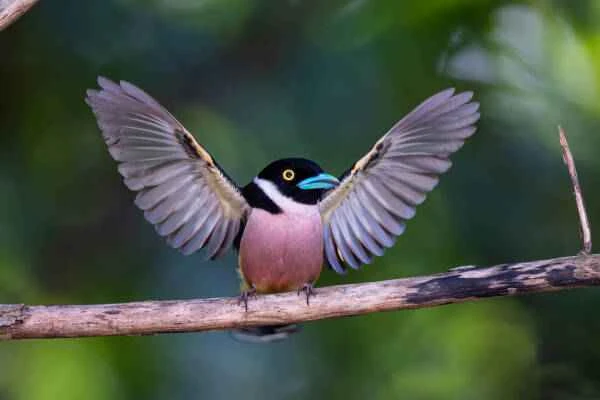
It was the start of the breeding season, and this black and yellow broadbill was making quite a commotion to attract a mate. Courtship behavior included a lot of loud vocalizations and attention-seeking wing-spreading. To me, the colors and patterns of its feathers resembled those used by artists to depict cartoons—stylized, but in some ways not quite like a real bird.
The Fujifilm X-T4 comes with a Canon 500mm f/4 II lens. Focal length 500mm; 1/250 sec; f/4.5; ISO 400.
Manitoba Cave Owl Restoration Plan
Walter Portrebka, Canada. Category: Conservation Award
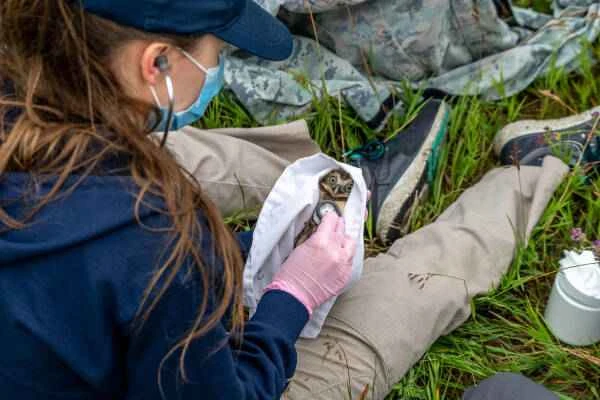
In 2021, I documented the work of the Manitoba Burrowing Owl Restoration Program. As the project's name suggests, it is working to rebuild the burrowing owl population in Manitoba, Canada. The approach includes reintroducing owl pairs and surveying juvenile wild owls, habitat improvement, and community engagement. Owls are reintroduced each breeding season in cooperation with private landowners. Despite these efforts, fewer than ten pairs of wild burrowing owls have been recorded nesting in Manitoba over the past decade. To the team's delight, with the help of local farmers, a wild nest with six healthy owls was reported in 2021—the first such nest observed since 2011!
The Sony A1 comes equipped with a Sony 70–200mm f/4 G lens. Focal length 70mm; 1/80 sec; f/6.3; ISO 320.
warts
Leander Hill, Austria. Category: Best Portrait.
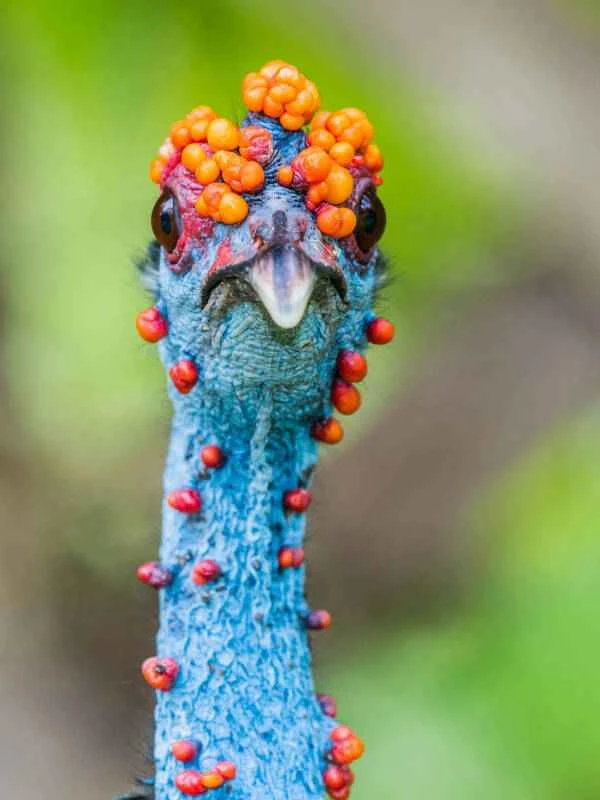
The male one-eyed turkey's head coloration and structure even surpass those of its close relative, the wild turkey of North America (Meleagris gallopavo). I've always wondered if the orange warts covering its head and neck serve any purpose other than sexual selection—they seem too extravagant. To present the bird in a way that differs from what is usually seen, I chose this frontal view when this person made eye contact with me at a private reserve in Belize.
The Nikon D810 comes with a Nikon 200–500mm f/5.6 lens. Focal length 500mm; 1/250 sec; f/6.3; ISO 500.
struggle
Ellend Harberger, Norway. Category: Bird behavior.

Spring arrived late in Finnmarkshire in 2020, and the area was still covered in thick snow when the first migratory birds arrived. As a result, only a few places on the river offered open water, where many wading birds gathered to forage for food while waiting for the snow to melt at their nesting sites. I spent several days in the hiding places and witnessed some interesting behaviors, including a fierce fight between rival males, likely exacerbated by the frustration of being trapped in the snow. The most impressive of all occurred between these two spotted redshanks.
The Nikon D850 comes with a Nikon 180–400mm f/4 lens and a 1.4x teleconverter. Focal length 550mm; 1/2,500 sec; f/6.3; ISO 1,600.
Full contact information
Gabo Barros, Hungary. Category: Bird behavior.
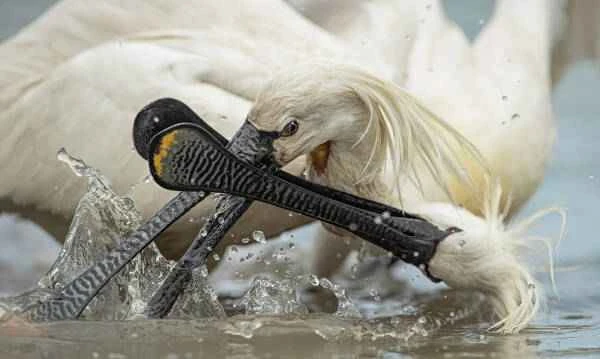
This photo was taken on my second visit to this small pond. On my first visit, there were many birds and plenty of opportunities to take action photos. Now, however, silence is my companion. All I saw was a lone grey heron (Ardea cinerea), which attacked any birds that approached the pond.
However, the situation improved in the afternoon when a flock of Eurasian spoonbills landed not far from me. One immediately noticed an aggressor among them, a bird with a strong territorial instinct. I focused my attention and camera on this bird. In most cases, the other spoonbills chose to avoid confrontation. However, on one occasion, one bird turned to face the aggressor, and a minute-long, unbridled battle ensued.
The birds' aggression far exceeded my expectations. It felt like they were fighting for their lives, pressing each other's heads underwater or simply grabbing each other's legs to prevent the other from flying away. During the struggle, they drew closer and closer, so much so that they completely filled the frame when this photo was taken.
The Canon EOS-1D X Mark II comes with a Canon 400mm f/2.8 lens. Focal length 400mm; 1/6,400 sec; f/4; ISO 1,000.
Penguins dance at sunset
Audrey Wooller, British. Category: Best Portrait.
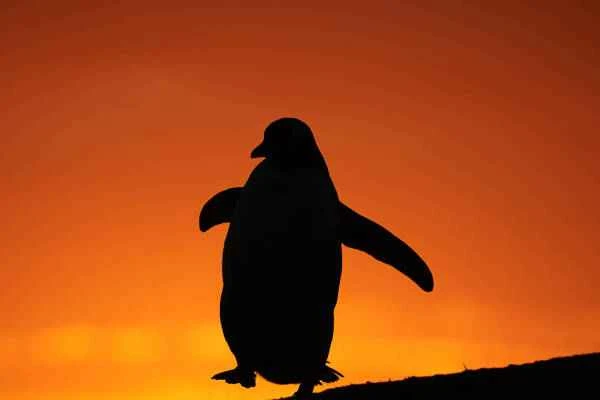
Bathed in the setting sun, the penguin looked as if it were dancing. I lay on the ground, waiting and hoping for a suitable penguin to pass by during the few minutes when the sunset provided the perfect light for the silhouette. The penguin complied, its beak, feet, and webbed feet perfectly positioned as it passed. I deliberately underexposed the image slightly to enhance the contrast between the sunset colors and the penguin silhouette.
The Canon EOS-1D X Mark II is equipped with a Canon 100–400mm f/4.5–5.6 II lens. Focal length 371mm; 1/1,600 sec; f/5.6; ISO 100.
Life hangs in the balance
Glenn Nelson, United States of America. Category: Bird behavior.
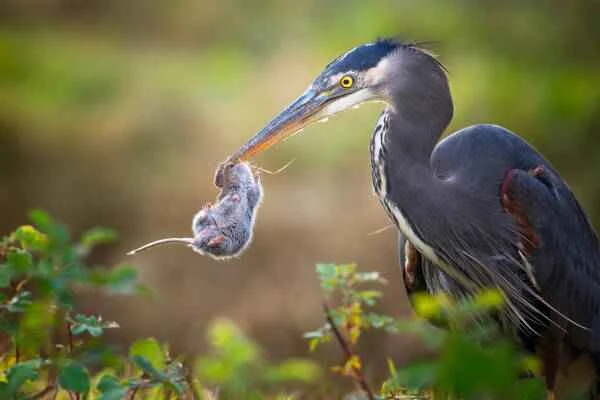
Great Blue Heron (Ardea Herodias). Skageter Valley, Washington, USA.
I spend most of the year photographing the Great Blue Heron, the official bird of my hometown, Seattle. I had just acquired a brand new lens and wanted to try something different, so I pulled over to observe a grey heron in a field. Before that, I had only ever photographed these birds near water. I was shocked when the bird caught a field mouse, and I had to force myself to keep taking pictures. Some people might find the photo too gruesome to look at, and the heron's choice of prey might surprise many. But it shouldn't be: after all, we humans also prey on other mammals besides birds.
The Nikon Z 6 comes with a Nikon 500mm f/5.6 PF lens. Focal length 500mm; 1/3,200 sec; f/5.6; ISO 2,800.
Bewitched by love
Marty Phillips, United States of America. Category: Bird behavior.
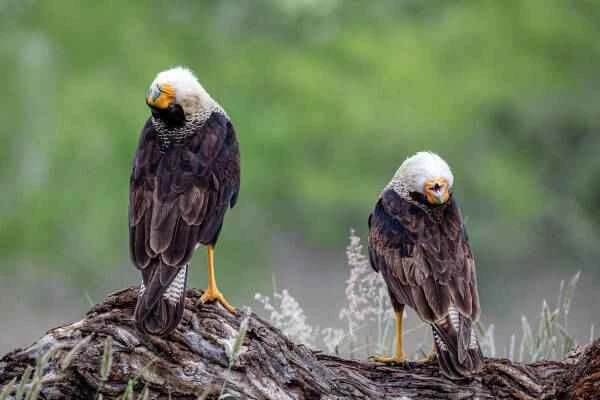
I traveled to the Rio Grande region of Texas for my first bird photography workshop. This photo was taken at a regularly fed area, where crested caracals were among the species attracted. Most of the time, they just sat around, so imagine how excited I was to be able to photograph these two engaging in mating behavior.
Canon EOS 5D Mark IV with Canon 100–400mm f/4.5–5.6 II lens. Focal length 400mm; 1/500 sec; f/5.6; ISO 2,000.
Hummingbird Paradise
Lillon Gertzman, Canada. Category: Bird behavior.
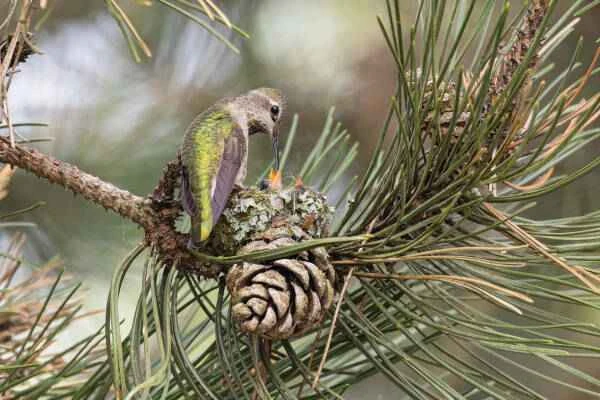
During the Covid-19 pandemic, travel restrictions meant my photography activities were limited to my local area for quite some time. I decided to take this opportunity to learn as much as possible about the Vancouver area. Every morning, I would venture into local parks to look for birds and wildlife.
Throughout the spring, I managed to locate seven Anna hummingbird nests in the area. To avoid disturbing this important and sensitive stage of the bird's life cycle, I kept a proper distance from the nests and limited my visits to a maximum of 15 minutes.
For weeks I'd been watching this particularly beautiful nest as a hummingbird worked hard to build it and incubate her eggs. One afternoon, I stopped to watch and was delighted to see two tiny beaks peeking out of the nest! I captured this intimate moment as their mother flew over to feed them.
The Canon R5 comes equipped with a Canon 100–400mm f/4.5–5.6 II lens and a 1.4x teleconverter. Focal length 560mm; 1/160 sec; f/8; ISO 800.
Highland bald eagle and Cossack fox
Wang Baozhu, China. Category: Bird behavior.
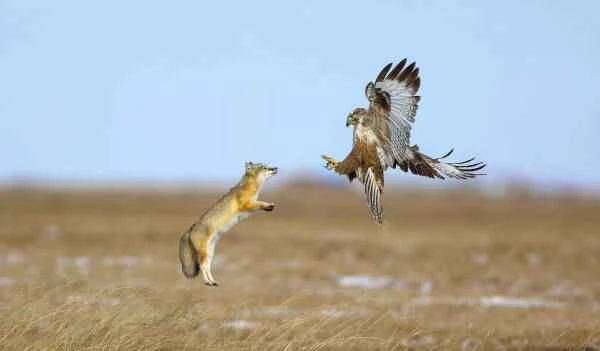
This photo was taken on the Mandu Grassland in Dongwu Banner, Inner Mongolia. The highland bald eagle and the Cossack fox (Vulpes corsac) are both apex predators in this grassland environment, their diet consisting mainly of small rodents. Therefore, they are competitors in terms of food, sometimes even fighting each other for prey.
Such confrontations are usually a show, a contest of wills, and never lead to a life-or-death battle. In this situation, the highland vulture decides to abandon its food and fly away.
The Canon EOS 5D Mark IV comes with a Canon 600mm f/4 lens. Focal length 600mm; 1/1,600 sec; f/4, ISO 160.