Recently, PLoS ONE published online a report on the discovery of Platylomaspis serratus gen. et sp. nov., the earliest known multigillated fish in the Silurian strata of the Tarim Basin in Xinjiang, China. This discovery pushes back the origin of multigillated fishes from the Early Devonian to the Landoville epoch of the Silurian, advancing the timeline by approximately 20 million years. Furthermore, it expands the paleogeographic distribution of multigillated fishes from the South China Plate to the Tarim Plate, demonstrating that these two plates were once very close together in the Early Silurian, a discovery of significant paleogeographic importance.
The new genus and species, along with the newly discovered Nanningaspis zengi gen. et sp. nov. from the Devonian system of Nanning, Guangxi, are mainly identified by the broad ventral rings on the edge of the cephalic plate and the elongated snout at the anterior margin. Phylogenetic analysis shows that they are closely related to Gumuaspis from the Early Devonian of Yunnan, and together they form a new family of polygillids—Gumuaspidae fam. nov., representing the most primitive group of polygillids.
Chinese armored fish have long been considered benthic fish living in nearshore coastal environments. However, a series of new discoveries in recent years suggest that their lifestyles may be much more complex than previously thought. For example, the *Rhegmaspis*, discovered in 2015 in the Early Devonian Posongchong Formation of the Blag Formation in Zhaotong, Yunnan, possesses a series of specialized features, including a torpedo-shaped head armor, a slender snout, orbital openings located on the ventral side of the head armor, and the absence of abdominal rings. It is the first armored fish with a streamlined body shape discovered in China, indicating that some armored fish may have begun an active swimming lifestyle with more proactive feeding behaviors. Meanwhile, the newly discovered *Serpentina serrated-bellied* and *Nanningia zengeri* exhibit many characteristics of parallel evolution with modern rays, likely representing a new lifestyle for armored fish—a semi-buried lifestyle. This new lifestyle allows armored fish to better conceal themselves and evade predators. It is possible that this new lifestyle is why the family *Rhegmaspis* has become the longest-surviving lineage within the subclass Armored Fishes. New research suggests that by the Early Devonian Lag stage, armored fishes may have successfully diversified into various lifestyles, including semi-buried, surface-benthic, and upper-benthic (self-swimming), to adapt to different ecological niches, thus reaching the peak of evolution.
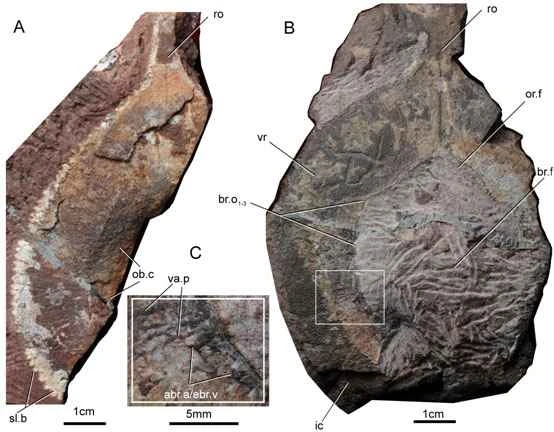
Figure 1. Platylomaspis serratus gen. et sp. nov. (Provided by Gai Zhikun)
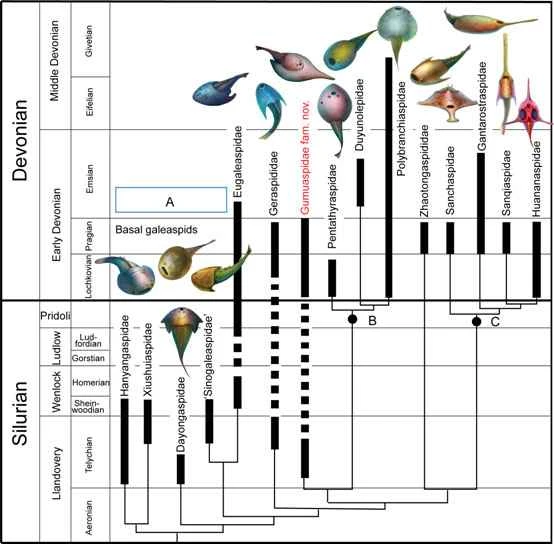
Figure 2. The discovery of the serrated broad-bellied fish pushes back the origin of multigillated fish from the Early Devonian to the Silurian Landovillie, advancing it by about 20 million years (Image provided by Gai Zhikun).
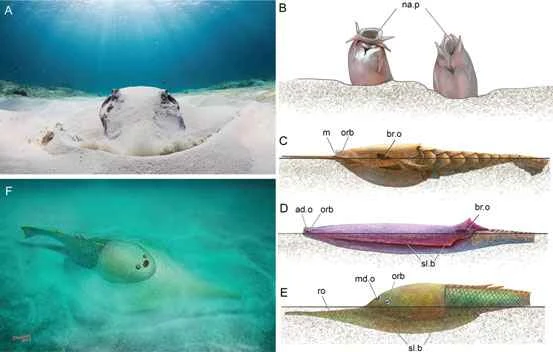
Figure 3. Adaptive characteristics of fish living a semi-buried lifestyle (A. Eugene Kitsios provided, B-F illustrations by Yang Dinghua)

Figure 4. Three lifestyles of armored fish during the Early Devonian Bragg stage (illustrated by Yang Dinghua)