On February 16, 2017, *Scientific Reports* published the latest research findings on the origin of pterosaurs by a research team led by Wang Xiaolin from the Institute of Vertebrate Paleontology and Paleoanthropology, Chinese Academy of Sciences, including Jiang Shunxing and Cheng Xin, in collaboration with Wang Xiaoli and Zhang Junqiang from the Institute of Geology and Paleontology, Linyi University. The pterosaur fossil reported in this study belongs to the Jurassic Yanliao Biota, and the specimen was unearthed from Linglongta, Jianchang, Liaoning Province. The morphological features of this specimen, such as the caudal vertebrae, pterygometra, and fifth toe, are intermediate between pterosaurs and non-pterosaurs. Based on these characteristics, it was named *Douzhanopterus zhengi*. The discovery of this specimen allows for a deeper understanding of the evolution of the postcranial skeleton in the origin of pterosaurs.
In traditional classification systems, pterosaurs can be divided into the long-tailed "Rhinocerosauridae" (non-pterodactyls) and the short-tailed "Pterodactylae," with the former being more primitive and the latter relatively more advanced. Since phylogenetic studies were applied to pterosaur research, cladistic analysis has consistently shown that only pterodactyls are a monophyletic group, while the "Rhinocerosauridae" is a polyphyletic group encompassing all basal pterosaur groups, hence it is also referred to as non-pterodactyls. Pterodactyls possess fused preorbital fenestraes, significantly elongated pterygometras, shortened tails, and vestigial fifth toes—features that are distinctly different from non-pterodactyls. For a long time, any one of these features could be used to differentiate between pterodactyls and non-pterodactyls.
Since 2009, the Chinese and Brazilian pterosaur research team led by Wang Xiaolin first studied and named *Li's Wukongpterosaur*, establishing the Wukongpterosauridae family, and subsequently reported several types of Wukongpterosaurs. Without exception, these pterosaurs possess skulls similar to those of pterodactyls, with fused anterior orbital fenestrae; their cervical vertebrae and pterygometra are relatively elongated, more so than in non-pterodactyls but less so; their elongated tails and specially developed fifth toes are very similar to those of non-pterodactyls. *Wukongpterosaur*, *Darwin's Pterosaur*, and *Kunpeng's Pterosaur* are currently the most confirmed members of the Wukongpterosauridae family, and these members are considered to be transitional links in the evolution from non-pterodactyls to pterodactyls.
Recently, two unnamed pterosaur specimens were discovered in the Late Jurassic Solnhofen limestone, famous in Germany for its Archaeopteryx fossils. Their skull morphology is not significantly different from other pterosaurs from the same region, and their postcranial skeletons are also quite similar. However, their caudal vertebrae are slightly larger and longer than those of pterosaurs, but significantly smaller than those of non-pterosaurs. Their fifth toe has two phalanges similar to those of non-pterosaurs, but each phalanx is highly reduced. Therefore, this unnamed type is considered to be the final stage in the evolution from non-pterosaurs to pterosaurs.
Researchers, through morphological and systematic studies of the Zheng's *Agniformes zhengi* fossil, believe that *Agniformes zhengi* is more advanced than *Wukongopteran* in several key pterosaur evolutionary features, including the cervical vertebrae, tail, pterygomephagos, and feet. Phylogenetic analysis also supports this view. Compared to the unnamed specimen discovered in Germany, *Agniformes zhengi* exhibits a more primitive tail and phylogenetic position. The discovery and study of *Agniformes zhengi* makes the pterosaur evolutionary chain—from *Rhizosuchians* to *Wukongopteran* to *Agniformes zhengi* to the unnamed German type to pterosaurs—more complete and clear.
In the scatter plots showing the variations in three main characteristics between non-pterodactyls and pterodactyls, the distribution areas of the two groups can be clearly distinguished. Specifically, regarding the relationship between tail length and body size (humerus), non-pterodactyls, except for the somewhat unique frog-mouthed pterosaurs, all have long tails, while pterodactyls all have short tails; *Ospreyron* is located in the region between these two groups. In the distribution of the ratio of the pterygomephalus to the ulna relative to the size of the pterosaur, a clear distinction is made between larger pterodactyls and smaller non-pterodactyls, with *Ospreyron* again appearing between these two regions. The relationship between the first phalanx of the fifth toe and the foot also shows a clear difference between the two groups, with *Ospreyron* again positioned between the two.
The Zheng's *Agniformes* is found in the Daohugou Formation (or Tiaojishan Formation) of the Late Jurassic Yanliao Biota. Compared to the numerous *Wukongopterosaurs* found in the same stratum, only one *Agniformes* specimen has been discovered so far. Based on this, it is speculated that *Agniformes* may have only just appeared in the very early Late Jurassic (approximately 160-161 Ma), at which time *Wukongopterosaurs* were dominant. The first appearance of *Agniformes* may have been slightly earlier than this period, while *Wukongopterosaurs* may have appeared even earlier.
The genus name *Fighting Pterosaur*, like *Wukong Pterosaur*, originates from the famous Chinese mythological novel *Journey to the West*, where Sun Wukong, the Monkey King, can perform seventy-two transformations and roam freely across the land. *Wukong Pterosaur* represents a crucial transitional stage between the "rhinosaurs" and pterodactyls, sharing mosaic features from both, hence its name. *Fighting Pterosaur*, on the other hand, is a further evolutionary type of pterosaur within the *Wukong Pterosaur* group. Sun Wukong was ultimately bestowed the title of Victorious Fighting Buddha for successfully protecting Tang Sanzang on his journey to the West. The species name *Fighting Pterosaur Zheng* was presented to Zheng Xiaoting, the founder and curator of the Shandong Tianyu Natural History Museum, in gratitude for his strong support of this collaborative research.
This research was supported by the National Natural Science Foundation of China, the 973 Program of the Ministry of Science and Technology, and the Strategic Priority Research Program (B) of the Chinese Academy of Sciences.

Figure 1. *Douzhanopterus zhengi*. Scale bar a: 5 cm; b, c: 1 cm (Image provided by Jiang Shunxing)
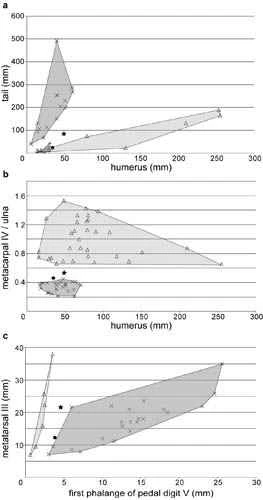
Figure 2. Line drawing of Zheng's Fighting Pterosaur. Scale bar: 5 cm (Image provided by Jiang Shunxing)
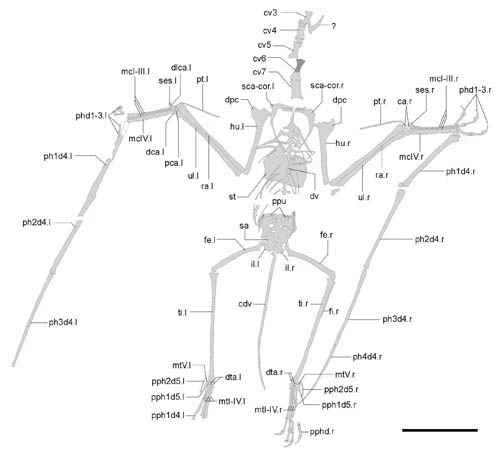
Figure 3. Scatter plot comparing the features of *Zheng's Fighting Pterosaur*. ê *Zheng's Fighting Pterosaur*, ? Unnamed German type, r Pterodactyl, ? Non-pterodactyl (Image provided by Jiang Shunxing)
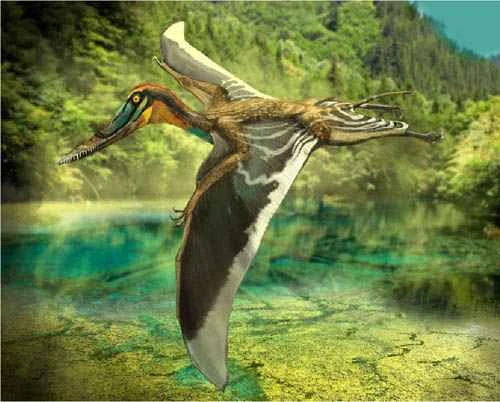
Figure 4. Ecological reconstruction of Zheng's Fighting Pterosaur (drawn by Zhao Chuang)