This question sounds absurd. Fish live in water and can breathe in it, so how can they drown? To understand this, we first need to study what "drowning" actually means.
The concept of drowning
Drowning, as we commonly refer to it, means death caused by the loss of respiratory function due to the submersion of the face and upper respiratory tract by various liquids, including water.
Organisms that need to obtain oxygen from the air (such as mammals) often hold their breath when they enter water to prevent water from entering their lungs.
However, this active control of breathing is limited. As oxygen levels decrease and carbon dioxide levels increase, the breathing reflex becomes increasingly strong until it reaches a critical point where the organism can no longer hold its breath. At this point, water (or other liquids) begins to enter the trachea, causing muscle spasms and blocking the airway. If the continuous inflow of water cannot be stopped, it will soon reach the lungs, hindering gas exchange.

During this process, water entering the lung tissue leads to a reduction in alveolar surfactant. Alveolar surfactant is a lipoprotein (mainly composed of dipalmitoyllecithin) secreted by alveolar cells. It is distributed at the gas-liquid interface on the alveolar surface and is crucial for maintaining alveolar shape and ensuring gas exchange. When alveolar surfactant is damaged, gas exchange in the lungs cannot proceed smoothly, leading to tissue hypoxia and metabolic acidosis. Hypoxemia and acidosis rapidly affect various organs in the body. The brain loses consciousness due to lack of oxygen, followed by respiratory failure, cardiac arrest, and drowning.
From this perspective, the reason for drowning is that water hinders gas exchange, leading to oxygen deficiency in the body and causing death.
For fish, does water hinder gas exchange?
How do fish breathe?
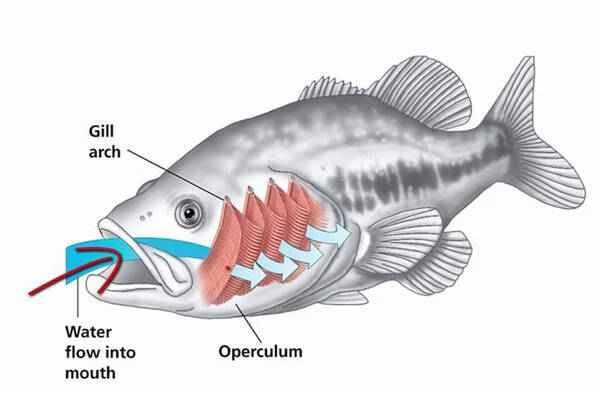
Here we have to talk about how fish breathe: most species breathe with gills, while some species breathe with gills and also use other breathing methods.
As the most important respiratory organ in fish, the gills are characterized by their thin walls, large gas exchange area, and abundant capillary distribution. The gills are usually arranged symmetrically on both sides of the pharynx, with gill lamellae attached to the gill septa (in cartilaginous fish) or gill arches (in bony fish).
For cartilaginous fish (such as sharks), the gill slits typically open directly onto the body surface. Under the control of the branchial muscles, the gill arches rhythmically contract and relax, allowing water to continuously flow from the mouth through the gill cavity and then out through the gill slits. As the water flows through the gill slits, oxygen in the water exchanges gases with the blood in the gill vessels.
Boneless fish are different. Their gill cavities are covered by gill covers, and they mainly rely on the movement of the gill covers to breathe. The direction of water flow through the gills is opposite to the direction of blood flow, which is a countercurrent exchange, and the efficiency of oxygen intake is very high.
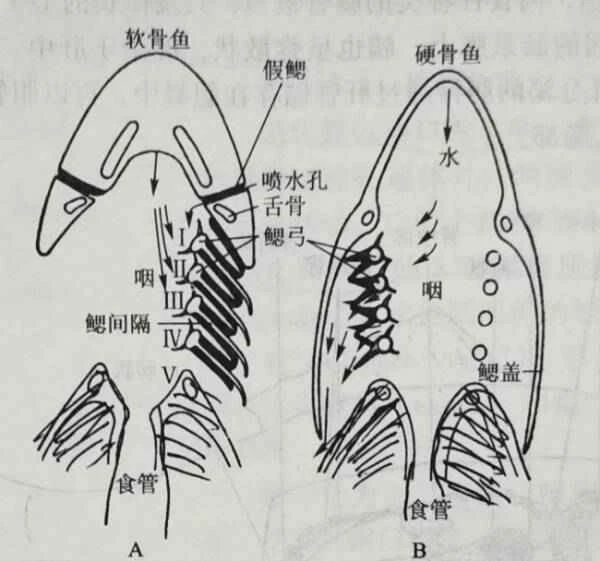
The difference in gills between cartilaginous fish (A) and bony fish (A), image source: *General Zoology*.
In addition to breathing through gills, some bony fish have developed adaptive and special respiratory methods. For example, eels and mudskippers can breathe through their skin; loaches can breathe through their intestines; fighting fish and snakeheads can breathe through their suprabranchial organs; lungfish can breathe through their swim bladder (a sac-like organ located on the back of the intestine in fish), and so on.
For fish that rely on gills to obtain oxygen from the water, the water itself does not hinder gas exchange. From this perspective, fish that breathe with gills will not "drown".
However, some fish are not very dependent on gills and mainly obtain oxygen from the air, so water is not so friendly to them. A more extreme example is the Brazilian bony-tongued fish (Arapaima gigas).

The Brazilian Arapaima lives in a rather unique environment. During the dry season, the water is often filled with decaying organic matter, resulting in very low oxygen levels. To obtain enough oxygen, the Brazilian Arapaima has had to develop a special skill—obtaining oxygen from the air. They breathe using their swim bladder (which is actually homologous to lungs, and current evidence suggests that the swim bladder likely evolved from primitive lungs), but the function of their gills has gradually been lost, to the point that almost 80% of their oxygen supply comes from the air.
In this way, the Brazilian Arapaima not only perfectly adapts to the oxygen-deficient environment, but also unlocks the special ability to survive out of water for a period of time. However, everything has two sides. The Brazilian Arapaima is too dependent on air, so it has to surface to breathe every now and then, otherwise it will "drown".
Fish can also suffer from oxygen deficiency in water.
If we define "drowning" as death from lack of oxygen, then apart from extreme cases like the Brazilian Arowana, other fish can also succumb to the effects of oxygen deprivation in water. There are two main reasons why fish may die from lack of oxygen: either the water itself is oxygen-deficient, or the fish itself is diseased.
People are actually quite familiar with the situation of oxygen deficiency in water. For example, before it rains, fish in ponds always huddle together to the surface to breathe, which is because there is not enough oxygen in the water. Also, when keeping fish at home, you usually need to prepare an air pump to prevent the fish from lacking oxygen.
Factors such as air pressure and water temperature can alter the oxygen content of water, but these changes are generally not severe enough to suffocate fish. However, phenomena like red tides can be truly deadly. During a red tide, the amount of organic matter in the water increases dramatically, leading to a proliferation of aerobic bacteria that consume the already limited oxygen in the water (the oxygen content in water is far less than that in air), causing fish and shrimp to suffocate.
Besides environmental factors, fish diseases can also cause breathing difficulties. A typical example is gill rot, in which the tips of the gill filaments of diseased fish rot and become congested, obstructing their breathing. If not treated in time, even if there is sufficient oxygen in the water, the fish will not be able to breathe and will eventually suffocate and die.
From this perspective, it doesn't seem impossible for fish to drown in water.