The fastest bird on Earth to swoop down and hunt is the frigatebird. Frigatebirds are a general term for five species of large tropical seabirds in the family Frigatebirdidae of the order Pelecaniformes. They have a gular pouch used to temporarily store prey. With well-developed pectoral muscles, they are excellent fliers and are known as "flying champions," being exceptionally skilled aviators. Although they weigh only about 1500 grams, their wingspan can reach 2 meters. Their flight is like lightning, reaching speeds of up to 418 kilometers per hour when hunting, making them the fastest flying birds in the world. They can fly to altitudes of about 1200 meters, perform agile flips in the air, and continuously fly to places more than 1600 kilometers from their nests, with the furthest reaching about 4000 kilometers. Frigatebirds can even withstand gale-force winds of up to level 12, safely taking off and landing.
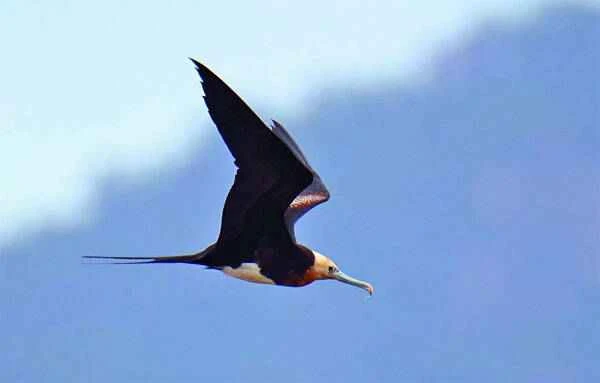
The name "frigatebird" originates from their habits. Frigatebirds have long, pointed wings and are exceptional fliers. When their wings are spread, the distance between their wingtips can reach 2.3 meters. During the day, frigatebirds are almost always soaring in the air. They can tumble and circle at high altitudes and also dive in straight lines at great speed; their superb flying skills are truly astonishing. It is with this skill that frigatebirds attack other seabirds carrying fish in the air. They often swoop fiercely at their target, causing the attacked bird to panic and drop its fish in a hasty flight. At this moment, the frigatebird immediately swoops down, snatches the falling fish in mid-air, and swallows it instantly. Due to this predatory habit of seabirds, early naturalists named them frigatebirds. Here, "frigate" refers to a type of sailing ship equipped with cannons used by pirates in the Middle Ages. In modern English, "frigate" means frigate or guard ship. Later, people simply shortened them to "man-of-war," meaning warship. That's how the name "frigatebird" came about.
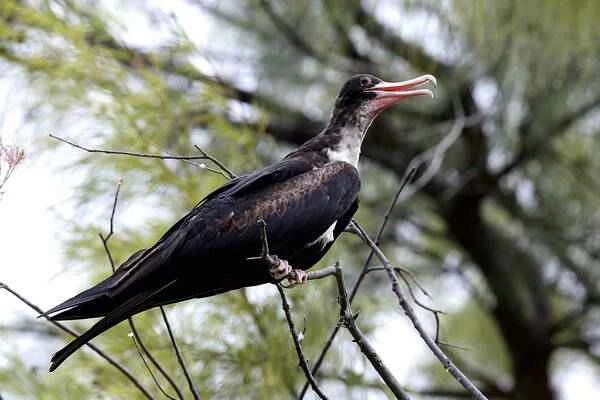
Frigatebirds also obtain food by harassing other seabirds returning with prey. By interfering with other flying birds, they often obtain food dropped from the beaks of other seabirds. If they see their neighbor, the red-footed booby, returning from fishing, they will suddenly launch an aerial attack, forcing the red-footed booby to abandon its fish and shrimp, then swooping down to snatch the falling fish and shrimp for themselves. Because of this "food-stealing" behavior, frigatebirds are derogatoryly called "robber birds."
Frigatebirds are excellent fliers, with large wings, but their bodies are relatively small and their legs are short and thin. Their feathers lack oil and cannot get wet, otherwise they will drown. Therefore, they hunt for food themselves, catching only a small number of fish near the water's surface. Most of their prey is caught by intercepting fish from other birds in the air using their superior flying skills.
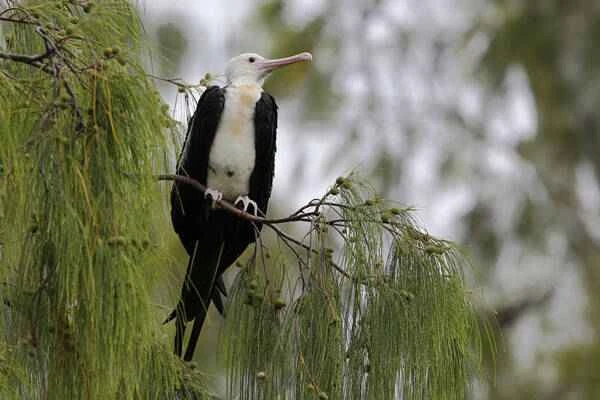
Thus, through long-term evolution, frigatebirds became like pirates among birds, compensating for their lack of foraging abilities by plundering food. Frigatebirds always return to land or islands to roost at night.
Frigatebirds are gregarious. When roosting, large flocks of frigatebirds huddle together, creating a very crowded scene. Other seabirds, such as gannets and gulls, also often gather around frigatebirds to roost. These seabirds, who are bullied and preyed upon by frigatebirds during the day, end up roosting with them at night—something truly incredible about nature.