Have you ever wondered how animals without a "brain" perceive their surroundings, eat, and move? In nature, there are indeed a number of animals that are "brainless" or lack a centralized brain . They mostly live in the ocean, have relatively primitive structures, yet use unique physiological "designs"—such as neural networks, dispersed ganglia, and even "collective individuals" (symbionts)—to perform all the functions necessary for survival. Below, we'll introduce you to 14 typical examples.
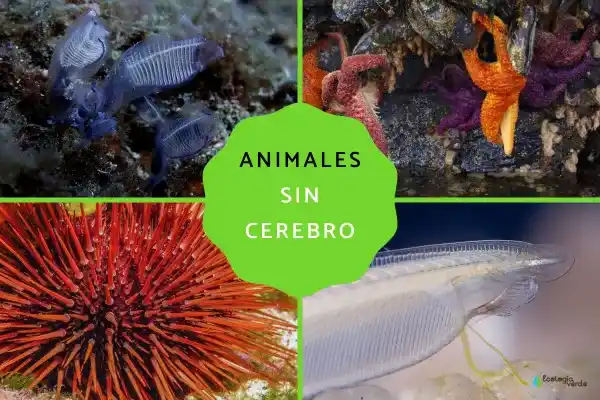
Table of contents
Why can some animals survive without a "brain"?
Portuguese warship Physalia physalis
Upside-down jellyfish Cassiopea xamachana
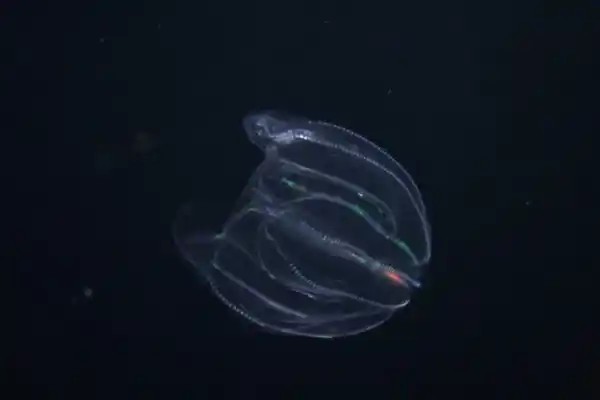
Ctenophora
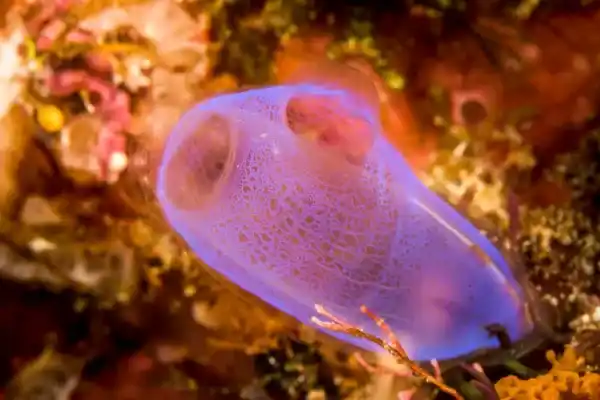
Sea squirts ( Ascidiacea )
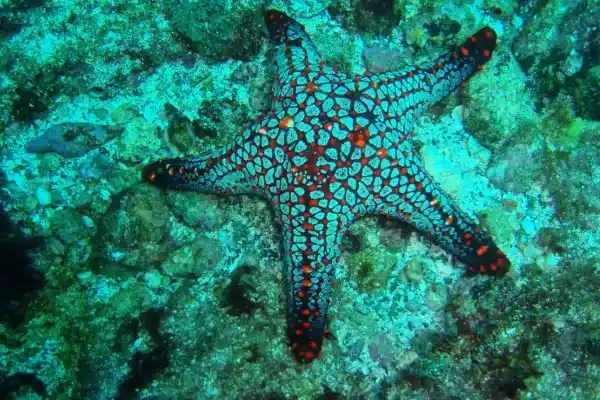
Starfish ( Asteroidea )
Sea urchins (Echinoidea, class Echinoidea )
Sea cucumber ( Holothuroidea )
Crinoides / Feathered Star ( Crinoidea )
Sponge (Yellow tube sponge Aplysina aerophoba )
Sea anemones ( Actiniaria )
Red Corallium rubrum
Amphioxus / Two-headed snake (Branchiostoma lanceolatum)
Leeches ( Hirudinea , subclass Trematoda, phylum Annelida)
Earthworms ( Lumbricidae family)
Why can some animals survive without a "brain"?
"Brainless" does not mean "nerveless" : many primitive groups do not have a centralized brain, but have neural networks (such as cnidarians: jellyfish, sea anemones), circular and radial nerves (such as echinoderms: starfish, sea urchins), or segmented ganglia (such as annelids: leeches, earthworms).
With a minimalist architecture and sufficient functionality , they rely on chemoreception, touch, and photosensitive cells to locate, hunt, and defend themselves; their movement is driven by muscle contraction, ciliary swaying, or a water pipe system .
"Groups of individuals" can also collaborate : for example, the Portuguese warships are a group of floating bodies composed of "individuals" with different functions, each with its own tasks and working together as a whole.
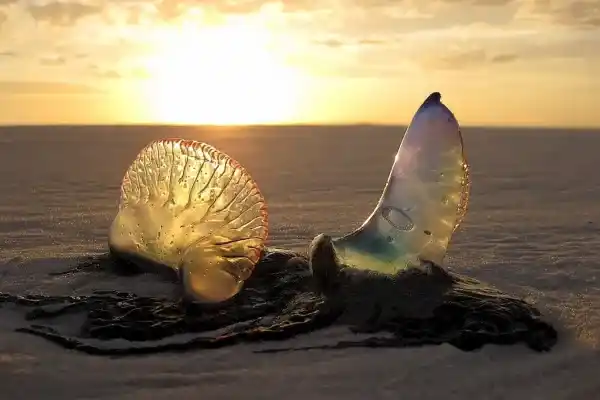
Portuguese warship Physalia physalis
Group : Phylum Cnidaria (Class Hydrozoa, Order Iridopodi), not true jellyfish, but siphonophores (colony) .
Why is it "brainless" ? It has no centralized brain; each "individual" (called a colony or "insect body") has a specific function: the float is responsible for floating, the tentacles are responsible for predation and defense, the stomach is responsible for digestion, and the reproductive body is responsible for reproduction.
Highlight : The tentacles are covered with nematocysts , which are highly venomous and used to paralyze prey (small fish, zooplankton).
Habitat : Drifting on the surface of warm seas with the wind and waves.
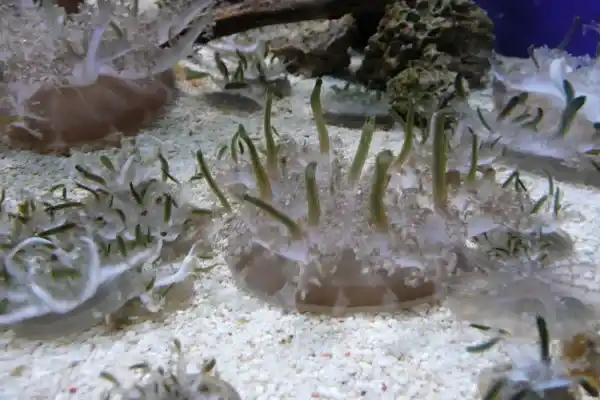
Upside-down jellyfish Cassiopea xamachana
Group : Phylum Cnidaria, Family Leymus ("True Jellyfish")
Why it is "brainless" : It has a neural network but not a brain; its receptors are scattered.
Morphology and Habits : The jellyfish lies upside down in shallow water with its bell facing downwards and its oral arms facing upwards; its body color is often greenish, derived from symbiotic small algae (which provide energy). It is common to "hitch a ride" with small crabs: the jellyfish provides protection, and the small crabs help with movement.
Ctenophora
Why is it "brainless" ? It has no centralized brain, but a simple nervous system and eight rows of "plasts" (cilia) , and it moves forward by paddling with its cilia.
Characteristics : Mostly transparent gels, capable of bioluminescence ; predation relies on adherent cells (glial cells) rather than nematocysts.
Ecological niche : an important zooplankton , forming the bottom of the food chain for baleen whales and many fish.
Sea squirts ( Ascidiacea )
Why are they "brainless" ? Adults live a sessile life and have filter-feeding structures; they lack a centralized brain and use simple neural tissue to control siphoning and adductor muscles.
"Amazing contrast" : The larvae resemble tadpoles, possessing a notochord and primitive "brain" receptors ; after metamorphosis, they become attached to and degenerate their nerve centers, and switch to filter feeding.
Distribution : Hard substrates such as nearshore rocks and wharf piles worldwide.
Starfish ( Asteroidea )
Why is it "brainless" ? The central ring nerve connects to the radial nerves of each arm, but it has no brain.
Key systems : Unique water pipe system and tube feet for crawling, feeding and breathing; amazing regenerative ability, capable of regenerating severed limbs.
Diet : It mainly preys on benthic invertebrates such as bivalves and sea urchins.
Sea urchins (Echinoidea, class Echinoidea )
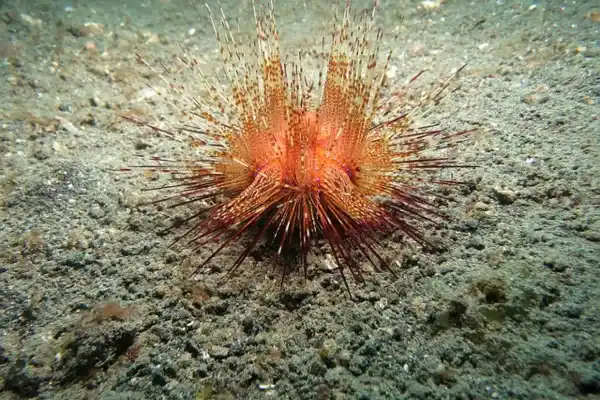
Why is it "brainless" ? Similar to starfish, it has a circular and radial nervous system; it has no true brain.
Features : A spherical exoskeleton ("shell") covered with movable spines, and mouthparts resembling the famous "Aristotelian lantern".
Ecology : They feed on algae and stir up sediment, acting as "gardeners" of the benthic system.
Sea cucumber ( Holothuroidea )
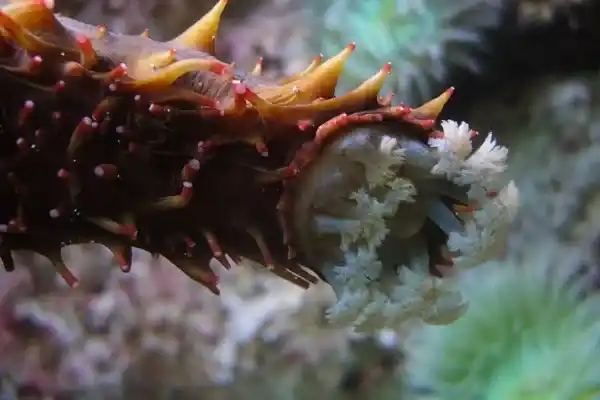
Why it is "brainless" : neural rings and longitudinal nerves; no centralized brain.
Characteristics : Soft body with well-developed loose connective tissue; can cut off internal organs to escape when threatened.
Diet : It ingests mud and sand and feeds on organic debris, promoting substrate renewal.
Crinoides / Feathered Star ( Crinoidea )
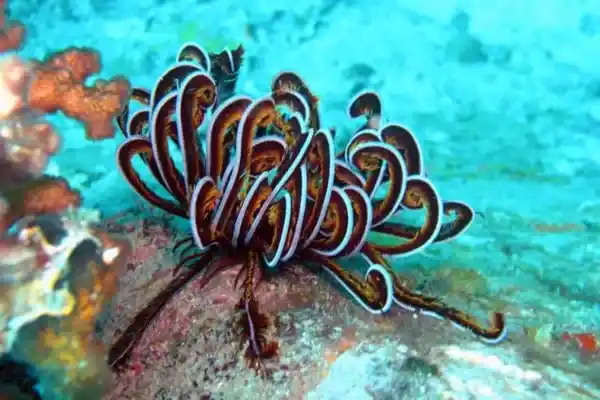
Why is it "brainless" ? It has no brain, so that the nerves control the numerous feathery arms separately.
Characteristics : One of the oldest echinoderms; there are sessile (crinoid) and free (feathered star) types, which use grooves and cilia to deliver granular food to their mouths.
Distribution : From shallow to deep sea, less numerous than other echinoderms.
Sponge (Yellow tube sponge Aplysina aerophoba )
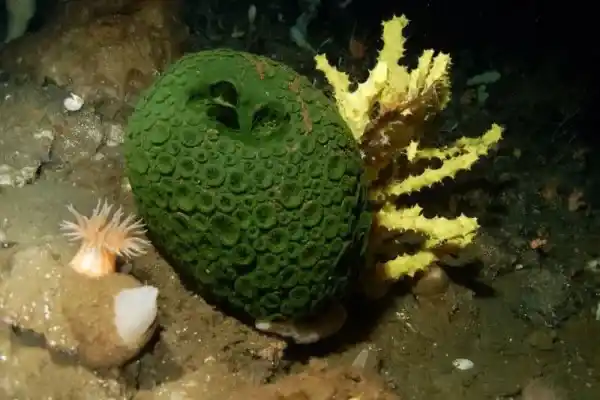
Group : Phylum Porifera (Sponges)
Why is it "brainless" ? It has no real tissues, organs, or nerve cells ; it relies on leading cells to form water flow, filtering particles and dissolving organic matter.
Ecological role : A powerful filter feeder and anchorage engineer , maintaining water clarity and nutrient cycling.
Sea anemones ( Actiniaria )
Why is it "brainless" ? It has a diffuse neural network but no centralized brain.
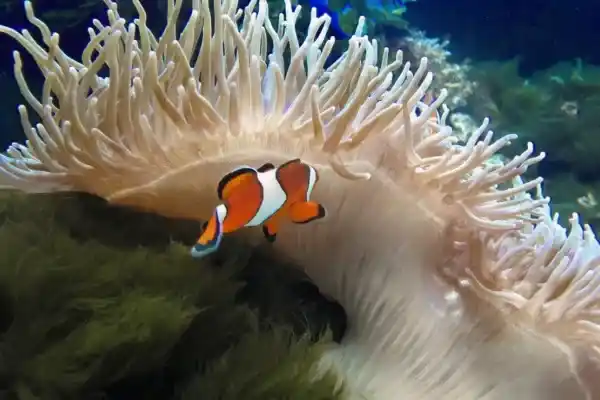
Characteristics : Tentacles covered with spiny sacs, settled on rock surfaces or corals; symbiotic relationship with clownfish .
Feeding : Paralyzes and consumes small fish and crustaceans.
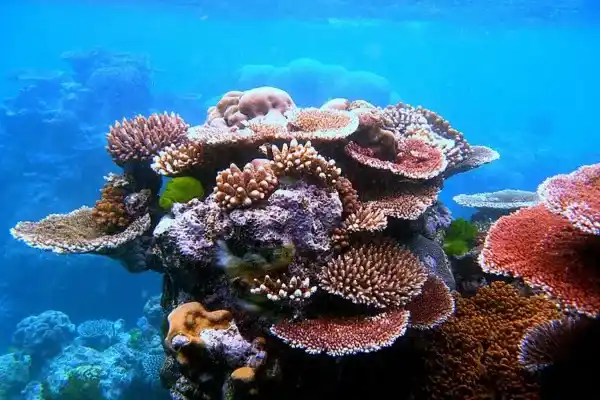
Red Corallium rubrum
Group : Cnidaria, Octocoral corals ("jewel corals")
Why is it "brainless" ? It is a group of polyps with no centralized brain; it coordinates contraction and tentacle responses through neural networks.
Characteristics : The skeletons of the colony are reddish and of high value; they form a complex habitat structure that shelters a large number of small marine organisms.
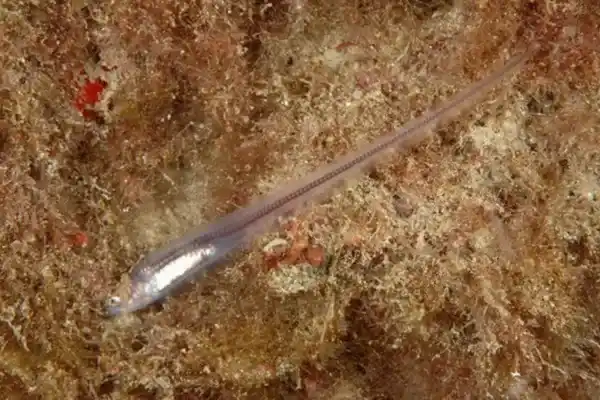
Amphioxus / Two-headed snake (Branchiostoma lanceolatum)
Classification : Cephalochordate (commonly known as "lance-shaped worm" or "amphioxus"), not a true "fish".
Why it is "almost brainless" : It has a dorsal nerve canal but no skull or real brain ; its nervous system is extremely simple.
Characteristics and ecology : It has a slender body that is partially buried in the sand and mainly feeds by filtering ; it is an important model organism for studying the origin of vertebrates .
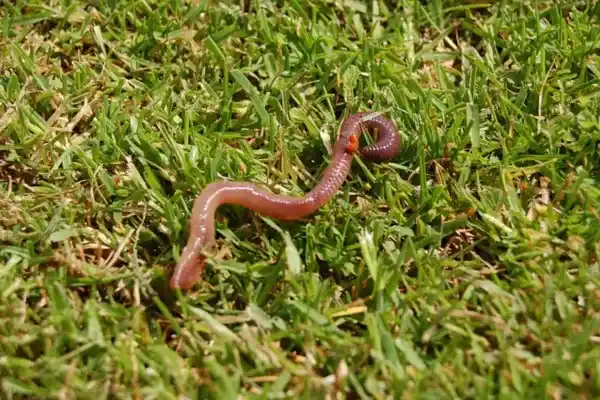
Leeches ( Hirudinea , subclass Trematoda)
Why is it called "uncentralized brain" ? It has anterior ganglia (often called "brain ganglia") and ventral ganglia , but does not form a complex centralized brain.
Features : Anterior and posterior suckers, distinct body rings; saliva contains anticoagulant components such as hirudin .
Habitat : Mostly found in freshwater, but also in terrestrial and marine environments.

Earthworms ( Lumbricidae family)
Why it "lacks a true brain" : It has small cerebral ganglia and ventral nerve cords with segmented ganglia, and its nerve centers are dispersed .
Ecological value : It feeds on litter and soil organic matter, loosens the soil, and promotes nutrient cycling, making it a typical "ecological engineer".
Respiration : Gas exchange occurs through the moistened skin .
summary
"Brainless" does not mean "incompetent." From the sponge's minimalist "water pump" to the starfish's water pipe system and regeneration techniques, and the amphioxus's primitive neural axis, these seemingly "simple" solutions can still function efficiently in their respective ecological niches. They remind us that the diversity of life lies in the ingenuity of its functions, not in the extravagance of its organs.
bibliography
Diéguez, A. et al., (2014). Animals and Humanity. Editorial Twenty-First Century: Biblioteca Nueva (Colección razón y sociedad).
Conway S. and Collins D. (1996). "Mesocambrian comb jellies from the Stephen Formation, British Columbia, Canada." Philosophical Transactions of the Royal Society: Biological Sciences (London: Royal Society), Vol. 351 (1337), pp. 279-308.
Pandolfi, M. (January 15, 2013). Learning from Fish: Brains and Strategic Resources with Unique Characteristics. Cornishette.