A sauropod dinosaur from China may have had the longest neck of any known dinosaur. This discovery comes 30 years after the species was first found, as scientists sought to learn more about how sauropods evolved in what is now East Asia.
Around 160 million years ago, during the Late Jurassic period, a peculiar dinosaur roamed the Chinese mainland.
Sauropod dinosaurs are known for their long necks, but Mamenchisaurus had a neck that reached a height of 15 meters, towering into the clouds.
Despite this record-breaking feature, the South China Mamenchisaurus is far from the largest dinosaur ever discovered due to its relatively small tail and body.
Scientists are trying to understand why this dinosaur might have had such a long neck.
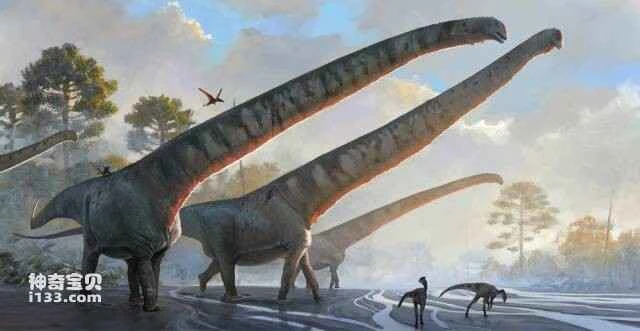
The sauropod dinosaur Mamenchisaurus sinocanadorum had a neck 15 meters long, making it taller than other dinosaurs.
"It appears that these necks may have enhanced feeding abilities like those in other sauropods, but they may have served more than one function," said Professor Paul Barrett, a dinosaur expert at the museum and one of the study's authors.
"It could also be related to sexual display, or used for neck-butting contests between males to compete for mates and territory, similar to the behavior of giraffes today. But we can't say for sure. At this point, it's purely speculation about why they evolved such long necks."
The study has been published in the Journal of Systematic Paleontology.
fossil of the lower jaw of the Chinese Mamenchisaurus on a support
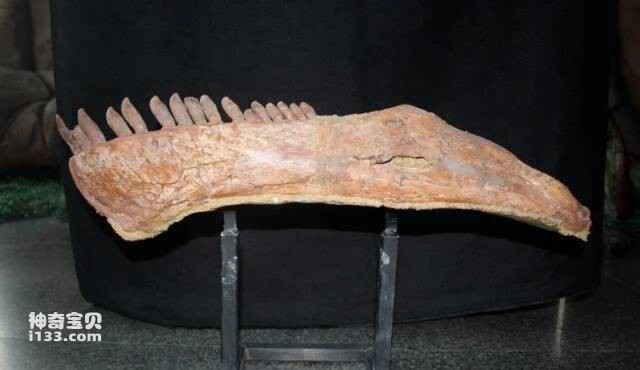
Only a few fossil fragments of the South China Mamenchisaurus have been discovered to date, such as this mandible.
Why do we need to have necks?
Sauropods were a group of very large herbivorous dinosaurs, known for their exceptionally long necks and tails.
Notable members of this group include Diplodocus, Brachiosaurus, and the enormous Patagotitan, one of the largest animals ever to have ever existed.
Scientists believe that sauropods evolved long necks as part of their feeding strategy , allowing them to consume large amounts of food in their immediate surroundings without expending too much energy moving around.
The question remains about how the unusual proportions of Mamenchisaurus sinocanadorum enable it to function routinely.
“We really don’t know how that animal works mechanically,” Paul said.
“It takes a lot of muscles to support such a large neck, and then the question is how it gets air into the lungs and then rises again.”
"This may support the theory that these necks are a sexually selective feature, and that only the strongest and healthiest dinosaurs were able to support these enormous necks in an impressive way to mate."
Only one specimen of the Chinese Mamenchisaurus has been found. It is an incomplete skeleton consisting of the front of the neck, including an impressive rib and several skull fragments, including the mandible.
Because of the lack of a complete skeleton, scientists have difficulty determining the overall size of this dinosaur, and they need another well-preserved sauropod skeleton for comparison.
In 2012, a new type of giant sauropod dinosaur from China was discovered, named Xinjiang Titan, which possessed a complete neck. Researchers compared incomplete fossils of Mamenchisaurus from South China with fossils of sauropod dinosaurs such as Xinjiang Titan to calculate the possible length of its neck.
Paul explained, "We achieved this using only a little basic math."
“We simply observed the proportions of the individual vertebrae within the complete neck as a guideline for expanding the entire neck of the incomplete Chinese Mamenchisaurus.”
"So we measured the vertebrae of one dinosaur and the corresponding bones of another dinosaur and calculated the differences. Then we multiplied the length of each vertebra in the complete neck by that coefficient to estimate the neck length of the Chinese Mamenchisaurus."
Two fossilized vertebrae of the Chinese Mamenchisaurus were mounted on a support.
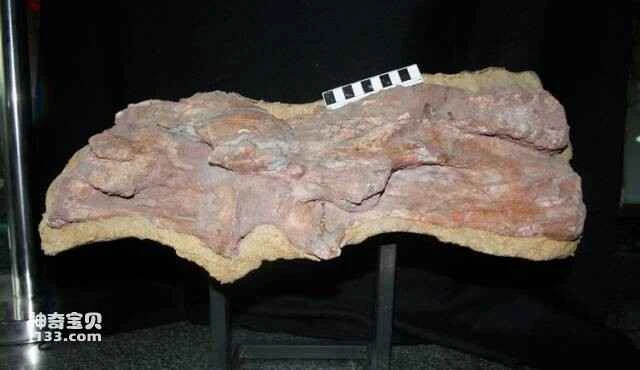
These two vertebrae from the Chinese-Canadian Mamenchisaurus were used to estimate their total neck length.
Ancient Chinese megafauna
In August 1987, the broken end of a huge neck rib was discovered at a site in the Shishugou Formation in northwestern China, revealing fossils of the Chinese Mamenchisaurus.
Located in Xinjiang, the site is a rich deposit of vertebrate fossils, including dinosaur, pterosaur, and crocodilian fossils from the Middle to Late Jurassic periods. To date, four additional sauropods have been named from this stratum.
Mamenchisaurus is a group of unusually long-necked dinosaurs, primarily discovered in China, and first found in the 1950s. Since then, scientists have excavated other similar specimens, prompting a reassessment of this group to determine how related its many different species are.
“Sauropods were widely distributed in China during the Late Jurassic period,” Paul said.
We are trying to uncover how many different types of sauropods roamed around during this period, and what their relationship was with other sauropods in other parts of the world.
"Some have suggested that Mamenchisaurus was only found in China, which was a huge, isolated island continent during the Jurassic period. Others believe that the evolution of sauropods in China differed slightly from that in other parts of the world."
“We are working with our colleagues in China to re-examine these specimens and, using modern methods and new knowledge about sauropods, to learn more about these dinosaurs and how they roamed the globe.”